Egypt and Djibouti Strengthen Their Partnership with New Agreements in Maritime Transport and Green Energy

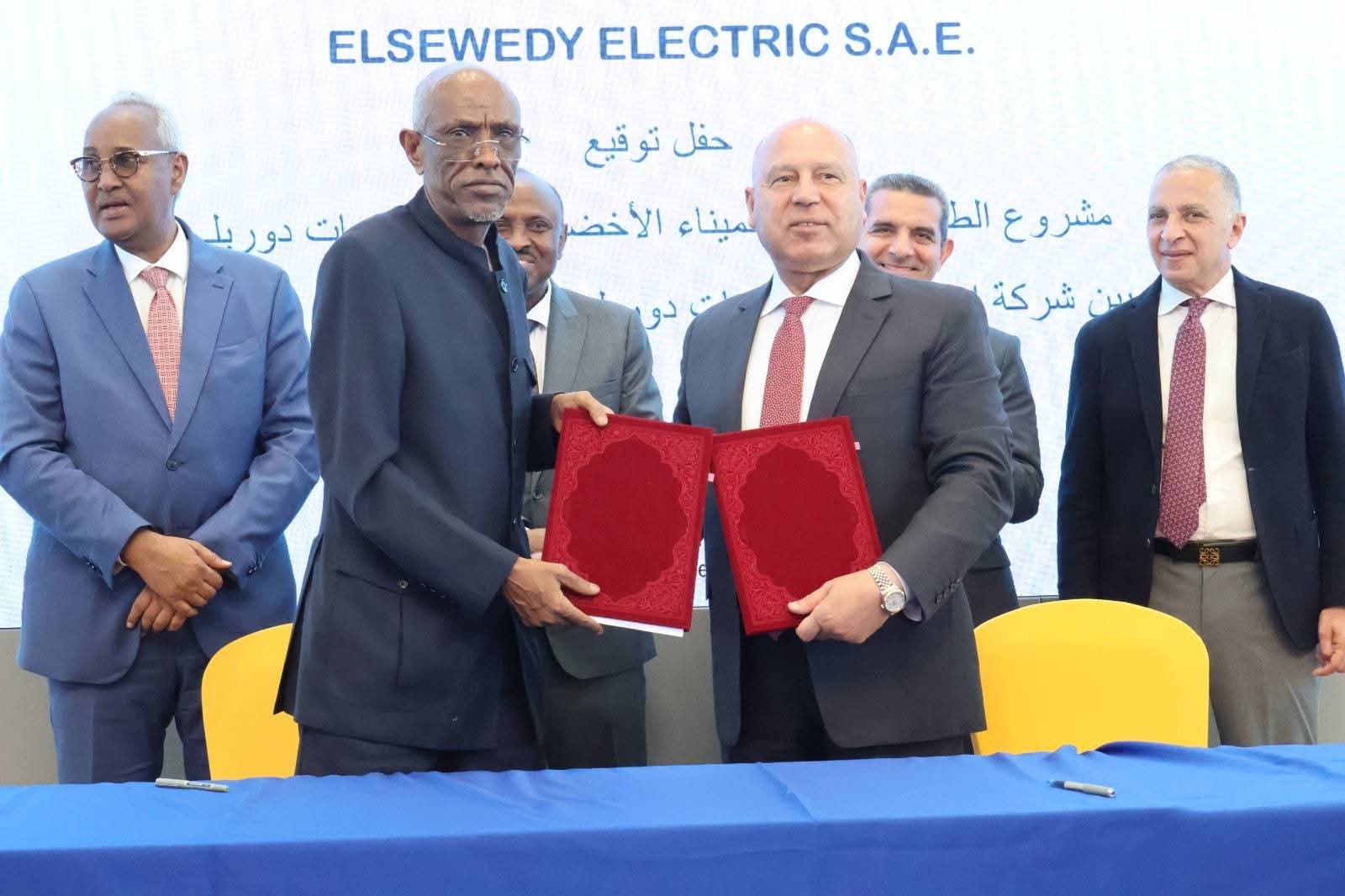
Eng. Kamel El-Wazir, Deputy Prime Minister for Industrial Development and Minister of Industry and Transport, and Hassan Hamad Ibrahim, Djibouti’s Minister of Infrastructure and Equipment, witnessed the signing of several key agreements aimed at enhancing bilateral cooperation between the two countries in the fields of maritime transport, logistics zones, and green energy.
The agreements were signed during a visit by the Egyptian minister and his accompanying delegation to the headquarters of the Djibouti Ports and Free Zones Authority (DPFZA), in the presence of Aboubaker Omar Hadi, Chairman of the Djibouti Ports and Free Zones Authority, and Ambassador Abdel Rahman Raafat, Egypt’s Ambassador to Djibouti.
In a statement issued on Sunday, the Ministry of Transport said the agreements fall within the framework of the outcomes of the historic visit paid by President Abdel Fattah El-Sisi of Egypt to Djibouti in April. The agreements include the signing of terms and conditions for the New Terminal Project (a multi-purpose terminal) between an Egyptian consortium led by the Holding Company for Maritime and Land Transport and Green Horn Investment Holding. The project is considered one of the most strategically ambitious initiatives, as it establishes an Egyptian-Djiboutian partnership for the development and operation of a new multi-purpose terminal that will serve as a cornerstone for joint cooperation in supporting international trade.
An additional agreement was signed between Elsewedy, the Djibouti Ports and Free Zones Authority (DPFZA), and the Khor Ambado Free Zone (KAF) to launch a regional logistics hub for a consortium comprising the Holding Company for Maritime and Land Transport and Elsewedy within Djibouti’s free zone. The project aims to boost trade exchange and serve as a gateway to neighboring regional markets.
The two sides also signed the terms and conditions for the Green Port Solar Project between Elsewedy Electric and Doraleh Container Terminal Management Company (SGTG). This project is regarded as a fundamental pillar for ensuring the sustainability of operational activities at Doraleh Port, as it seeks to decouple energy costs from fluctuations in global fuel prices and provide a clean, stable power source for cranes and heavy equipment.
In this context, the Deputy Prime Minister and his delegation attended a presentation on the Djibouti Ports and Free Zones Authority, highlighting its core mandates, responsibilities, and key projects and initiatives. This was followed by an expanded meeting with Djibouti’s Minister of Infrastructure and Equipment and the Chairman of the Ports and Free Zones Authority, attended by Egypt’s Ambassador to Djibouti, Dr. Ismail Abdel Ghaffar, President of the Arab Academy for Science, Technology and Maritime Transport, Eng. Mohamed Fathi, Assistant Minister for Maritime Transport, and the heads of seven Egyptian companies specialized in infrastructure and port projects: the Holding Company for Maritime and Land Transport, the Holding Company for Roads and Bridges, Elsewedy Group (and its CEO), EDIX, Qased Kheir, Al-Rowad, and Egypt Construction Company.
During the meeting, El-Wazir praised the deep-rooted, brotherly relations between Egypt and Djibouti, as well as the positive and significant outcomes of President El-Sisi’s historic visit to Djibouti in April, which marked a new starting point for bilateral cooperation, particularly in priority sectors such as energy, infrastructure, industrial development, and the green economy.
The Deputy Prime Minister noted that among the key outcomes of the presidential visit was the official opening of Banque Misr Djibouti on November 3, 2025, followed by the inauguration of a solar power station in the village of “Omar Kaja” in the Arta region of Djibouti last Friday. He stressed Egypt’s commitment to closely following up on the implementation of the visit’s outcomes in line with the joint statement issued by the two presidents, through continuous coordination between the relevant authorities in both countries.
The meeting also discussed cooperation in several areas requested by the Djiboutian side, including solar and wind energy, infrastructure projects, road construction and maintenance, and port development. El-Wazir welcomed these proposals, affirming the readiness of the ministry and Egyptian companies to cooperate with Djibouti’s Ministry of Transport in these fields.
For their part, representatives of the Egyptian companies expressed full readiness to implement various projects and participate in Djibouti’s development plans in accordance with the highest quality standards and within the shortest possible time, in appreciation and respect for the brotherly Djiboutian people. They highlighted their extensive experience in executing major projects in Egypt and across several Arab and African countries.
The meeting also reviewed the latest developments regarding the memorandum of understanding previously signed between the Holding Company for Maritime and Land Transport and the Djibouti Ports and Free Zones Authority. The MoU marked the launch of a number of investment alliances involving Egyptian and international private-sector partners, led by the holding company, to cooperate on developing Djibouti’s National Road RN18, implementing renewable energy projects, and studying the feasibility of establishing a wind farm within the International Free Zone in Djibouti. The feasibility study is scheduled to be completed within one year, in addition to agreed port expansion projects, including the expansion of Djibouti Port and the development of the maritime port sector.
The meeting also reaffirmed Egypt’s appreciation for the enrollment of Djiboutian students each year at the Arab Academy for Science, Technology and Maritime Transport, and welcomed cooperation to open a branch of the academy in Djibouti.
Following the meeting, the two sides conducted an inspection tour of port and free zone facilities, including a visit to the Doraleh Container Terminal, the site of the planned solar power station to be implemented as part of the port’s projects in cooperation with Egyptian companies, and the location of the logistics zone at the port.l