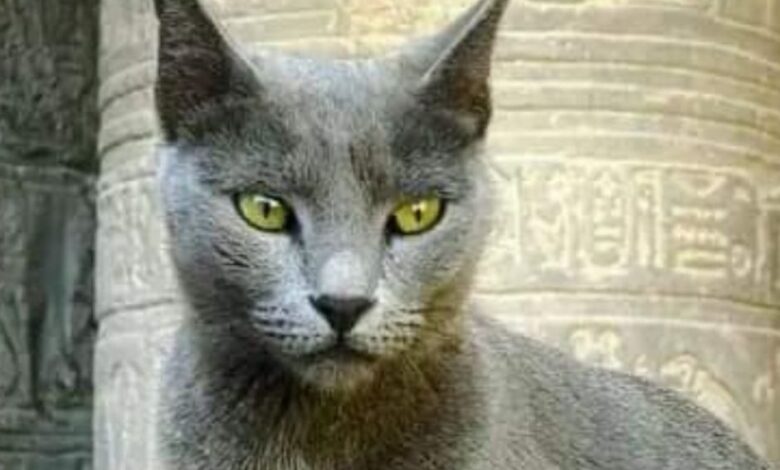
The African continent stands as the primordial cradle of the feline soul. From the Saharan dunes to the lush Zambezi basin, African cats have prowled through history, transitioning from sacred deities to biological marvels. According to genomic studies published in Science, nearly all domestic cats trace their matrilineal ancestry back to the African Wildcat, making the continent the true fountainhead of feline grace.
Today, the status of African felines is a dichotomy. While breeds like the Mau thrive globally, their wild cousins face habitat loss. The International Union for Conservation of Nature (IUCN) warns that preserving these lineages is crucial for ecological balance. Their “True Fame” lies in their role as sentinels of the wild, preserving a fragment of the primordial savanna within our modern world
1. The Egyptian Mau: The Living Papyrus
The Mau is the most direct link to the ancient world. With its naturally spotted coat and “scarab” marking, it remains a living relic. Genetic research by the International Cat Association (TICA) confirms that the Mau possesses a unique primordial flap of skin that allows for its incredible 48 km/h sprinting speed. In Ancient Egypt, as noted in the Book of the Dead, these “Miw” were protected by law and mourned like royalty.
2. The Abyssinian: The Ethiopian Intellectual
Often called the “Bunny Cat,” the Abyssinian radiates a regal aura. While its exact origins are debated, historical records from the British Museum suggest the breed was brought to Europe from Ethiopia (Abyssinia) in the 1860s. They are the intellectuals of the feline world, possessing an insatiable curiosity that mirrors the spirit of the Horn of Africa.
3. The Sokoke: The Forest Ghost
Hailing from the Arabuko-Sokoke Forest in Kenya, this breed was known to the Giriama people as “Kadzonzos.” They possess a unique wood-grain camouflage. The Sokoke Forest Cat Society highlights that this is one of the few breeds that evolved through natural selection in a rainforest environment, surviving in isolation for centuries.
4. The Savannah: The Modern Apex
A bold hybrid of the African Serval and the domestic cat, the Savannah is an architectural marvel. As detailed in National Geographic’s wildlife profiles, this breed mimics the long limbs and ocellated ears of the Serval. It reflects a modern desire to bring the untamed spirit of the savanna into the domestic sphere while maintaining fierce loyalty.
5. The African Wildcat (Felis lybica): The Matriarch
The ancestor of all domestic cats, its DNA is the foundation of every feline in our homes. Archaeological findings in Cyprus, reported by Smithsonian Magazine, suggest that this cat taught early farmers the value of a symbiotic relationship over 9,000 years ago, guarding grain stores by the hearth.
6. The Chausie: The Nile’s Envoy
Derived from the Nilotic jungle cat, its roots are deeply intertwined with the African landscape. The Cat Fanciers’ Association (CFA) notes that mummified remains of similar hybrids have been discovered in Egyptian tombs, suggesting that the ancients valued their robust build and aquatic prowess long before formal breeding began.
7. The Serengeti: The Plains Visionary
A breed designed to capture the aesthetic of the Serval without using wild blood, the Serengeti is a tribute to the Tanzanian plains. Breeding standards emphasize the piercing eyes and upright posture that define the predators of the Rift Valley, aiming to replicate the visual majesty of the East African landscape.
8. The Sand Cat: The Desert Hermit
Though rarely domesticated, the Sand Cat is the quintessential Saharan survivor. As documented by the World Association of Zoos and Aquariums (WAZA), this cat has thick fur on its paws to endure blistering sands. It embodies the mystery of the deep desert, appearing in North African folklore as a shadow that never leaves footprints.
9. The Serval: The High-Jumper
The ballerina of the veldt, the Serval possesses the longest legs of any cat relative to its size. Field studies by African Wildlife Foundation (AWF) show it can leap three meters into the air. In various sub-Saharan traditions, the Serval’s pelt was historically a symbol of high status and spiritual vision.
10. The Caracal: The Black-Eared Myth
Known for its tufted ears, the Caracal was tamed in ancient North Africa for hunting. Its name, as cited in linguistic studies of the region, stems from the Turkish “Karakulak” (Black ear). It remains the “lynx” of the African steppes, a creature of profound silence and explosive energy.
Read more