Slavery Reparations Rift: Washington Stands Against UN Resolution as Africa Demands Historical Accountability

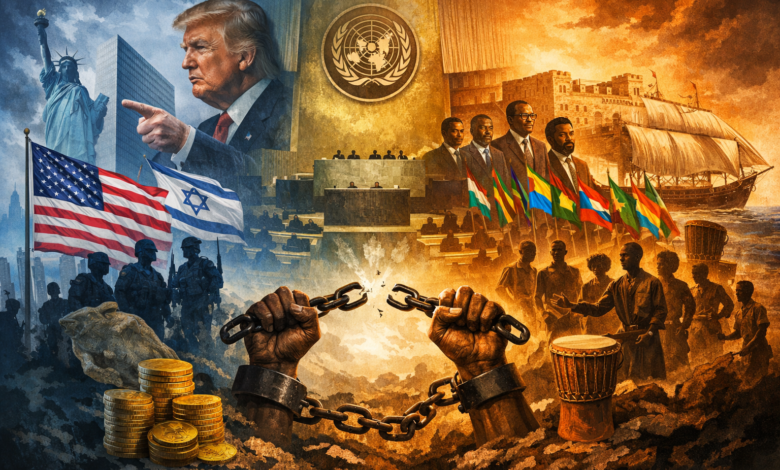
The United States stands in firm opposition to a landmark United Nations resolution calling for reparatory justice over the transatlantic slavery , a move that has exposed a profound and widening diplomatic schism between Washington and the Global South. While U.S. officials repeatedly maintained that they would have supported a universal and uncompromising condemnation of slavery as a historical atrocity, they rejected the reparations component, characterizing it as an exercise in “moral grandstanding” on settled historical questions.
According to an extensive statement released by the U.S. Mission to the UN, this stance is a direct reflection of a broader policy recalibration under President Donald Trump, which seeks to return the United Nations to what Washington describes as its “core mission” of maintaining international peace, security, and the resolution of active, contemporary conflicts.
U.S. officials argued that the push for reparations is a symptom of a systemic drift within the UN, where the organization increasingly expands its mandate into areas—such as climate change and historical justice initiatives—that Washington considers “unproductive” and disconnected from immediate global security concerns.
At the heart of this ideological collision is a resolution addressing the horrific legacy of the transatlantic slave trade between the 15th and 19th centuries, which explicitly calls for compensatory measures for the descendants of enslaved people. While acknowledging the undeniable severity of the historical record, the United States argued that the resolution fundamentally lacks clarity and actionable outcomes, questioning the feasibility of identifying specific claimants or responsible parties centuries after the events in question.
Washington’s mission to the UN pointedly described the resolution as a diversion from the “very real and current” crises of human trafficking and modern-day slavery, which it insists require urgent and coordinated global action rather than retrospective financial debates. This position, however, stands in stark contrast to the intensifying advocacy of African and Caribbean states, who view reparatory justice not as a historical footnote, but as a necessary mechanism for addressing the systemic economic inequities and underdevelopment that persist as direct consequences of colonial-era exploitation.
The resolution was championed primarily by African nations, with Ghana emerging as the continent’s most vocal and sophisticated advocate for historical accountability.
Under the leadership of President Mahama, Ghana has utilized high-level diplomatic forums and diaspora initiatives to build a global consensus around the idea that the wealth of many Western nations was built upon the forced labor of millions, and that a formal recognition of this debt is a prerequisite for a more equitable global order. Despite Washington’s opposition, the resolution ultimately passed with a resounding majority of 123 votes, reflecting a solidified bloc of Global South countries.
The United States found itself in a small minority, joined only by Israel and Argentina in direct opposition, while 52 nations chose to abstain. This voting pattern underscores a significant shift in the international arena, where African and Caribbean states are increasingly assertive in challenging the traditional Western-led consensus at the UN.
The fallout from this vote suggests that the debate over reparations is entering a more confrontational phase, where the moral authority of the UN is being leveraged against the strategic and financial interests of its largest donor. Washington’s insistence that revisiting the past is an “unserious” distraction from the future has done little to quell the momentum of the reparations movement.
Instead, it has highlighted a fundamental disagreement over whether the international community can truly secure a peaceful future without first rectifying the structural injustices of the past. As the resolution moves toward implementation without the support of the world’s most powerful economy, the stage is set for a protracted and increasingly bitter diplomatic struggle over the definition of justice, accountability, and the very purpose of the United Nations in the 21st century.
read more