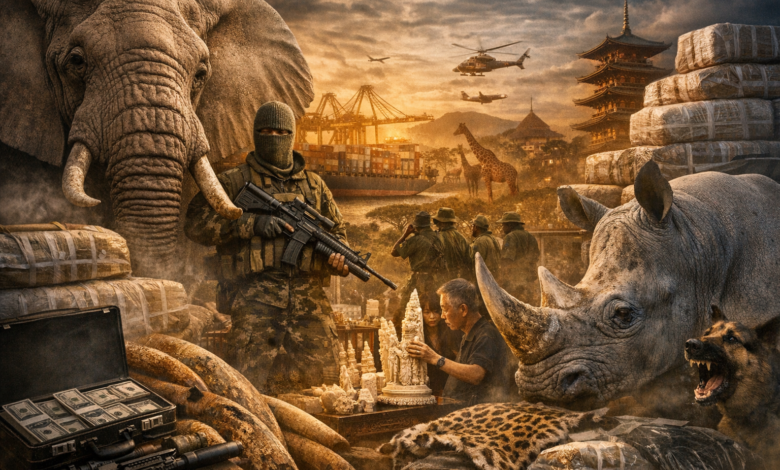
In the dense thickets of the Congo Basin and across the sweeping plains of the Serengeti, a silent war is being waged, It is not a war over ideology or borders, but over “blood currency, ” The illegal trade in elephant ivory, rhino horns, and exotic skins has evolved from opportunistic poaching into a sophisticated, multi-billion-dollar global empire that rivals the drug and arms trades in both scale and brutality.
A Gold Mine on Four Legs
The economics of this shadow industry are as lucrative as they are lethal. According to the latest data from INTERPOL and TRAFFIC, wildlife trafficking generates an estimated $7 billion to $23 billion annually. The driving force behind this massacre is the skyrocketing price of contraband. On the black market, a single kilogram of rhino horn can command upwards of $60,000, making it more valuable by weight than gold. This hyper-profitability has effectively placed a bounty on the head of every rhino in Africa, turning these ancient sentinels into “walking gold mines.”
• The Cartel Infrastructure
This is no longer the domain of the lone hunter. Today’s trafficking is managed by transnational criminal syndicates that mirror the structure of high-tech corporations. Intelligence reports indicate that these “wildlife mafias” utilize military-grade hardware—GPS trackers, night-vision goggles, and high-caliber silenced weapons—to outmaneuver underfunded park rangers.
The logistics are equally sophisticated. Contraband typically flows through “corridors of corruption,” exiting major African ports like **Lagos** or **Mombasa**. To bypass customs, tusks and skins are professionally vacuum-sealed and hidden within shipments of legitimate exports like timber, tea, or salted fish, creating a “scent-screen” that baffles even the most trained sniffer dogs.
• The Appetite for Prestige
Where does the blood flow? The destination is dictated by a lethal combination of vanity and pseudo-science.
The Asian Connection: China and Vietnam remains the primary hubs for rhino horn and ivory. While the horn is marketed as a “miracle cure” for everything from hangovers to terminal illness—despite being chemically identical to human fingernails—ivory carvings are prized as the ultimate “status symbol” for the rising elite.
Western Luxury: In Europe and North America, the demand is driven by the high-fashion “underground,” where rare furs and exotic skins are still covertly traded to satisfy a niche but powerful market for “forbidden” luxury.
• The Governance Gap
The fight against these cartels is often undermined from within. While nations like **Kenya** have gained international praise for their “militant conservation”—evidenced by the public burning of massive ivory stockpiles—other regions suffer from a “culture of the blind eye.” The Global Initiative Against Transnational Organized Crime points to systemic corruption as the industry’s greatest ally. When customs officials or port authorities are on the payroll of the cartels, the “thin green line” of protection effectively vanishes.
• The Counter-Offensive
The tides, however, are beginning to turn. Organizations like the “World Wildlife Fund (WWF)”and “IFAW” have pivoted to a “financial decapitation” strategy. By working with global banks to track money laundering and suspicious transfers, investigators are now targeting the “kingpins” in their glass offices rather than just the “foot soldiers” in the bush.
Furthermore, the focus is shifting toward “Community-Led Conservation.” In places where villagers are given a stake in eco-tourism, the local population becomes the first line of defense. As one veteran ranger put it: *”An elephant is a bank account for a village that lasts generations; once it’s dead, the bank is closed forever.”
As the global community ramps up its response, the message is clear: the cost of this trade is far higher than its price tag. If the current rate of extraction continues, the “Big Five” may soon exist only in history books and on the shelves of the collectors who funded their demise.
read more
Fiscal Red Alert: IMF Warns of Libya’s Unsustainable Economic Trajectory