Maritime Stranglehold: Washington Challenges China’s African Mineral Monopoly at the Great Straits

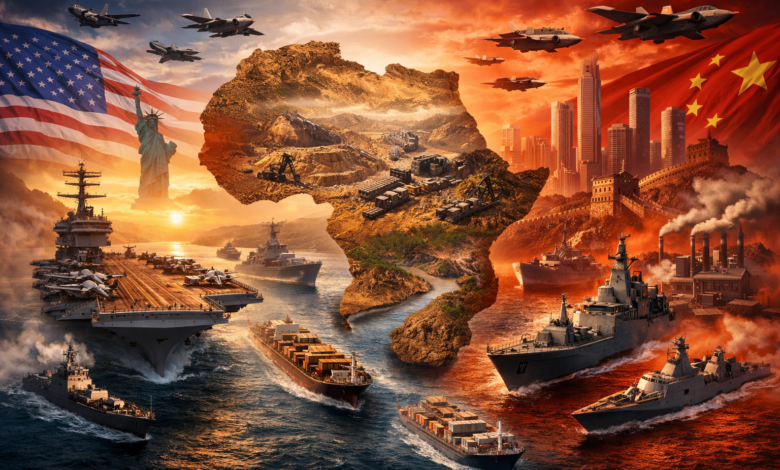
As the race for the 21st century’s industrial “crown jewels” intensifies, a new and dangerous front has opened in the rivalry between the world’s two largest economies, While china has spent the last decade consolidating its grip on Africa’s rare earth and critical minerals, the United States has launched a bold counter-offensive—not in the mines, but on the high seas.
The Battle for the Veins of Industry
The strategy is clear: China owns the resource, but Washington intends to control the route. According to a report by Olamilekan Okebiorun on April 15, 2026, the U.S. is strategically tightening its influence over vital maritime arteries—the Strait of Hormuz, the Panama Canal, and the Strait of Malacca.
This maritime pincer movement is a direct response to China’s aggressive acquisition of African mining assets. From the Ngualla rare earth project in Tanzania to lithium mines in Mali and Nigeria, Chinese investments—backed by $24.9 billion in Belt and Road loans—have outpaced Western efforts, leaving Washington to play a game of strategic interdiction.
Targeting the Achilles’ Heel
Data highlights a glaring vulnerability in Beijing’s rise: nearly 50% of China’s crude oil transits through the Strait of Hormuz, and up to 80% flows through the Strait of Malacca. By strengthening its naval presence and seeking expanded military airspace near Indonesia, the U.S. is effectively hovering over China’s energy and industrial lifelines.
A prolonged U.S. blockade or disruption along these routes doesn’t just raise costs; it threatens to stall the vast manufacturing engine that sustains the Chinese economy. As the BBC recently noted, these maritime enforcement measures are already disrupting tanker movements, sending a tremor through the global supply chain.
China’s “Mineral Shield”
Beijing, however, is not sitting idle. It has weaponized its dominance in rare earth processing—a sector where it controls a staggering 87% of global capacity. In the lead-up to President Donald Trump’s expected visit to Beijing in mid-May, China has ramped up export controls on critical materials like gallium, germanium, and graphite.
These controls are a potent geopolitical tool. By restricting the flow of rare earth magnets—essential for everything from electric vehicles to fighter jets—China is signaling that it can cripple Western manufacturing just as easily as Washington can block a strait.
The African Front: Mines vs. Infrastructure
In Africa, the competition has turned into a bidding war of ideologies. While American asset managers attempted to outbid Chinese firms for Tanzanian deposits, Beijing secured the win through a total “package” deal—integrating mines with railways, roads, and power systems. This “pit-to-port” integration ensures that African minerals flow efficiently into Chinese trade networks, bypassing Western influence until they hit the open ocean.
The New Cold War of Commodities
As Washington shifts its focus to maritime leverage and China doubles down on upstream control, the global economy finds itself caught in a strategic stalemate. The rivalry is no longer just about who digs the minerals out of the ground; it’s about who controls the gates of global commerce.
In this high-stakes game of Strait-Side Diplomacy, the world is watching to see if the upcoming May summit will offer a de-escalation, or if the “shadow war” over Africa’s resources and the world’s waterways will lead to a total decoupling of the global industrial order.
read more
Tragedy in Ghana Premier League: Berekum Chelsea Player Killed in Violent Highway Ambush