Kwame Nkrumah … From the Struggle for Ghana’s Independence to the Dream of African Unity

As the 63rd anniversary of the founding of the Organization of African Unity (OAU) approaches, “ Afronews” sheds light—through a series of successive features—on the founding fathers of the OAU. The aim is to acquaint new generations across African countries with the role played by an ambitious generation of African youth more than 62 years ago in wresting their nations from the grip of colonialism that had weighed heavily on them for decades, and in pursuing the subsequent dream of uniting the African continent.
Dr. Nermin Tawfiq, in a study published by the Pharos Center for Studies, notes: “When we read this immortal statement made by Ghanaian President Kwame Nkrumah, one of the most prominent advocates of African unity among the peoples of the continent—‘We are no longer a colonial people. We are free men. We are masters of our own destiny. We are born today, but we are born strong’—we see how it reflects the struggle of African peoples and the injustice they suffered at the hands of Western colonial powers.”
Tawfiq added that African unity 63 years ago was a seemingly unattainable dream, but it has since become a reality thanks to the efforts of the early pioneers who took it upon themselves to liberate their countries from colonialism and safeguard their sovereignty, before going on to envision the creation of a continental entity through which integration and unity could be achieved.
Dr. Nermin Tawfiq emphasized the importance of the role played by the symbols of African struggle who believed in the unity of the continent and devoted their efforts—and their lives—to seeing it become a reality.
Kwame Nkrumah, the First President of Independent Ghana
Ghanaian leader Kwame Nkrumah is regarded as one of the earliest African fighters against colonialism. He was the first president of independent Ghana, one of the foremost advocates of African unity, and a founding figure of the Organization of African Unity.
Kwame Nkrumah (1909–1972), the first president of the independent Republic of Ghana and a leading figure of African unity, was born in the town of Nkroful—then part of the Gold Coast (the former name of Ghana)—into a modest family. He received his early education at Catholic mission schools, then attended the Teachers’ College in Accra, graduating in 1931. He worked as a teacher until 1935, after which he traveled to the United States to continue his studies. There, he studied economics, sociology, and education at Lincoln University.
After graduating, Nkrumah worked as a lecturer in political science at the same university. He became deeply involved in the student movement and was elected president of the African Students Organization in the United States and Canada.
In 1945, he traveled to England, where he connected with the British Labour Party and familiarized himself with its principles and organizational structure. He also met many progressive intellectuals, including some communists.
Nkrumah’s Struggle for Independence
After completing his education, Nkrumah returned to Ghana in late 1947. In 1949, he founded a new political party, the Convention People’s Party (CPP), whose primary objective was to achieve Ghana’s independence.
In early 1950, Nkrumah was arrested again following a series of strikes and was sentenced to three years in prison. Despite his imprisonment, his party won municipal and general elections, and Nkrumah himself won the Accra constituency by a landslide while still in jail. He was subsequently released and assumed the post of prime minister in March 1952.
The slogans and principles championed by Nkrumah attracted millions of Ghanaians, who quickly joined his party due to its mass-oriented messages and innovative propaganda methods.
In February 1951, the British authorities held general elections in the country. Nkrumah led his party’s campaign from prison, presenting a manifesto that outlined the CPP’s vision for national development through industrialization, free education, equal opportunities, and employment for all. The party won 34 of the 38 parliamentary seats, and Nkrumah was elected a member of parliament while still incarcerated, forcing the British governor to release him.
In March 1952, Nkrumah became prime minister. Through negotiations with Britain, he reached the 1954 constitution, under which all ministers were Africans. In elections held under the new constitution, his party won 70 of the 104 parliamentary seats, while opposition forces—formed from a coalition of several parties with tribal and sectarian orientations—secured a combined total of 23 seats.
Independence
In 1957, Britain agreed to grant Ghana independence, and the territory of Togoland was attached to it. Togoland later became an independent state in 1967.
In May 1960, a popular referendum resulted in the declaration of the Republic of Ghana and the election of Nkrumah as the first president of the independent republic.
The Dream of African Unity
One of Nkrumah’s oft-repeated statements was: “Our independence is meaningless unless it is linked up with the total liberation of the African continent.” This quote clearly reflects Nkrumah’s foreign policy, which was based on combating colonialism and supporting national liberation movements in Africa. He was also a staunch opponent of racial discrimination.
Nkrumah is considered one of the most prominent advocates of the dream of African unity, which he embodied by calling for a conference of independent African states in Accra to formulate a common policy on political, economic, and cultural affairs.
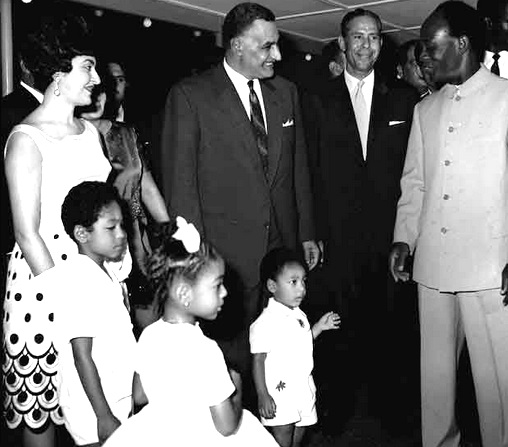
Samia Nkrumah said in a previous interview with “Afronews” that relations between Egypt and Ghana were very strong during the 1950s and 1960s following Ghana’s independence from colonial rule. This was due to the close relationship between her father, founding President Kwame Nkrumah, and the late President Gamal Abdel Nasser. The two leaders shared common views on many issues, particularly supporting African peoples and states in achieving independence. They also agreed on the principle of non-alignment, as Egypt and Ghana were among the founding members of the Non-Aligned Movement.
She added that President Nkrumah frequently repeated a famous saying: “We face neither East nor West; we face forward.”
Samia Nkrumah further noted that her father and President Gamal Abdel Nasser also shared the belief that “Africa must unite.” They were among the founders of the Organization of African Unity, which later became the African Union. Both leaders clearly understood what Africa needed to do and the path it had to follow in order to “become free”—not only politically, but also economically—so that it could provide its peoples with a better quality of life.
She pointed out that President Kwame Nkrumah firmly believed that Africa is one and indivisible—that there is no Africa of the north or south, east or west. He often stressed that “the desert must unite us, not divide us.” Africa, he believed, is home to diverse ethnicities, races, religions, and languages, yet there is a powerful bond that unites all Africans: shared life experiences, common historical circumstances, liberation from colonialism, and a shared goal—the struggle to uplift African peoples.