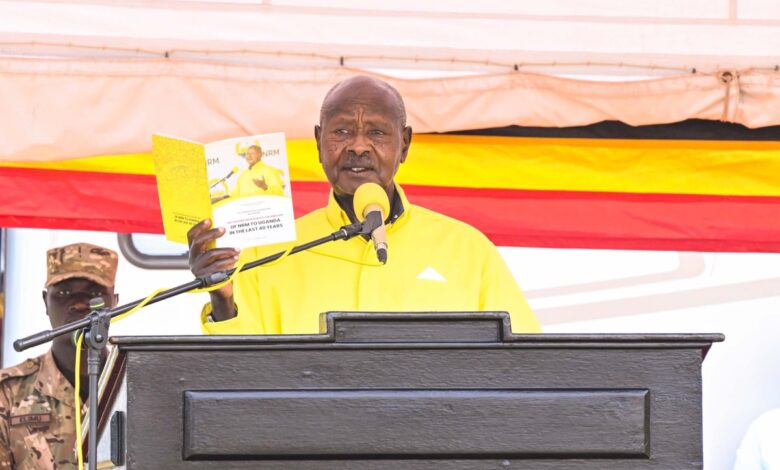
Ugandan authorities have saturated the capital with armored vehicles and elite troops ahead of Thursday’s general election, a move the government labels a security necessity but the opposition decries as a heavy-handed intimidation tactic.
As 81-year-old President Yoweri Museveni hunts for a seventh term to extend his four-decade rule, the state has preemptively severed mobile internet access, effectively silencing digital dissent while Bobi Wine, the popular singer-turned-challenger, rallies a youthful base amid mounting allegations of state-sponsored violence and electoral repression.
president Yoweri Museveni and his political opponents in Uganda held their final rallies on Tuesday before an election that authorities will oversee with soldiers in the streets — deployments that have alarmed opposition figures who see signs of the authoritarianism they want to do away with.The Uganda Communications Commission on Tuesday directed mobile internet providers to temporarily suspend services less than 48 hours before the election, citing misinformation, electoral fraud and incitement of violence.
Restoration of internet services will only be done after the commission issues a notice to providers, according to a letter to the internet companies.
Museveni, Africa’s third-longest governing president, seeks a seventh term to extend his time in office into a fifth decade after Thursday’s election.
His main opponent is the singer-turned-politician best known as Bobi Wine, whose real name is Kyagulanyi Ssentamu.
Wine told The Associated Press in a recent interview that he and his supporters have been attacked by security forces that used tear gas and sometimes even bullets, allegations repeated by Amnesty International.
Museveni “will likely retain power in forthcoming polls,” Brussels-based nongovernmental organisation International Crisis Group said recently.
Museveni, 81, has a loyal following across northern Uganda and his western home region.
His supporters credit him with restoring relative peace and stability in a country that is home to hundreds of thousands of refugees fleeing violence elsewhere.
Museveni has spoken disparagingly of Wine, calling him as unpatriotic and an agent of foreign interests. Wine rejects the charges.
Six other candidates are running for president in the East African nation of roughly 45 million people. Electoral authorities say there are 21.6 million registered voters.
Military spokesman Col. Chris Magezi said that the deployment was meant to deter violence, rejecting concerns that the mobilisation was anti-democratic.
“No cause for alarm,” Magezi said. “However, we do not take threats of violence during the election period by some political actors and their supporters lightly.”
Incumbent vs. youthful challenger Museveni and Wine are reprising their rivalry from the previous election in 2021, when Wine rattled authorities with a bold quest for leadership that appealed to mostly young people in the urban areas.
With voter turnout of 59 percent, Wine secured 35 percent of the ballots against Museveni’s 58 percent, the president’s smallest vote share since his first electoral campaign three decades ago.
The prominence of the opposition leader has since grown. The 43-year-old Wine appears to have kept much of his base intact in parts of eastern Uganda as well as the metropolitan area around Kampala, where he has held boisterous rallies while wearing a flak jacket and helmet to protect himself from gunfire.
Many in Uganda’s governing party, known as the National Resistance Movement, have suggested that Museveni would never hand power to Wine if the challenger won the election.
Museveni campaigned under the banner of “protecting the gains,” a term some see as misguided, because it evokes concerns about largesse from rampant official corruption. Others also perceive a measure of force in the slogan, suggesting power isn’t negotiable.
“I was born when Museveni was in power,” said 37-year-old Farouk Mugaya, who operates a passenger motorcycle in Kampala. “They have had enough time to protect the gains. I want to see change.”
Some critics say removing Museveni from power through elections remains difficult, but the aging president’s authority has become increasingly dependent on the military led by his son, Muhoozi Kainerugaba.