Redrawing the West Bank: The Guardian Scrutinizes the Mechanics of Systematic Erasure

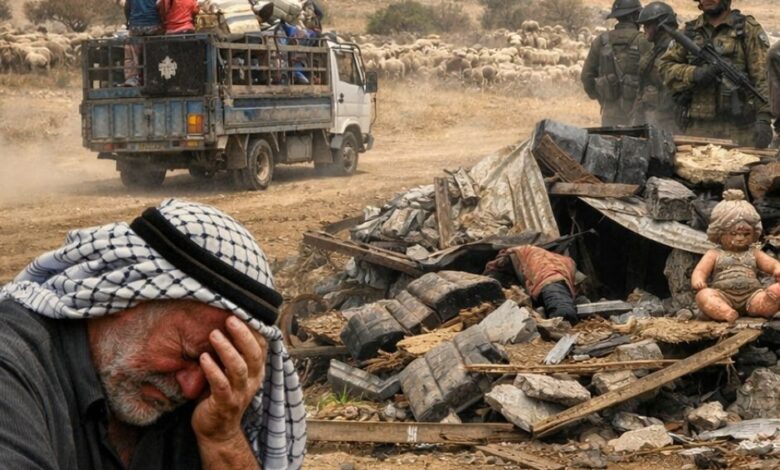
The Guardian reports from the heart of the Jordan Valley, specifically from the village of Ras ‘Ein al ‘Auja, documenting what it describes as a harrowing process of “ethnic cleansing” driven by escalating settler violence.
In a poignant dispatch, the newspaper highlights the tragic displacement of Mahmoud Eshaq, a 55-year-old resident who, after five decades on his land, was forced to dismantle his home.
The Guardian notes that Eshaq, a man who had not cried since childhood, was overwhelmed by grief as his children loaded their meager belongings into trucks, marking the end of a generational presence in the valley.
The investigative piece points out that the displacement of Ras ‘Ein al ‘Auja is not an isolated incident but part of a broader, systemic campaign.
The Guardian indicates that while Palestinian families were fleeing, masked Israeli soldiers were seen escorting teenage settler shepherds,
who posed triumphantly for photos amidst the ruins of Palestinian life. The publication further explains that Ras ‘Ein al ‘Auja was once the largest and most established Bedouin community in the area, yet by early 2026, it remained the last one standing before its final collapse under the weight of relentless attacks.
The Guardian details the methods used to render life untenable for the villagers, listing acts of arson, mass theft of livestock, physical beatings, and the deliberate destruction of property. The report cites Dror Etkes, founder of the settlement monitoring group Kerem Navot, who confirms that Israeli settlers now exercise full control over more than 250 square kilometers of land in this specific part of the West Bank—land that was once exclusively used by Bedouin herds and earmarked by the international community for a future Palestinian state.
A significant portion of the report focuses on the role of the Israeli state.
The Guardian stresses that these violent groups are not acting in a vacuum; rather, they are “backed by far-right cabinet ministers.
” The newspaper specifically mentions Bezalel Smotrich, the finance minister and a settler himself, noting that all-terrain vehicles and equipment used in these raids are often handed out at public ceremonies by high-ranking politicians.
Furthermore, the Guardian observes a disturbing lack of accountability. It states that while security forces have the resources to manage minor local issues, they frequently “ignore or support” settler violence.
The report adds that in the two years following October 2023, soldiers and settlers have killed over 1,000 Palestinians in the West Bank—one in five being children—with “no one tried or convicted” for these deaths. The newspaper emphasizes this point by recalling the killing of an American citizen last year, which prompted a futile outcry from US senators regarding the total absence of legal repercussions.
The Guardian identifies the “tipping point” for Ras ‘Ein al ‘Auja as the moment settlers established a makeshift outpost inside the village boundaries.
The report describes how settlers roamed between houses at night, severing electricity cables, emptying water tanks, and even invading rooms where women and children slept. By early January, the Guardian confirms, 26 families—totaling more than 120 people—concluded that the risk of staying had finally outweighed the agony of leaving.
The report continues by framing this displacement as a “mainstream project.” While the immediate violence is carried out by extremists, the Guardian argues that the annexation of the Jordan Valley is a long-standing goal supported across many Israeli political lines.
The publication warns that despite sanctions from the UK, France, and Canada, the “obliteration of Palestinian communities” is only gathering speed.
In its final analysis, the Guardian underlines a grim reality: across the West Bank, settlers have now seized over 18% of the land designated for a Palestinian state.
The report concludes with the words of Mahmoud Eshaq, who insisted to the reporters: “We were living here peacefully, but they made us into an enemy.
The settlers brought the violence.” Through this exhaustive documentation, the Guardian reaffirms its stance that what is occurring in the Jordan Valley is not mere friction, but a calculated effort to empty the land of its indigenous inhabitants, fundamentally altering the geography of the conflict for generations to come.
22 Countries Condemn Israeli Visit.. Uphold Somalia’s Sovereignty and Unity