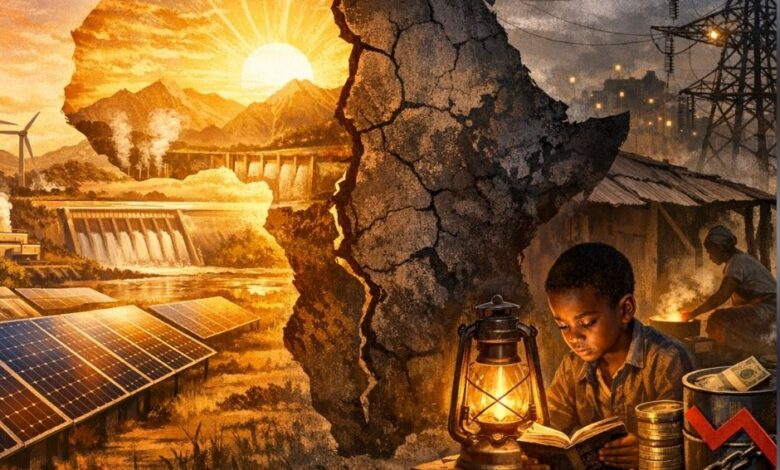
A new report reveals that Africa, despite holding 60% of global solar potential, received only 2% of worldwide clean energy investment last year.
While the West accelerates its transition, African nations are trapped by borrowing costs nearly double those of Europe and aging infrastructure that cannot support new wind and solar projects, leaving 600 million people in the dark despite the continent’s immense natural wealth.
while Africa possesses the world’s most abundant clean energy potential, it is currently being left behind by the global green revolution.
-
The Resource Wealth vs. Reality Gap
- The Potential: Africa holds 60% of the world’s best solar resources, along with massive untapped wind, hydro, and geothermal potential. In theory, the continent could generate more power than the entire world currently consumes.
- The Reality: Despite this, Africa only accounts for 2% of global clean energy investment. In 2024, while the world added a record 585 GW of renewable capacity, Africa added a mere 4 GW.
-
The Financing Paradox
- High Borrowing Costs: African nations pay a “risk premium” that stifles progress. Investors charge 8.5% – 9% to finance a solar plant in countries like Kenya or Senegal, compared to just 5% – 6% in Europe or North America.
- Public Debt: UN projections show African public debt servicing hitting record highs (~$89 billion). This leaves governments with little fiscal space to invest in the $13.7 billion transmission lines and grid upgrades needed to support renewables.
- Fossil Fuel Bias: The report notes that 64% of energy investment in Africa still flows to fossil fuels, whereas globally, the ratio is flipped 2:1 in favor of clean energy.
-
The “Energy Poverty” Crisis
- Access Gap: Approximately 600 million Africans (nearly half the population) still lack reliable access to electricity.
- Economic Cost: Power shortages are estimated to cost the continent between 2% and 4% of its annual GDP.
- Cooking Crisis: Beyond electricity, nearly 900 million people lack access to clean cooking fuels, leading to nearly 500,000 premature deaths annually due to indoor air pollution from charcoal and wood.
-
Strategic Obstacles & “The Roadmap”
- The Grid Bottleneck: The report identifies transmission and distribution as the “weakest link.” Even when solar farms are built, aging grids often cannot handle the intermittent power supply.
- The Necessity of Gas: While the focus is on renewables, the report suggests that Natural Gas will likely remain a “transitional fuel” in the medium term to provide a stable energy base for industrialization, especially in countries like Nigeria and Mozambique.
- Proposed Reforms: The report calls for:
- Regulatory Streamlining: Reducing red tape to lower lead times for projects.
- De-risking Tools: Using blended finance (a mix of public and private capital) to lower the cost of borrowing.
- Regional Cooperation: Creating a “Single African Electricity Market” to allow energy-rich nations to sell power to their neighbors.
-
The “Nairobi Declaration” Target
African leaders have set an ambitious goal of reaching 300 GW of renewable capacity by 2030. To hit this target, the continent needs to more than triple its current annual growth rate (requiring 23% annual growth).
Economic Report: Resilient Growth in Africa Despite a Weaker Dollar and Falling Oil Prices