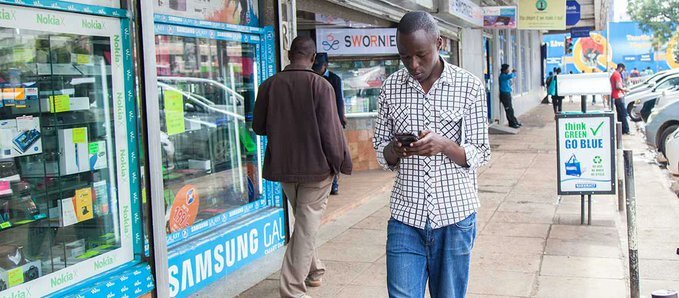
As Africa stands at a digital crossroads, the traditional “smartphone-first” strategy is being challenged by a more inclusive paradigm: AI-enabled accessibility. While network coverage spans the continent, a persistent “usage gap” leaves millions stranded in the voice-only era due to high device costs and linguistic barriers.
By integrating Voice-enabled AI and Natural Language Processing (NLP) into basic feature phones, tech pioneers are bypassing expensive hardware requirements.
This shift transforms a standard 20 device into a sophisticated gateway for healthcare, finance, and education, ensuring that digital transformation is measured not by the devices sold, but by the lives empowered.
The Paradox of Connectivity Africa’s digital narrative is often told through the lens of infrastructure, yet connectivity alone is a hollow metric.
While millions live within reach of a mobile signal, they remain “digitally invisible.
” The barrier isn’t just the absence of a signal; it is the prohibitive cost of smartphones and a chronic lack of relevant content. With over 2,000 indigenous languages, the internet—predominantly English and French—remains a foreign territory for many.
This creates a systemic exclusion where those who need digital services most—farmers, rural women, and the semi-literate—are the least likely to access them.
AI as the “Access Layer” The emergence of Artificial Intelligence is turning this tide. Instead of waiting for universal smartphone adoption, companies like MTN and startups like KrosAI are using AI as an “access layer” over existing low-tech infrastructure. Voice-enabled AI allows users to bypass complex interfaces entirely.
Through simple USSD codes or voice calls, users can interact with Large Language Models (LLMs) that “speak” their language. As Ghana’s Minister for Communications, Samuel Nartey George, aptly notes, AI can either advance inclusion or deepen inequality; the outcome depends entirely on intentional design.
From Voice Calls to Vital Services The practical applications are already reshaping socio-economic landscapes:
Agriculture: Farmers now receive real-time, voice-based weather and market updates, allowing them to make data-driven decisions without needing a data plan.
Healthcare: Solutions like “Ask Viamo Anything” (AVA) provide symptom assessments and health education via voice, a critical tool for women who, according to GSMA data, engage more deeply with AI when privacy and language barriers are removed.
The Case of Miss Baza: MTN’s “Miss Baza” assistant exemplifies this revolution. It allows a user on a 2G feature phone to ask a question in a local dialect and receive a verbal answer sourced from the global internet. This effectively turns a “dumb phone” into a smart assistant.
The 80-20 Linguistic Strategy The challenge of 2,000 languages is met with a pragmatic “80-20 principle.” By first digitizing the most widely spoken regional languages, developers create a scalable pipeline for content. This prevents a “digital bias” where African perspectives are absent from the global AI training sets.
The Path Forward The future of African digital inclusion does not hinge on a gadget, but on a collaboration. Policymakers, telcos, and AI developers must treat inclusion as a “default setting” rather than an afterthought. By decoupling digital participation from the smartphone, Africa is setting a global precedent: technology serves the person, not the other way around.
African Website: Tourism Emerges as the New Engine of Africa’s Economy