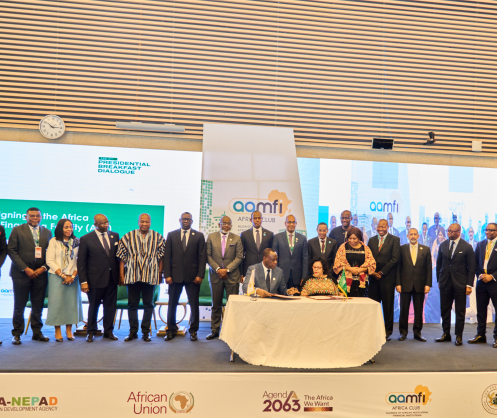
African Heads of State and Government officially launched the Africa Infrastructure Financing Facility (AIFF) on February 14, 2026, marking a major milestone in strengthening the continent’s financial architecture and accelerating financing for priority cross-border infrastructure projects aligned with Agenda 2063.
The announcement was made during the Third Presidential High-Level Dialogue of the Alliance of African Multilateral Financial Institutions (AAMFI), held on the sidelines of the 39th African Union Summit under the theme: “Strengthening Africa’s Financial Architecture to Finance Agenda 2063.”
High-Level Dialogue Reinforces Africa’s Financial Sovereignty Agenda
The Dialogue took place under the patronage of John Dramani Mahama, President of the Republic of Ghana and African Union Champion on AU Financial Institutions. The event emphasized Africa’s determination to transform financial sovereignty into practical mechanisms capable of mobilizing large-scale, long-term capital for development.
African leaders highlighted persistent financing constraints facing Agenda 2063, including fragmented capital markets, high cost-of-capital premiums, limited access to long-term financing, and continued reliance on external financial systems that often fail to reflect Africa’s economic realities.
Participants stressed the importance of strengthening African Multilateral Financial Institutions (AMFIs) while accelerating the operationalization of African Union financial institutions to support sustainable development across the continent.
President Mahama noted that Africa possesses significant domestic financial resources, stating that the continent holds capital pools exceeding $2.5 trillion. He emphasized that the primary challenge lies not in capital availability, but in strategically directing investments toward infrastructure development, industrialization, and job creation to realize Agenda 2063 and advance the African Continental Free Trade Area.
African Union Commission Reaffirms Commitment to Financial Coordination
Representing the African Union Commission, Commissioner for Economic Development, Trade, Tourism, Industry and Minerals Francisca Tatchouop Belobe reaffirmed the African Union’s commitment to strengthening continental financial coordination.
She described the launch of the AIFF as a clear example of effective collaboration between political leadership and institutional coordination, expressing confidence that the Facility would help address Africa’s infrastructure financing gap, estimated at approximately US$221 billion annually between 2023 and 2030.
Coordinated African Capital Deployment at the Core of Development Strategy
Delivering opening remarks, Samaila Zubairu, President and Chief Executive Officer of the Africa Finance Corporation and outgoing Chairman of AAMFI, underscored the importance of coordinated African financial action.
He noted that AAMFI institutions collectively represent balance sheets exceeding $70 billion, working collaboratively to bridge trade, investment, and development financing gaps across Africa. According to Zubairu, collective institutional action is essential for mobilizing resources needed to deliver transformative infrastructure projects and deepen regional integration.
He further emphasized that Africa’s development ambitions require financial scale, institutional alignment, and disciplined capital mobilization to close infrastructure and industrial financing gaps.
AIFF Designed to Bridge the Gap Between Political Approval and Financial Execution
Highlighting the strategic importance of the Facility, George Elombi, President and Chairman of the Board of Directors of African Export-Import Bank, explained that the AIFF directly addresses one of Africa’s most persistent infrastructure challenges — the disconnect between political approval and financial execution.
He noted that many infrastructure projects stall not due to lack of relevance but because they are insufficiently prepared, poorly structured, or misaligned with long-term capital requirements. By pooling expertise, balance sheets, and risk frameworks among African Multilateral Financial Institutions, the AIFF aims to transition Africa from fragmented financing interventions toward a coordinated system capable of mobilizing capital at scale.
Institutional Collaboration Key to Africa’s Financial Ecosystem
Incoming AAMFI Chair Corneille Karekezi, CEO of the Africa Reinsurance Corporation, emphasized that Africa’s development finance strategy must be grounded in collaboration and innovation.
He highlighted the importance of strategic risk-sharing, institutional strengthening, and mobilization of both domestic and private capital to build a resilient financial ecosystem capable of delivering transformative infrastructure and industrial growth across the continent.
Addressing Early-Stage Infrastructure Project Challenges
Discussions during the Dialogue revealed that despite strong political commitment to infrastructure development, many projects face obstacles during early preparation stages. Key challenges identified included:
- Limited funding for project preparation
- Fragmented regional policy frameworks
- Insufficient institutional coordination
The AIFF is designed specifically to address these structural bottlenecks.
Structure and Objectives of the Africa Infrastructure Financing Facility (AIFF)
The AIFF was established under a Cooperation Framework Agreement between AUDA-NEPAD and AAMFI. The Facility provides a structured, Africa-led coordination mechanism aimed at:
- Accelerating infrastructure project preparation
- Facilitating indicative, non-binding financing engagement
- Supporting priority cross-border infrastructure aligned with Agenda 2063
The initiative represents a significant step toward improving project bankability and attracting long-term investment into African infrastructure.
Progress Toward Operationalizing African Union Financial Institutions
In a further demonstration of progress toward strengthening Africa’s financial architecture, the Dialogue concluded with the ceremonial deposit of the Instrument of Ratification of the Protocol and Statutes of the African Monetary Fund (AMF) by the Republic of Cameroon.
This milestone supports ongoing African Union efforts to operationalize key continental financial institutions designed to promote macroeconomic stability, provide balance-of-payments support, and enhance monetary and financial cooperation among AU Member States.
About the Alliance of African Multilateral Financial Institutions (AAMFI)
The Alliance of African Multilateral Financial Institutions, also known as the Africa Club, is a coalition of African-owned and controlled multilateral financial institutions launched in February 2024 in collaboration with the African Union Commission.
The Alliance brings together twelve institutions with a combined balance sheet exceeding US$70 billion. AAMFI works to promote coordination, collective action, and unified advocacy aimed at mobilizing African capital, strengthening the continent’s financial architecture, and advancing sustainable development and regional integration in line with Agenda 2063.
African Leaders Launch Africa Water Vision 2063 at AU Summit