African Historical Pride: This is What to Know About The Golden Pilgrimage of Mansa Musa

African Historical Pride: This is What to Know About The Golden Pilgrimage of Mansa Musa
The annals of history are often written in blood, but The Golden Pilgrimage of Mansa Musa was written in pure, glittering gold. In the year 1324, the Emperor of Mali, known as Mansa Musa, embarked on a journey that would forever change the global perception of the African continent. This was not merely a religious trek to Mecca; it was a sophisticated display of geopolitical power and economic immense wealth that remains unparalleled to this day. The Golden Pilgrimage of Mansa Musa serves as a testament to the advanced civilization of the Mali Empire, which at its peak, was the largest producer of gold in the world.
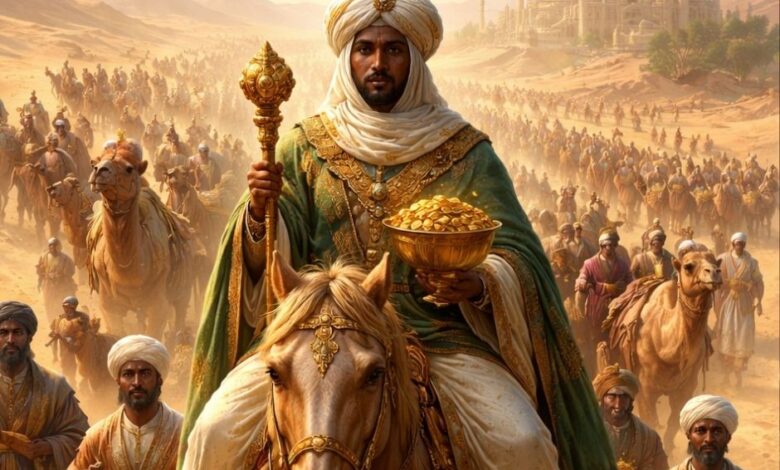
As the massive caravan departed from Niani, the scale of The Golden Pilgrimage of Mansa Musa began to stagger contemporary observers. Chroniclers like the historian Al-Umari, writing in his encyclopedia Masalik al-Absar, recorded a procession of 60,000 men, including 12,000 slaves clad in Persian silk and brocade. Each of these attendants carried a staff of solid gold, signaling the prestige of their monarch. The logistical brilliance behind The Golden Pilgrimage of Mansa Musa involved thousands of camels, each laden with 300 pounds of gold dust, creating a mobile treasury that stretched as far as the eye could see across the Saharan horizon.
When the procession arrived in Cairo, the economic impact of The Golden Pilgrimage of Mansa Musa became a historical anomaly. Musa was so generous with his wealth, distributing gold to the poor and purchasing countless goods, that he inadvertently caused a massive devaluation of the metal in Egypt. For over a decade following The Golden Pilgrimage of Mansa Musa, the Egyptian economy struggled with hyperinflation because the market was saturated with Malian gold. This event is cited by modern economists and was documented by the 14th-century scholar Ibn Khaldun in his Muqaddimah as the only time in history that one man single-handedly controlled the price of gold across the Mediterranean.
Beyond the distribution of riches, The Golden Pilgrimage of Mansa Musa was a profound intellectual mission. Musa did not return to Mali alone; he recruited the finest architects, such as the Andalusian poet and architect Abu Ishaq al-Sahili, as well as jurists and scholars from the Islamic world to join him in Timbuktu. Through the cultural exchange initiated by The Golden Pilgrimage of Mansa Musa, the city of Timbuktu was transformed into a global hub of learning. The construction of the Great Djinguereber Mosque and the University of Sankore were direct fruits of the connections made during The Golden Pilgrimage of Mansa Musa, eventually housing hundreds of thousands of manuscripts that are still studied today.
The international recognition garnered by The Golden Pilgrimage of Mansa Musa eventually led to Mali’s inclusion on the 1375 Catalan Atlas, produced by the cartographer Abraham Cresques. This famous map depicted the African king holding a gold coin, cementing the legacy of The Golden Pilgrimage of Mansa Musa in the European consciousness. For centuries, the tales of this journey fueled the imagination of explorers, though few could grasp the spiritual and administrative discipline that allowed Musa to coordinate such a gargantuan feat across thousands of miles of desert. The Golden Pilgrimage of Mansa Musa was, in essence, a masterclass in soft power and cultural diplomacy.
The legacy of The Golden Pilgrimage of Mansa Musa also highlights the spiritual depth of the Malian leadership. While the gold dazzled the masses, the true intent of The Golden Pilgrimage of Mansa Musa was the fulfillment of a sacred pillar of faith. This duality—of immense material wealth and deep religious devotion—defines the “Luminous” period of West African history, as noted in the Tarikh al-Sudan. Even today, scholars look back at The Golden Pilgrimage of Mansa Musa as a moment where Africa stood at the absolute center of the world’s economic and intellectual stage, proving that light and knowledge flowed from the heart of the continent.
Reflecting on the historical significance of this event, The Golden Pilgrimage of Mansa Musa remains a crucial study for any journalist or historian interested in African agency. It shatters the myth of a “dark continent” by showcasing a sophisticated state capable of executing complex transcontinental operations. The Golden Pilgrimage of Mansa Musa was not just a passage through physical space, but a passage into the permanent memory of humanity. Every grain of sand in the Sahara seems to hold a whisper of the time when a king’s generosity could reshape the markets of a distant empire.
In conclusion, the narrative of The Golden Pilgrimage of Mansa Musa provides a vivid blueprint of African excellence. It reminds us that true power lies not just in the possession of resources, but in the vision to use them for the elevation of one’s people and the enlightenment of the world. Through The Golden Pilgrimage of Mansa Musa, the light of Mali reached the furthest corners of the earth, leaving a trail of gold and wisdom that continues to shine in the 21st century. The Golden Pilgrimage of Mansa Musa is, and will always be, a spearhead of African historical pride.
read more
Solar Gold Rush: Investors from Washington to Beijing Alerted by Nigeria’s $750M Mini-Grid Rollout