The cradle of ancient civilizations is being methodically emptied. As Sudan’s catastrophic civil war grinds into its third year, the nation is not only facing one of the world’s most dire humanitarian crises but also a systematic erasure of its cultural DNA. According to an extensive report by NBC News, the Sudan National Museum, once a sanctuary for treasures spanning from the Stone Age to the Islamic era, now stands as a hollowed-out shell of its former glory.
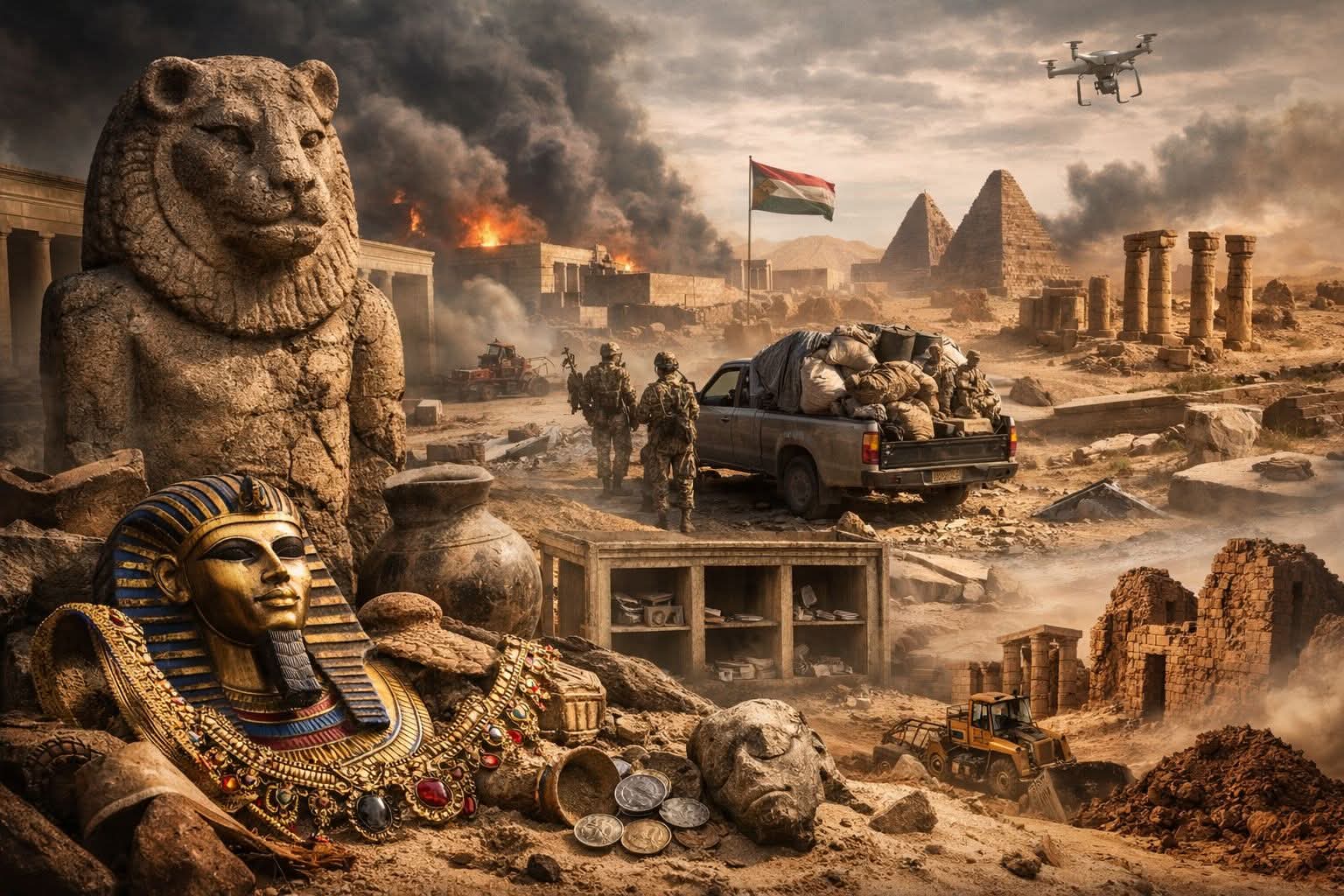
NBC News reported that the devastation is most visible in the desolate halls of the National Museum in Khartoum. Where thousands of artifacts once told the story of the Pharaohs and the sophisticated Meroitic Empire, only the heaviest monuments remain. A solitary statue of the Nubian lion-god Apademak stands defiant in the courtyard—a
“survivor” of what experts describe as organized, high-value looting. NBC News noted that the statue’s immense weight likely saved it from the same fate as the gold, jewelry, and lightweight relics that were whisked away during the occupation of the museum by the Rapid Support Forces (RSF).
Ghalia Jar Al-Nabi, director of the General Authority for Antiquities and Museums, informed NBC News that more than 60% of the museum’s total holdings have vanished. This includes priceless jewelry belonging to the royal houses of Napata and Meroe. The loss is not merely financial; it is a decapitation of the Sudanese national memory.
The conflict, which erupted in April 2023 between the RSF and the Sudanese military, has a human cost that is staggering—at least 40,000 dead and 13.6 million displaced. However, NBC News highlighted that the “cultural cost” is equally irreversible. Sudan’s Minister of Culture and Information, Khalid Ali Aleisir, told NBC News that the preliminary losses in the antiquities and tourism sector have already crossed the $110 million mark.
The minister emphasized that this figure is a conservative estimate. At least 20 museums across the country have been targeted. From the historic Republican Palace to the Sultan Ali Dinar Museum in Darfur, the trail of destruction follows the frontlines of the war. NBC News pointed out that in the Darfur region specifically, three museums were completely leveled during the initial months of the fighting, effectively wiping out the localized history of non-Arab communities—a move that a UN report cited by NBC News described as having the “hallmarks of genocide.”
Perhaps the most harrowing detail revealed by NBC News is the commercialization of this tragedy. Reports surfaced of trucks heavily laden with stolen artifacts moving away from the National Museum in the early months of the war. These items, according to NBC News, have begun appearing on international e-commerce platforms like eBay.
UNESCO has sounded the alarm, declaring that the illicit trafficking of Sudanese cultural property has reached an “unprecedented level.” While a recovery committee has managed to intercept approximately 570 pieces, thousands remain missing. Graham Abdel Qader, a high-ranking official at the Ministry of Culture, told NBC News that roughly 8,000 items were looted specifically from the National Museum’s secure concrete storage rooms, suggesting the thieves knew exactly where the most valuable items were kept.
Beyond the urban looting, Sudan’s World Heritage sites—Naqa and Musawwarat es Sufra—are under grave threat. NBC News detailed how the collapse of central authority has paved the way for “artisanal” gold miners to invade archaeological zones. On Sai Island, bulldozers are reportedly tearing through ancient burial grounds.
Ikhlas Abdel Latif, head of the looted antiquities recovery committee, expressed her deepest fears to NBC News: these sites are losing the security and maintenance required to maintain their World Heritage status. Miners, equipped with metal detectors, are often unable or unwilling to distinguish between gold deposits and metallic funerary masks or ancient coins. The war has turned these sites into “free-for-all” zones where ancestral lands are being desecrated for immediate survival or profit.
“The looted artifacts are not merely inanimate objects,” Ghalia Jar Al-Nabi told NBC News. They represent the “national memory” that preserves the social fabric of a diverse nation. The deliberate targeting of these sites suggests a broader strategy to “erase the country’s identity,” a sentiment echoed by Sudan’s Finance Minister, Jibreel Ibrahim, in an interview with NBC News.
As the international community focuses on the desperate need for food and medicine, the silent death of Sudan’s history continues. NBC News concluded its report by emphasizing that without broad international cooperation to monitor global art markets and secure these sites, the “Light of Sudan’s past” may be extinguished forever, leaving future generations with no physical link to the kingdoms that once rivaled ancient Rome .