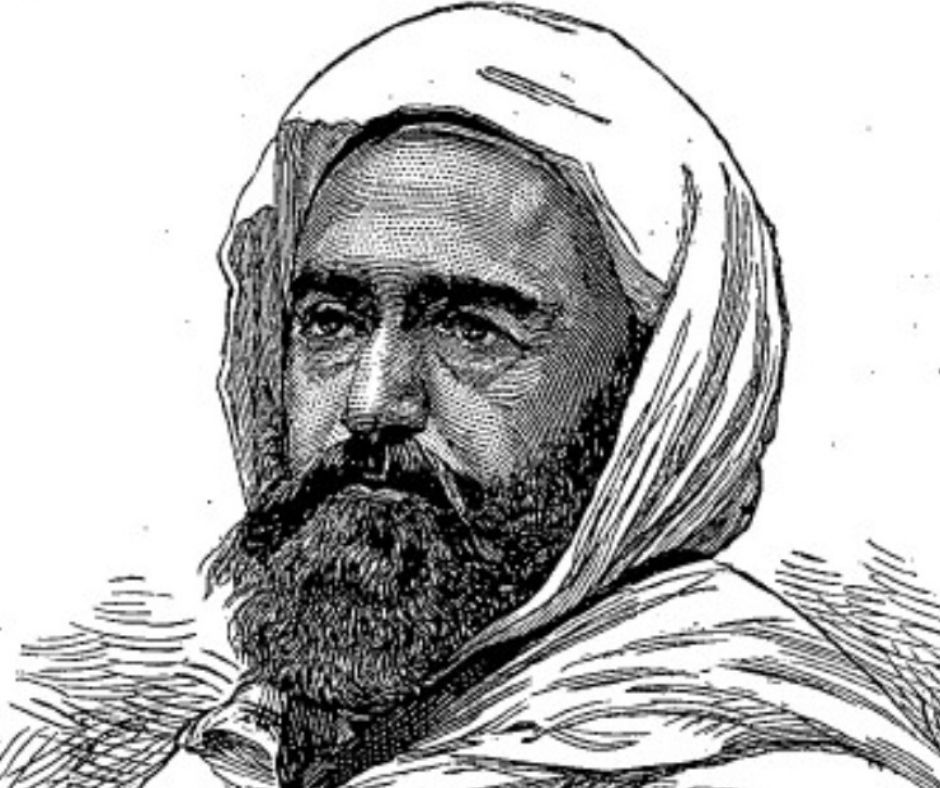
History rarely produces a figure who embodies the scholar, the warrior, and the statesman in equal measure, but Emir Abdelkader was the definitive exception. Long before he became a global icon of humanitarianism, he was the heartbeat of North African resistance. He did not merely lead a rebellion; he architected a nation from the shifting sands of the Maghreb. His legacy is not a relic of the past but a living manifesto of African sovereignty, proving that the light of the mind is the most formidable weapon against the steel of colonial expansion.
The Genesis of a Polymath
Born on September 6, 1808, in the village of Guetna, near the Algerian city of Mascara, Abdelkader was the product of a sophisticated intellectual and spiritual lineage. His father, Muhi al-Din, a prominent religious leader, identified his son as a “prodigy of destiny.” This was not a destiny built on raw power, but on a rigorous grounding in the “Logos”—the sacred word. The young Abdelkader was immersed in Islamic law, mathematics, philosophy, rhetoric, and medicine.
However, his education was not confined to books. To expose him to the staggering diversity of the human experience, his father took him on a two-year pilgrimage that crossed the intellectual arteries of the time: Alexandria, Cairo, Mecca, Damascus, and Baghdad. This journey was pivotal; it transformed a regional youth into a cosmopolitan strategist. While his heart was rooted in prayer and study, he was meticulously prepared for the physical demands of horsemanship and hunting. This dual nature—the mystic and the marksman—would become the hallmark of his leadership when the French invasion of 1830 shattered the peace of his homeland.
Architect of the First Modern Algerian State
When the French occupied Algiers, the traditional tribal structures were in disarray. In November 1832, the tribes turned to the 24-year-old Abdelkader, electing him as their leader. He did not settle for being a mere guerrilla commander; he set out to build a functioning, centralized state that could withstand a European superpower.
Abdelkader’s vision for Algeria was revolutionary. Through the Desmichels Treaty of 1834 and the Treaty of Tafna in 1837, he successfully leveraged temporary truces to consolidate his rule over the interior of Oran and the Titteri. He was a master of “Institutional Integrity.” He abolished the privileges of warlike clans, established a unified judicial system based on equality, and created a fair taxation model.
His state was a masterpiece of strategic logistics. He fortified interior sites like Sebdou, Saïda, and Tiaret, turning them into industrial hearts where he opened arsenals, warehouses, and workshops. He organized a regular army of 2,000 men, teaching them that modern warfare required discipline, not just bravery. Perhaps most impressively, he governed from a tent, rejecting the traditional pomp of royalty to set a personal example of austerity and focus. By 1838, his authority stretched from the Moroccan border to the Sahara, uniting the diverse tribes of Algeria under a single banner of national identity.
The Nomad’s Resilience: A War of Shadows
By 1841, the French shifted their strategy, moving toward a scorched-earth policy under General Bugeaud. They systematically destroyed the Emir’s fortified sites, forcing him to abandon his sedentary capitals. It was here that Abdelkader’s “Unflagging Energy” became legendary. He transformed into a nomad of the interior, leading his people in a war of shadows.
Even as he lost communication with his allies and faced immense physical pressure, he managed to reach Morocco and continue the struggle. His ability to rally support from Algerians who were indignant over French violence was unparalleled. He was a master of psychological and tactical warfare, penetrating deep into the interior and escaping French columns with a grace that frustrated the most seasoned European generals. However, the geopolitics of the era eventually turned against him. When the Sultan of Morocco was forced to withdraw his support following the defeat at Isly, Abdelkader faced a choice between a futile massacre or a dignified conclusion. In 1847, with his honor intact, he surrendered to General Christophe de Lamoricière, ending his military career but beginning his global intellectual journey.
The Humanity of a Captive and the Damascus Sanctuary
Abdelkader’s five-year imprisonment in France did not break him; it elevated him. His unexpected humanity toward French prisoners during the war had already created a circle of admirers among his enemies. Intellectuals, military officers, and Catholic clerics lobbied for his release, which was finally granted by Louis Napoleon in 1852.
After a period in Turkey, he settled in Damascus, joining an elite intellectual circle of Jews, Christians, and Muslims. It was here, in 1860, that his life of study was once again interrupted by the call of justice. When Turkish authorities instigated a pogrom against the city’s Christian minority, Abdelkader did not hesitate. He and his Algerian followers plunged into the Christian neighborhoods, bringing thousands of terrified innocents to the safety of his palace.
When a violent mob arrived at his door, the Emir stood alone. He did not argue from a position of political expediency but from a position of “Transcendent Truth.” He informed the mob that their actions were a violation of the faith they claimed to defend. His moral authority was so absolute that the crowd dispersed. He is credited with saving over 10,000 lives, an act of “Humanitarian Chivalry” that earned him the French Legion of Honor and gifts from world leaders like Abraham Lincoln and Queen Victoria.
The Eternal Bridge: An African Legacy for the World
Abdelkader passed away on May 26, 1883, but his spirit remains a “Luminous Pillar” of African history. He was the first to spread the concepts of modern independence and nationality to the Algerian people, creating a blueprint that would eventually lead to the successful War of Independence in 1954.
He was a “Spiritual Bridge” who showed that one could be a fierce nationalist while also being a universal humanitarian. His life proved that power is not found in the number of men one commands, but in the integrity of the soul that commands them. As the world reflects on the 19th century, Abdelkader stands out as a man who conquered the hearts of his enemies and the history of his people, forever rewriting the narrative of African resistance.
Read more :
Several initiatives reviewd, Niger, Algeria discuss revival of energy cooperation