President Abdel-Fattah El-Sisi said Africa had advanced financing and institutional reforms under Agenda 2063 during his tenure, including launching the $500 billion Team Africa initiative to fund hundreds of development projects across the continent.
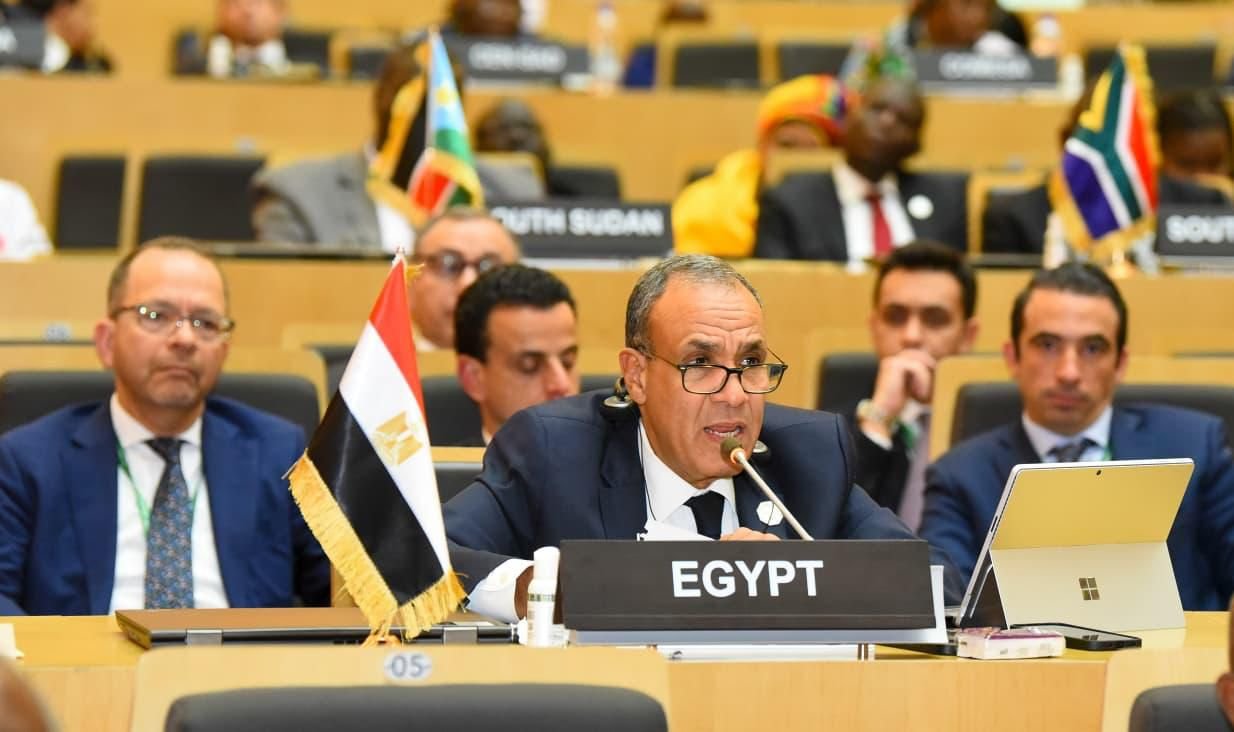
Foreign Minister Badr Abdelatty made the statement while delivering a speech on behalf of President Abdel-Fattah El-Sisi, in his capacity as chair of the Heads of State and Government Orientation Committee of the African Union Development Agency (AUDA-NEPAD), at the African Union (AU) Summit in Addis Ababa.
FM Abdelatty said El-Sisi had chaired the committee since February 2023 during a critical phase marked by the review of the First Ten-Year Plan of the African Union’s Agenda 2063 and the adoption of the Second Ten-Year Plan, amid major international and regional changes affecting food, water, and energy security across the continent.
In a statement on Sunday, the Ministry of Foreign Affairs said El-Sisi stressed that the presidency focused on two parallel tracks: restructuring and strengthening the agency and its secretariat and stepping up efforts to mobilize financing for priority sectors following the adoption of the second implementation plan.
Those efforts translated continental strategies into regional and national programmes, raising the agency’s programme budget to more than $300 million and enabling it to pass the European Union’s Nine Pillars assessment.
Among the main achievements, the president highlighted the launch of the Team Africa initiative to mobilize up to $500 billion for around 300 development projects, as well as the start of studies to establish a NEPAD-affiliated development fund to address financing gaps in a sustainable manner.
The agency also secured $100 million to support public health services and contributed to drafting and launching a new action roadmap for the Comprehensive Africa Agriculture Development Programme.
It advanced initiatives to empower women and youth in innovation, the digital economy, and value-chain integration within the framework of the African Continental Free Trade Area.
El-Sisi underscored the agency’s adoption of an integrated approach linking peace, security, and development, noting updates to the African Union’s post-conflict reconstruction and development policy, enhanced cooperation with the African Union Centre for Post-Conflict Reconstruction and Development in Cairo, and the Aswan Forum for Sustainable Peace and Development.
At the national level, Egypt launched a $100 million mechanism to finance feasibility studies and project implementation in Nile Basin countries, serving as a nucleus to mobilize funding from international and African financial institutions and the private sector.
The orientation committee’s meeting on 10 February reviewed progress on the Presidential Infrastructure Championing Initiative under South African President Cyril Ramaphosa before handing over the agency’s presidency to Angolan President João Lourenço and approving a recommendation to extend the executive director’s mandate for a second term.
In a separate session at the African Union, titled “African Union Membership in the G20,” Abdelatty outlined ways to maximize the continent’s gains from its accession to the Group of Twenty (G20), describing the membership as a strategic opportunity to strengthen Africa’s voice in global economic governance.
He congratulated South Africa on assuming the G20 presidency and stressed the need to leverage South Africa’s membership in the African Union to push for reform of the global financial system, improve the policies and practices of multilateral development banks, expand innovative financing tools, and identify lasting solutions to the sovereign debt crisis.
Abdelatty called for regularly updating the African Union’s priorities within the G20 framework, broadening African states’ engagement in shaping those priorities, and establishing clear mechanisms to monitor participation to ensure tangible benefits for African populations.
The African Union Development Agency (AUDA-NEPAD) is the implementation arm of Agenda 2063, the African Union’s long-term development strategy. Restructured in 2018, the agency coordinates infrastructure, agriculture, industrialization, and human capital programmes through successive 10-year plans.
While the First Ten-Year Plan (2014–2023) advanced regional integration and flagship infrastructure projects, it exposed persistent financing gaps and rising sovereign debt pressures. The Second Ten-Year Plan (2024–2033) places stronger emphasis on domestic resource mobilization, digital transformation, climate resilience, and alignment with the African Continental Free Trade Area (AfCFTA).
The AU’s admission as a permanent member of the Group of Twenty (G20) in 2023 elevated Africa’s representation in global economic governance, offering a platform to push for reform of the international financial system, improved debt frameworks, and expanded climate and development financing.
El sisi : I appreciate Trump’s “valued effort” for peace and stability