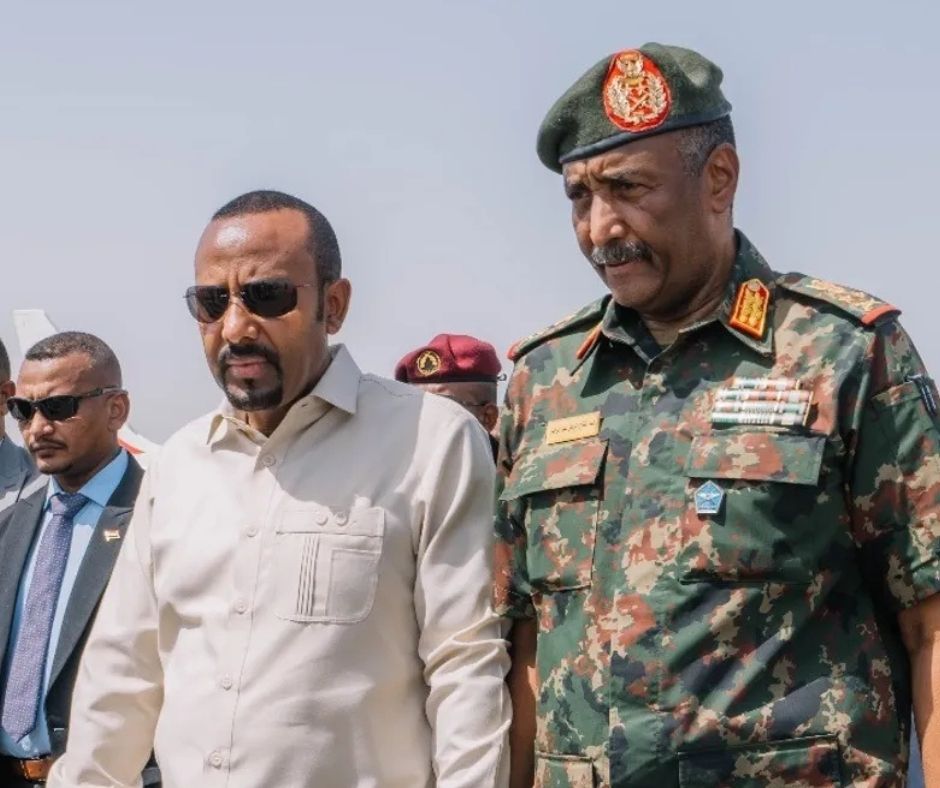
Relations between Sudan and Ethiopia are witnessing a serious and potentially dangerous escalation following official accusations by Khartoum against Addis Ababa of violating Sudanese sovereignty and allowing drones to be launched from Ethiopian territory to strike targets deep inside Sudan. Observers have described this step as an extension of Ethiopia’s regional policies, arguing that it has increasingly become a contributing factor to instability in the Horn of Africa.
Sudanese Expert: Accusations Reflect Sharp Deterioration in Bilateral Relations

Dr. Mohamed Torchine, a Sudanese expert in African affairs, affirmed that the statement issued by Sudan’s Ministry of Foreign Affairs accusing Ethiopia of breaching Sudanese sovereignty represents an extremely grave development and reflects the scale of deterioration that Sudanese-Ethiopian relations have reached in recent months.
In exclusive remarks to “Afronews “, Torchine stated that “the seriousness of the situation is compounded by reports revealing the presence of bases belonging to the Rapid Support Forces inside Ethiopian territory. These bases are reportedly being used as part of military arrangements aimed at preparing for a potential attack on the city of Kurmuk in Blue Nile State.” He added that linking these developments with accusations of cross-border drone launches places relations between the two countries at a critical juncture that could lead to further political—and possibly military—escalation in the coming phase.
The Sudanese expert explained that allegations regarding the use of Ethiopian territory as a launching point for drones targeting Sudanese territory, in addition to its use as a logistical and military rear base to channel support to the Rapid Support Forces, mean—according to his assessment—that Ethiopia has effectively become part of a neighboring axis directly involved in the ongoing conflict inside Sudan.
He further noted that this development reflects a dangerous strategic shift in the nature of Ethiopia’s role and threatens the future of relations between Khartoum and Addis Ababa, particularly amid mounting tensions between the two sides.
Expectations of Accelerated Deterioration and Possible Sudanese Measures
Torchine predicted that Sudanese-Ethiopian relations are likely to witness rapid deterioration in the near future, stressing that the Sudanese government will not stand idly by in the face of what it considers an infringement on its sovereignty and national security. He indicated that Khartoum may resort to serious and decisive measures to address what he described as failures or violations, employing multiple tools and options at its disposal.
The African affairs expert concluded his remarks by emphasizing that these developments foreshadow serious repercussions for the future of relations between the two countries over the next decade. He added that they are also likely to have a direct impact on the course of military operations in Sudan, given the complexity of the regional landscape and the entanglement of interests among the various parties to the conflict.
Khartoum Accuses Addis Ababa of Violating Sovereignty and Launching Drones
The Government of Sudan had earlier announced that throughout February and in early March it had monitored troubling developments concerning the entry of drones launched from within Ethiopian territory, which engaged targets inside Sudan. Khartoum described this move as a dangerous escalation and a direct violation of state sovereignty.
In a statement issued by the Ministry of Foreign Affairs, the Sudanese government characterized this conduct as a hostile act that is strongly condemned and entirely rejected. It affirmed that such actions constitute a blatant violation of Sudan’s sovereignty and an explicit act of aggression against the state, in addition to undermining its territorial integrity and national security.
Sudan Warns of Serious Repercussions for Regional Stability
In this context, Khartoum warned the Ethiopian authorities of the consequences of continuing such actions, stressing that the persistence of these practices could lead to serious repercussions at the level of bilateral relations and regional stability.
The Sudanese government underscored that it reserves its full and legitimate right to defend its national sovereignty and territorial integrity, enabling it to confront any attacks or threats targeting its security. It affirmed that it will take whatever measures it deems appropriate through various means and channels, in accordance with international law and the recognized right of states to self-defense.
read more :