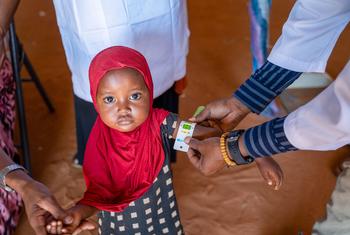
the U.N. World Food Programme said on its life-saving food and nutrition assistance in Somalia could grind to a halt by April unless new funding is secured, putting millions of people at risk of worsening hunger.
An estimated 4.4 million people face crisis-level food insecurity, with nearly one million of them experiencing severe hunger, due to the impact of failed rainy seasons, conflict and declining humanitarian funding, the WFP said.
“The situation is deteriorating at an alarming rate,” Ross Smith, WFP director of emergency preparedness and response, said in a statement.
“Families have lost everything, and many are already being pushed to the brink. Without immediate emergency food support, conditions will worsen quickly,” Smith said.
Somalia is in the midst of a very complex hunger crisis. Two rainy seasons have failed.
Conflict and insecurity persist. Thousands of people have been forced to flee their homes in search of shelter, food, and basic services. All of these have pushed the Somalia humanitarian response to the brink.
Making matters worse is that due to a severe lack of resources, WFP’s life-saving emergency food and nutrition assistance in Somalia will come to an end in a few weeks unless new and urgent funding is received.
Somalia declared a national drought emergency in November after recurrent seasons of poor rainfall, and other countries in the region have also been hit.
The WFP, the largest humanitarian agency in Somalia, said it has already scaled back assistance from 2.2 million people earlier this year to just over 600,000 due to funding shortages. Nutrition programmes for pregnant and breastfeeding women and young children have also been sharply reduced.
The agency said it faces a critical moment similar to a crisis in 2022, when famine was narrowly averted following large-scale international support. It is seeking $95 million to sustain operations between March and August.
“If our already reduced assistance ends, the humanitarian, security, and economic consequences will be devastating, with the effects felt far beyond Somalia’s borders,” Smith said.
In November, the Somalia Government declared a national drought emergency – triggered by severe water shortages, crop and livestock losses, and largescale displacement. We saw very similar conditions in Somalia in 2022 when famine was narrowly averted thanks to large-scale international support.
Today, most of the food security data points are flashing red. Our early warning systems, which we manage alongside partners and counterparts, indicate that we’re on the same path as previous food crises in Somalia.
A quarter of the population – 4.4 million people – face crisis-levels of food insecurity or worse (IPC3+). This includes nearly one million women, men, and children experiencing severe hunger. Nearly two million children are suffering from acute malnutrition, including over 400,000 with severe acute malnutrition. Nearly half a million people have also been displaced in the past five months
A detailed IPC food security and nutrition analysis report is expected to be published next week, and I expect we’ll see a deterioration of the situation.
WFP is a lifeline for millions of people and remains the largest humanitarian operator in Somalia. But right now, we are only able to reach one in seven people in need.
The lack of resources has meant that we’ve been forced to repeatedly reduce the vital assistance we are able to provide. We had no choice but to reduce our food and nutrition assistance by more than half in 2025 due to funding shortfalls.
Somalia signs defence agreement with Saudi Arabia