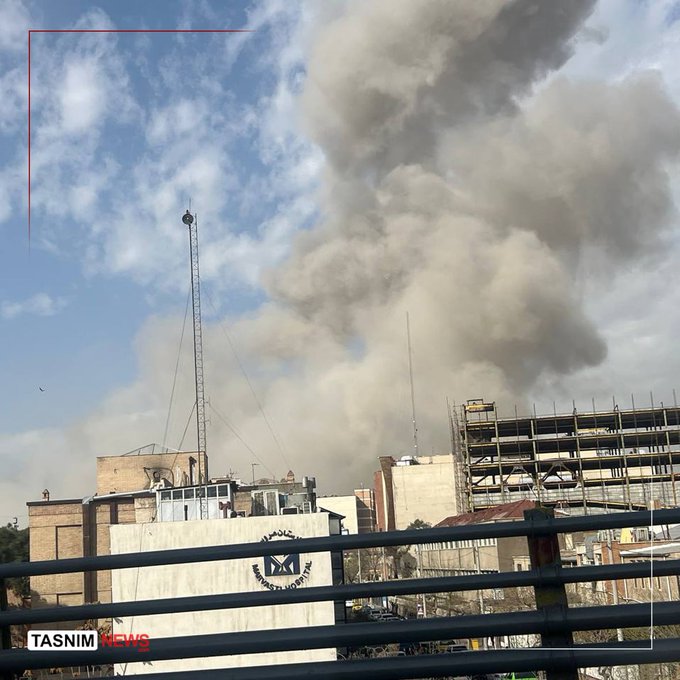
In the early hours of the escalation, the United States and Israel carried out coordinated airstrikes against targets inside Iran.American aircraft operated from bases across the Middle East and from a carrier strike group positioned at sea. Israeli outlets reported that preparations had been underway for months and that the first phase of the operation could last several days. President Donald Trump confirmed that “large-scale combat operations” had begun and stated that the purpose was to prevent Iran from acquiring a nuclear weapon.
On the other hand , Iran fired ballistic missiles at Israel and targeted US military bases in Kuwait, Bahrain, Qatar, the United Arab Emirates, and Saudi Arabia on Saturday, in retaliation for coordinated US and Israeli attacks on Iranian territory, according to regional authorities and multiple international media reports.
Air raid sirens sounded across Israel, including in Jerusalem and Tel Aviv, according to TRT and The Times of Israel. The Israeli military said warning systems were activated nationwide and instructed civilians to take shelter amid incoming missile fire. Israel closed its airspace to civilian traffic as the attacks unfolded.
Israeli media reported that a nine-storey building was destroyed in northern Israel following a missile strike, though there was no immediate official confirmation of casualties.Iranian state television said the strikes were part of Tehran’s response to aggression by Washington and Tel Aviv, announcing that US bases in Kuwait, Bahrain, and the UAE were being targeted.
Explosions were reported in Manama, Kuwait City, Dubai, and Abu Dhabi, according to AFP and Reuters, as Iran expanded its retaliation across the Gulf.In Bahrain, authorities confirmed that the headquarters of the US Navy’s Fifth Fleet had been targeted in a missile attack, with smoke seen rising from the Juffair district. Bahrain’s interior ministry urged residents to seek immediate shelter.
Qatar’s defence ministry said its air defence systems intercepted an Iranian missile and issued mobile alerts advising residents to remain indoors and away from military sites. Separate reports said a missile was intercepted over Kuwait.International media also reported that Saudi Arabia, including the capital Riyadh, was targeted, though there was no immediate confirmation from Saudi authorities.
The escalation disrupted regional air travel. Iran, Israel, Iraq, Qatar, Kuwait, and the UAE closed their airspace, while airlines suspended flights to and from Israel and major Gulf hubs.A senior Iranian official announced that “all American and Israeli assets and interests in the Middle East have become a legitimate target,” adding there were “no red lines” following the strikes on Iran.
Inside Iran, authorities closed the country’s airspace and suspended civilian flights. Telecommunications were disrupted in parts of Tehran. Reports indicated that the Supreme Leader had been moved to a secure location. Iranian state media announced that the country was preparing a response, and missiles were launched toward Israel within hours. Israeli military sources reported interceptions but warned that further launches were possible.
These initial developments establish that this was not a single, limited strike. The reference to multiple waves of bombardment and to a phased operation points to a campaign designed to continue beyond the first night. U.S. officials described targets linked to Iran’s military and security infrastructure. Although full details have not been released, statements from Washington and Tel Aviv suggest that missile production facilities, command-and-control nodes, and possibly naval assets are among the objectives.
If missile infrastructure is indeed a primary focus, that choice reflects an assessment of where Iran’s deterrent strength lies. Tehran has invested heavily in ballistic and cruise missile programs over the past two decades. These systems provide reach across the Gulf, into Israel, and potentially toward U.S. installations in the region. They compensate for the limitations of Iran’s conventional air force. Degrading missile production and storage facilities would aim to reduce Iran’s ability to retaliate over the medium term.
Naval assets are another likely focus. Iran’s strategy in the Gulf relies on fast-attack craft, mines, coastal missiles, and asymmetric tactics designed to threaten shipping lanes. While no confirmed maritime engagements were reported in the first hours, any sustained campaign against naval infrastructure would signal concern in Washington about the security of energy routes.
The closure of Iranian airspace is a practical step but also a political signal. It indicates anticipation of continued strikes and a need to clear civilian air traffic from potential combat zones. Communication disruptions in Tehran further suggest efforts to manage information flow and prevent panic. Such measures are consistent with a government preparing for prolonged military pressure.
The relocation of senior leadership is one of the more consequential early developments. Protective measures at this level are not routine. They indicate that Tehran assesses the strikes as potentially reaching high-value targets. Whether senior officials were directly targeted remains unclear, but the precaution itself reflects the scale of concern.
Iran’s missile launches toward Israel shift the confrontation into open state-level exchange. Previous rounds of tension between Iran and its adversaries often unfolded through proxies or in limited, carefully calibrated strikes. Direct missile fire reduces the buffer that proxies once provided. It also increases the likelihood of civilian impact, raising the political cost on all sides.
Israeli air defenses, including multilayered interception systems, were reportedly activated immediately. The performance of these systems will shape the next phase of escalation. Successful interceptions reduce pressure for further retaliation, while successful Iranian strikes could trigger additional Israeli and possibly American action.
Regional governments are now on heightened alert. U.S. bases in Qatar, Bahrain, Kuwait, and elsewhere have increased security measures. These facilities are within range of Iranian missiles. If Tehran chooses to expand retaliation beyond Israel, American personnel and assets across the Gulf would become direct participants in the confrontation.
The Strait of Hormuz remains a critical variable. Approximately one-fifth of the world’s traded oil passes through this narrow waterway. Even without confirmed attacks on shipping, the mere possibility of disruption affects insurance rates and energy prices. Early market reactions have reflected caution, with traders watching for signs of maritime escalation.
President Trump’s address set the political frame for the operation. He linked the strikes directly to the objective of preventing Iran from obtaining a nuclear weapon and cited decades of tension between Washington and Tehran. The emphasis on eliminating missile and naval capabilities indicates that the administration sees the nuclear issue as intertwined with broader military capacity.
The speech did not signal immediate diplomatic outreach. Instead, it emphasized military resolve and preparedness for continued operations. Acknowledgment that casualties are possible suggests that the administration anticipates the risk of prolonged engagement. Such language prepares domestic audiences for uncertainty rather than promising a quick resolution.
Within Iran, the leadership faces multiple pressures. It must demonstrate resilience and the ability to retaliate without exposing core infrastructure to further damage. Domestic public opinion is also a factor. Economic strain from sanctions has been significant in recent years. Sustained military pressure adds another layer of stress.
The speed of Iran’s initial missile response indicates a desire to show capability and resolve early. Whether Tehran escalates further—by targeting U.S. bases or maritime assets—will depend on its assessment of damage and on internal decision-making dynamics. Escalation carries the risk of drawing in additional states.
In Washington, the operation is likely to prompt debate over legal authority and strategic objectives. While initial strikes may command broad support, sustained combat operations often sharpen political divisions. Congressional scrutiny could intensify if the campaign extends beyond the initial phase or if American casualties occur.
International reactions are also emerging. European governments have expressed concern about escalation while reiterating opposition to Iran obtaining a nuclear weapon. Russia and China have called for restraint. Diplomatic channels remain formally open, but the immediate focus is on military developments.
The early phase of the campaign demonstrates coordination and planning. It also reveals the fragility of regional stability. Each retaliatory step narrows the margin for de-escalation. Communication between adversaries, whether direct or indirect, becomes critical in preventing unintended expansion.
The coming days will clarify whether the operation remains confined to specific military targets or broadens into infrastructure strikes with wider impact. The distinction matters. A narrowly focused campaign aimed at degrading missile capacity differs strategically from one that disrupts energy infrastructure or civilian facilities.
At present, several facts define the situation: sustained U.S.–Israeli strikes; Iranian defensive measures including airspace closure and leadership relocation; direct missile retaliation toward Israel; and heightened alert across Gulf states hosting U.S. forces. The trajectory will depend on whether either side seeks to limit objectives or to impose further costs.
The confrontation has entered a more direct and visible phase. It is no longer confined to covert operations or limited exchanges. The balance between military effectiveness and political calculation will determine whether this remains a contained campaign or evolves into a wider regional crisis. The initial hours have set the stage. The next phase will test the capacity of all parties to manage escalation under pressure.
The Middle East on Fire: The United States and Iran Enter Open Conflict