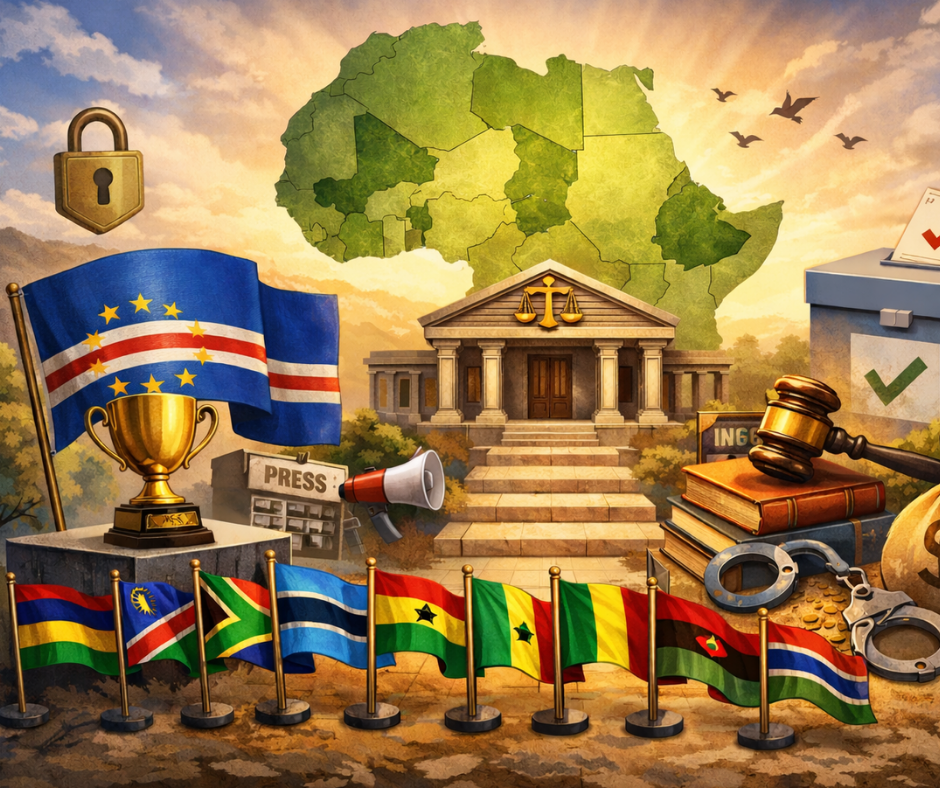
African countries are showing steady gains in political rights and press freedom, showing stronger democratic openness. However, weak rule of law and corruption control continue to limit overall governance performance across much of the continent.. Here are the top 10 best-governed countries in Africa, according to latest rankings.
The list is courtesy of World Economics Governance Index 2026.. Cabo Verde ranks first in Africa with a governance score of 74.0.
Governance usually sounds like a dry policy word politicians throw around at conferences. But strip away the jargon, and it really comes down to this: Can you trust institutions? Can journalists speak freely? Do laws actually work? And do citizens have real political choice?
That’s exactly what the World Economics Governance Index 2026 tries to measure.
Instead of looking only at elections or GDP, it combines four everyday signals of how a country functions: corruption levels, rule of law, press freedom, and political rights. Each country gets a score from 0 to 100, where 0 means the system barely works and 100 means institutions are strong and reliable.
1) Cabo Verde
Ranked 29th globally with a governance score of 74.0, Cabo Verde ranks first in Africa in the dataset, making it the continent’s strongest governance performer. The country records exceptionally high political rights (95.2) and strong press freedom (77.6), reflecting stable democratic institutions. While the rule of law (58.8) and corruption control (64.5) are comparatively moderate, they remain above many peers.
2) Mauritius
Mauritius ranks 37th globally with a governance score of 68.4, combining strong political rights (90.5) and the best rule of law (69.5) among listed African countries. Press freedom remains healthy at 67.7, though corruption control (46.1) weakens the overall rating. The figures indicate persistent integrity concerns within administrative and economic systems constrain a mature democratic structure with reliable institutions, but governance performance.
3) Namibia
Namibia places 42nd globally with a governance score of 65.0. It performs strongly in press freedom (78.1) and political rights (78.6), showing institutional openness. Rule of law (60.0) is solid, though corruption control (43.4) lowers the composite index.
4) South Africa
South Africa ranks 45th globally with a governance score of 62.3. It demonstrates high press freedom (78.6) and political rights (83.3), but a weaker rule of law (50.6) and low corruption control (36.8) weigh heavily on performance.
5) Botswana
Botswana ranks 49th with a governance score of 61.1. It records relatively strong corruption control (59.2) and rule of law (58.6), reflecting administrative stability. However, press freedom (55.3) and political rights (71.4) are comparatively lower than those of top performers.
6) Ghana
Ghana stands 52nd globally with a governance score of 60.2. Political rights (88.1) are among the strongest in the group, while press freedom (67.5) remains solid. However, the rule of law (45.7) and corruption control (39.5) pull the rating down.
7) Senegal
Senegal ranks 63rd with a governance score of 54.0. Political rights (73.8) and press freedom (57.6) indicate a participatory political system, but a weaker rule of law (41.1) and corruption control (43.4) reduce institutional effectiveness. The country appears politically open but administratively fragile, where democratic processes outpace institutional capacity.
8) Malawi
Malawi places 71st globally with a governance score of 50.7. Political rights (74.8) remain relatively strong, while press freedom (57.3) is moderate. However, low corruption control (27.6) and modest rule of law (44.2) significantly constrain governance performance.
9) Sierra Leone
Sierra Leone ranks 73rd with a governance score of 48.0. Political rights (71.4) and press freedom (66.5) are relatively healthy, but the extremely low rule of law (26.4) and corruption control (27.6) undermine governance quality.
10) Gambia
The Gambia ranks 74th globally with a governance score of 47.6. Press freedom (65.4) and moderate political rights (54.8) signal improvement in openness, but weak rule of law (38.5) and low corruption control (31.6) limit overall governance strength.
Adds $253 million special bonus, South African gold miner returns $1.7 billion to investors