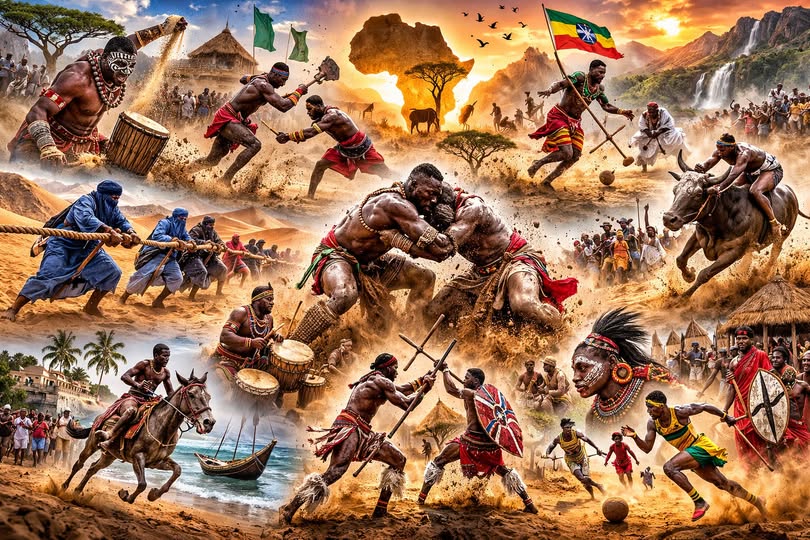
In the global collective consciousness, African sports are often reduced to the rhythmic thud of a soccer ball or the marathoner’s stoic endurance. Yet, beneath the veneer of modern athletics lies a vibrant, esoteric world of traditional sports—activities that are less about scoring points and more about the visceral expression of heritage, tribal hierarchy, and raw survival. From the dusty arenas of Senegal to the emerald hills of Ethiopia, these ten sports are a testament to the continent’s kaleidoscopic diversity.
Laamb: The Mystical Grapple of Senegal
This is not merely wrestling; it is a spiritual conflagration. According to reports by UNESCO regarding intangible cultural heritage, Laamb is a spectacle where physical prowess is augmented by spiritual healers known as “Marabouts.” Before the clash, wrestlers douse themselves in mystical potions to ward off evil eyes. It is a cornerstone of West African identity where brute force meets arcane ritual.
Dambe: The One-Armed Gladiator (Nigeria)
Originating from the Hausa butchers, Dambe is a brutal, high-impact martial art. As documented by the BBC’s African sports archives, fighters wrap their “strong” hand in a cord known as “Kara,” turning it into a literal spear. The goal is to knock the opponent down in a display of lethal precision and indomitable courage.
Genna: The Ethiopian Christmas Chaos
Imagine hockey, but with zero protective gear and a ball carved from a tree root. Genna is played during the Christmas season, and as noted in Ethiopian cultural studies, legend has it that shepherds played it to celebrate the birth of Jesus. It is a chaotic, sprawling game where the boundary between sport and a friendly riot is thin, yet it remains a sacred tradition.
Nguni Stick Fighting: The Zulu Rite of Passage
In the hills of South Africa, young Zulu men engage in Nguni, a duel of agility and pain tolerance. According to The South African Journal of Sports Medicine, combatants use two sticks—one for offense and one for defense—to engage in a dance of strategic strikes. It is a formal apprenticeship in warriorhood and discipline.
Ta Kurtiya: The Saharan Tug-of-War
Found among the Tuareg people, this sport is an elegant test of communal strength. As described by National Geographic’s Saharan expeditions, it often involves heavy wooden mortars. It serves as a social lubricant that strengthens the bonds of nomadic tribes in the harshest desert environments.
Savika: The Bull-Hugging of Madagascar
The Betsileo people of Madagascar don’t kill the bull; they embrace it. According to Madagascar’s Ministry of Culture, Savika involves a young man jumping onto a zebu’s hump and holding on as the beast bucks. It is a rite of passage that proves a man’s fortitude and intimate connection with nature.
Nuba Wrestling: The Ancient Echo (Sudan)
Depicted in 4,000-year-old tomb paintings, Nuba wrestling is perhaps the oldest sport on earth. The Smithsonian Institution highlights its importance as an innate part of harvest festivals. To win is to bring honor to one’s village, while to lose is to experience significant social ignominy.
Donkey Racing: The Lamu Steeplechase (Kenya)
On the idyllic island of Lamu, the annual donkey race is a test of perspicacity. As reported by Al Jazeera English during their cultural features, jockeys ride without saddles, mastering the stubborn temperament of their mounts through narrow, winding alleys in a display of incredible balance.
Surma Donga: The Lethal Beauty of Ethiopia
The Suri people engage in stick fighting to win the admiration of potential brides. The Anthropological Institute of Ethiopia records these as fierce, often bloody encounters. For the Suri, scars are not blemishes but rather accoutrements of bravery and marriageability.
Khokho: The African Tag (South Africa/Malawi)
The African adaptation of Khokho is a masterpiece of celerity. As recognized by The African Traditional Sports Union, it is a pursuit game requiring immense cardiovascular fitness and lightning-fast reflexes. It is the epitome of urban ebullience in the streets of the continent.