Dr. Hamdy Abdelrahman Hassan
In a defining moment during the Africa Cup of Nations in Morocco, a Congolese football supporter displayed Patrice Lumumba’s image, the visionary leader assassinated by colonial treachery over sixty years ago. This was far from a mere sporting display; it represented a profound revival of collective African memory that the world had attempted to suppress and forget.
The scene vividly illustrated that football transcends sport, acting as a living political theater and a platform for the marginalized to amplify their voices. It serves as a sanctuary where nations reclaim the martyrs and heroes who sacrificed their lives for dignity.
By invoking Lumumba, the fan was not just presenting a historical portrait but asserting a steadfast commitment to the flag of freedom, regardless of the cost. Across the continent, Lumumba’s name adorns central boulevards and public squares. Egypt was a pioneer in this commemoration, renaming Alexandria’s famous “Belgium Street” to “Patrice Lumumba Street”—a poignant irony reflecting a direct response to Belgium’s role in his execution. Similarly, a majestic monument stands in his honor in Bamako, Mali.
Following his assassination on January 17, 1961, a generation of African parents named their sons after him, including the renowned Kenyan law professor Patrick Lumumba. His life’s work has inspired countless academic honors and publications. To this day, Lumumba’s iconic Independence Day speech remains a priceless treasure for freedom fighters and the oppressed worldwide.
When Nasser Sheltered the Children of Lumumba: A Legacy of African Solidarity
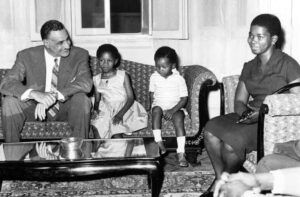
When Nasser Sheltered the Children of Lumumba: A Legacy of African Solidarity The clandestine operation to rescue Patrice Lumumba’s family from the brink of assassination remains a definitive testament to Cairo’s role, under Gamal Abdel Nasser, as a fortress for the continent’s freedom fighters.
This was far from a mere humanitarian gesture; it was a profound political declaration from Egypt to Africa: “We shall never abandon your children, even if colonial powers strike down your leaders.”
This high-stakes mission was orchestrated through the strategic brilliance of Lieutenant General Saad el-Din el-Shazly—commander of the Egyptian UN contingent in the Congo—who secured the operational theater, and the selfless courage of Ambassador Abdulaziz Ishaq, who opened his own home to embrace the martyred leader’s children.
At its core, the operation reflected Nasser’s worldview, where Egypt’s borders were never a barrier to its moral responsibility toward an oppressed Africa.
The escape began in the shadows, with the Lumumba children being smuggled into the Al-Nasr Export and Import Company building in Congo.
In a daring move of diplomatic camouflage, they were registered on Ambassador Ishaq’s own passport as his children from an African spouse.
To ensure their safe extraction, El-Shazly stationed two Egyptian Special Forces units at the airport, standing guard until the children were safely airborne.
In Egypt, young Patrice and his siblings found more than just a haven; they found a home. Nasser affectionately nicknamed the boy “Atris,” a gesture that reflected the warmth of a father who had adopted a child orphaned by the revolution.
Nasser treated them as his own, often insisting they sit beside him during lunch, thereby erasing any distinction between Egyptians and Africans.
It was a singular family—the family of the resistance, bound by dignity rather than submission.
The Lumumba family remained under Egypt’s protection until 1996, a pivotal year when Laurent-Désiré Kabila deposed Mobutu Sese Seko.
Only then, as political legitimacy returned to Congolese soil, did Lumumba’s children return to their homeland, reclaiming their historical right and their place in the living memory of their nation.
Tshombe in Cairo: When Mineral Wealth Collapsed Before Nasser’s Principles
Gamal Abdel Nasser’s commitment to the Congolese cause was no fleeting sentiment—it was steadfast loyalty to Africa’s liberation vanguard. This conviction faced its ultimate test through Moise Tshombe, Lumumba’s arch-nemesis and architect of Katanga’s secession. Tshombe, backed by Belgian and American interests and allied with Mobutu, bore direct responsibility for Lumumba’s assassination.
Following the tragic assassination of Lumumba in January 1961, Tshombe ascended to the premiership. While the Western world pressured for his recognition as the legitimate leader of the Congo, Cairo stood defiant. Under Nasser’s leadership, Egypt refused to acknowledge a government born of betrayal and murder, sending a chilling message: “Legitimacy cannot be bought with the blood of martyrs.”
The climax of this defiance occurred in July 1964, during the Non-Alignment Summit in Cairo.
Despite being pointedly excluded by an Egyptian-led African consensus, a stubborn Tshombe—convinced that his country’s vast mineral wealth could bypass any protocol—boarded his plane and landed in Cairo uninvited.
It was a reckless gamble; he had walked into “Nasser’s Den,” believing his pockets were deep enough to purchase international recognition.
Upon arrival, Tshombe found the doors of the summit hall barred. Instead of a diplomatic reception, he was met by Mohamed Fayek, the Minister in charge of African Affairs.
Nasser refused to grant him an audience, ordering instead that Tshombe be detained within the confines of the Orouba Palace. The situation escalated when Tshombe’s loyalists responded by besieging the Egyptian and Algerian embassies in the Congo.
In a tense showdown, Fayek confronted the captive Tshombe with the reality of his isolation. Nasser’s ultimatum was unwavering: “You shall not leave this palace until every member of the Egyptian and Algerian diplomatic missions, along with their families, is safely evacuated to Brazzaville—the stronghold of Lumumba’s allies.”
Realizing he was besieged not just by Egypt, but by the collective revolutionary spirit of Africa, Tshombe’s arrogance crumbled.
He telephoned his subordinates in Leopoldville, issuing immediate orders to lift the sieges.
Only after the safety of the diplomats was confirmed did Tshombe leave the Orouba Palace, exiting Cairo as he came—a man without legitimacy.
Nasser and the Non-Aligned Dilemma: The Shifting Tides of Global Trust
The catastrophic polarization triggered by the Congo crisis forced Gamal Abdel Nasser into a pivotal strategic choice: to stand as the guardian of Lumumba’s legacy or to yield to the rise of a corrupt elite under Western influence.
Initially, Nasser placed absolute confidence in the United Nations’ capacity to neutralize the conflict until a central government could be established.
This trust was reinforced by UN Secretary-General Dag Hammarskjöld, who personally urged Patrice Lumumba to rely on the international body—a request Lumumba honored by even forgoing Soviet assistance at Nasser’s behest.
During those formative years, the Non-Aligned Movement—with Nasser as a cornerstone—sought to insulate Africa from the freezing winds of the Cold War.
Nasser’s reliance on the UN was rooted in his personal experience following the 1956 Suez Crisis, which had convinced him of the organization’s potential as a “Supreme Court of Nations” and a beacon of conciliation.
However, this foundational trust was shattered during the final, turbulent months of the Congo crisis, as the UN failed to protect Lumumba’s legitimacy.
It was at this historic crossroads that Cairo’s role underwent a radical transformation. As faith in international intervention collapsed, Cairo emerged as the “Mecca of Revolutionaries” for liberation movements across the continent.
The profound bond between Nasser and Lumumba transcends a mere bilateral alliance; it stands as a timeless paradigm of Egypto-African cohesion, underscoring Cairo’s central and enduring leadership in Africa from the dawn of independence to the present day.
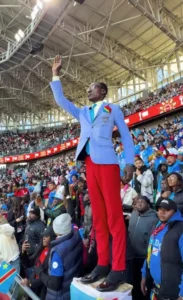
Lumumba’s “Ghost” Haunts AFCON: How a Viral Tribute Ignited Africa’s Resistance Spirit