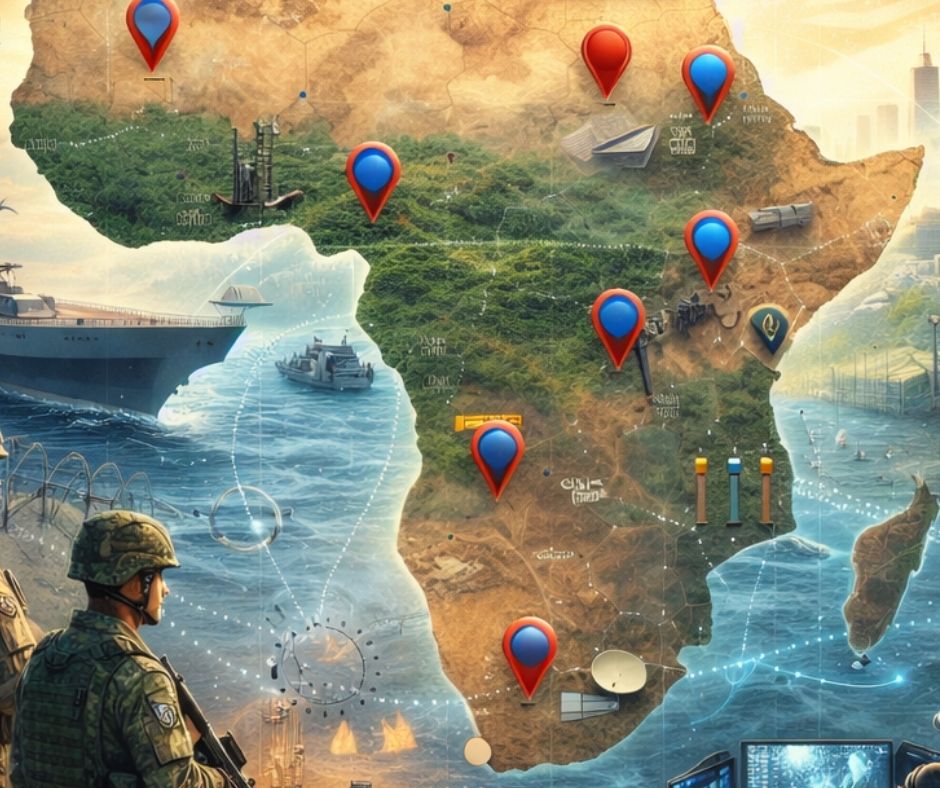
The African continent has evolved into the world’s most dense conglomerate of foreign military outposts. As of the first quarter of 2026, the count of foreign military installations including permanent bases, lily pads, and logistical hubs, has surpassed 52 across 16 countries. This expansion is no longer just about “counter-terrorism”; it is a high-stakes geopolitical chess game for control over trade routes and rare-earth minerals.
1- The Djibouti Sentinel: A Crowded Crossroads
Djibouti remains the global vortex of military presence due to its proximity to the Bab al-Mandab Strait.
- The US Presence: Camp Lemonnier remains the crown jewel of Africom, housing over 4,500 personnel. According to the 2026 Pentagon Posture Statement, the base has recently undergone a $1.2 billion upgrade to accommodate advanced MQ-9 Reaper drone swarms and enhanced electronic warfare (EW) capabilities.
- The Chinese Footprint: China’s People’s Liberation Army (PLA) base, located just miles from Lemonnier, has completed a new 400-meter pier. Jane’s Defence Weekly (Jan 2026) reports that this pier is now capable of docking China’s Type 003 “Fujian” class aircraft carriers, signaling a shift from “logistics” to “power projection.”
2- The Sahelian Vacuum & The Russian Surge
The most drastic shift in 2025-2026 has been the total realignment of the Sahelian belt (Mali, Burkina Faso, and Niger).
- The Niger Flip: Following the 2024 withdrawal of US and French troops, the “Africa Corps” (formerly Wagner) has fully occupied Air Base 201 in Agadez. The Institute for the Study of War (ISW, Feb 2026) notes that Russia has installed sophisticated S-400 missile defense systems there, effectively creating an A2/AD (Anti-Access/Area Denial) zone that challenges NATO’s southern flank.
- The French Retreat: France’s “Operation Barkhane” legacy has shrunk to a tenuous (thin/weak) presence in Chad, where internal political pressure threatens the last 1,000 French soldiers in N’Djamena.
3 -The Red Sea & Horn of Africa: The New “Great Game”
The competition for maritime sovereignty (supreme power) has brought middle powers into the fray:
- Turkey’s Somali Bastion: TURKSOM in Mogadishu is now Turkey’s largest overseas military training facility. Recent SIPRI (2026) data indicates Turkey has expanded the base to include a naval drone (SIDA) testing site, securing the Gulf of Aden.
- UAE & The “Port Strategy”: The UAE has transitioned from traditional bases to “dual-use” commercial ports. In Berbera (Somaliland) and Assab (Eritrea), the UAE maintains rapid-reaction forces and high-tech surveillance hubs to monitor the Houthi movements .
4 – The Indian Ocean: The Southern Pivot
The “Blue Economy” has turned the southern islands into military outposts (frontier stations):
- India’s Agaléga Ambition: India has officially operationalized its $250 million naval and air facility on the Mauritian island of Agaléga. The Lowy Institute (2026) describes this as India’s “Stethoscope on the Indian Ocean,” designed to track Chinese submarine activity.
- The UK/US Diego Garcia Dispute: Despite international legal pressure to cede the Chagos Islands to Mauritius, the US has extended its lease on Diego Garcia through 2036, citing its “indispensable” role in B-52 bomber sorties across the Middle East and Africa.
5- The Emergence of “Technical Hubs”
A new trend in 2026 is the rise of “non-kinetic” bases—cyber and drone surveillance hubs:
- Germany & The EU: Maintain a “Special Operations” hub in Niamey (Niger) focused on migration surveillance using high-altitude balloons.
- Israel: While discrete, Africa Intelligence (2026) reports Israeli signals intelligence (SIGINT) stations in the Dahlak Archipelago (Eritrea), focused on monitoring Iranian maritime corridors.
read more
Will Africa Define the 21st Century? Here Are the Ten Pillars Shaping the Continent’s Future