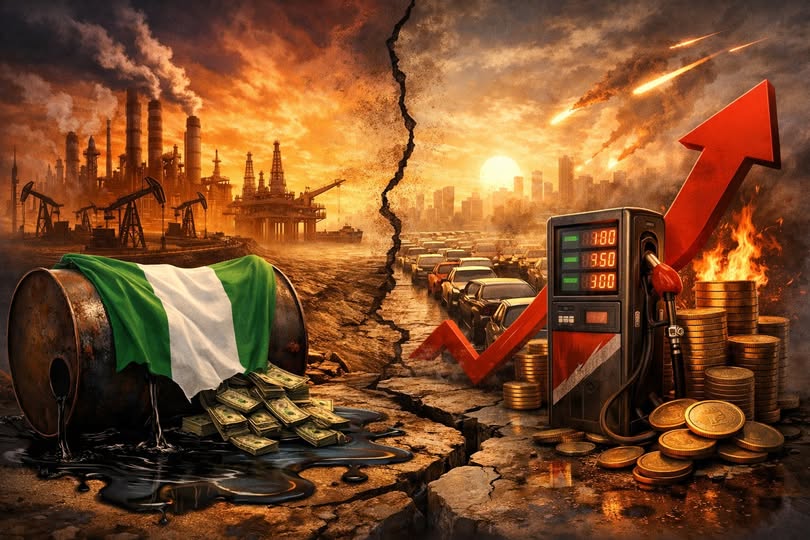
The global energy landscape is currently undergoing a seismic shift, but nowhere is the tremor felt more acutely than in Nigeria. As geopolitical hostilities between the United States, Iran, and Israel escalate, the resulting shrapnel has pierced the heart of Africa’s largest economy. Despite its status as a continental petroleum giant and the proud host of the world’s largest single-train refinery, Nigeria has officially emerged as one of the most vulnerable casualties of the ongoing Middle Eastern conflict. Recent data paints a harrowing picture of a nation caught in a structural vice, recording a staggering 39.5% surge in gasoline prices—a figure that places it second globally only to Vietnam in terms of the steepness of its fuel price rally.
This dramatic escalation is not merely a byproduct of distant drums of war; it is the culmination of decades of domestic fragility meeting a ruthless global market. For a nation that provides the lifeblood of global industry through its crude exports, the irony of its citizens queuing for hours to pay exorbitant pump prices is both bitter and profound. The outbreak of the Iran conflict has acted as a catalyst, exposing the thin veneer of Nigeria’s energy security. While oil remains the indispensable engine powering 70% of global demand, the disruption of critical shipping routes like the Strait of Hormuz has sent shockwaves through supply chains that Nigeria, with its import-dependent history and nascent refining stabilization, was ill-equipped to absorb.
The internal mechanics of this price surge reveal a rapid-fire transmission of global shocks into the Nigerian household budget. Following the total deregulation of the downstream sector, the domestic market now operates as a mirror reflecting international volatility in real-time. In early March, the Dangote Refinery—once hailed as the ultimate panacea for Nigeria’s fuel woes—was forced to adjust its ex-depot prices from ₦774 to ₦874 per litre, representing a 13% jump. This wholesale increase trickled down to the retail level with devastating speed, pushing prices in some regions toward the ₦1,175 mark. Simultaneously, the state-owned NNPC Limited saw even more aggressive hikes, with urban pump prices leaping from ₦900 to as high as ₦1,400 per litre. This 40% surge underscores a harsh reality: in a deregulated environment, being an oil producer offers no sanctuary if the refining and distribution infrastructure remains tethered to global benchmarks and fluctuating exchange rates.
The deepening paradox of Nigeria’s energy sector lies in its transitional state. While the Dangote Refinery has commenced operations, it has yet to achieve the full-scale stabilization required to decouple domestic prices from the whims of the global market. Nigeria finds itself in a precarious middle ground—no longer solely reliant on foreign refineries, yet not yet fully self-sufficient. This “refining gap” means that any threat to oil transit or any spike in Brent crude prices is immediately compounded by the persistent depreciation of the Naira. The currency’s weakness acts as a force multiplier; as the cost of importing refined products and crude feedstock rises in dollar terms, the local price at the station explodes, leaving the Nigerian consumer to bear the brunt of a geopolitical storm brewing thousands of miles away.
Furthermore, the comparison with developed economies highlights a significant disparity in resilience. While other nations utilize strategic reserves and diversified energy portfolios to cushion the blow of the Iran-Israel tensions, Nigeria’s lack of a robust “shock absorber” mechanism means its economy is naked to the wind. The current crisis is a loud clarion call for the urgent fortification of domestic refining logistics and foreign exchange stability. Without these pillars, the nation remains a hostage to external variables. As the world watches the unfolding conflict in the Middle East, Nigeria stands as a cautionary tale of how structural vulnerabilities can transform a resource-rich nation into a victim of its own wealth, proving that possessing oil is meaningless if you cannot control the cost of the energy that drives your own streets.
read more