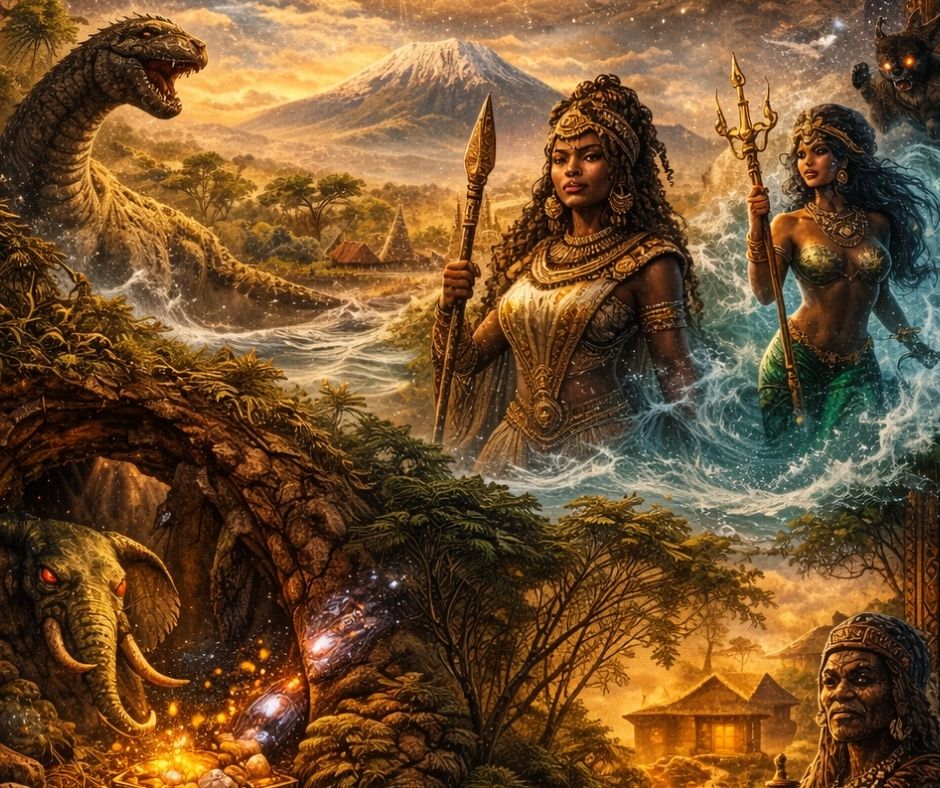
In the vast expanse of the African continent, the line between the physical and the spiritual is often a porous veil. Beyond the modern skyscrapers of Lagos and Nairobi lies a profound “Logos” of storytelling—a collection of myths that serve as moral compasses and cultural anchors.
Based on the 2026 Pan-African Folklore Archive, here are the ten most enduring and haunting legends that continue to resonate in African literature, cinema, and belief systems.
This report is compiled from the UNESCO African Intangible Heritage List and the 2026 Oral History Project by the University of Cape Town.
The Celestial and the Creators
1. The Spider God, Anansi (West Africa):
Perhaps the most famous trickster in world folklore. Anansi is the “Keeper of Stories” who uses wit and cunning to outsmart those more powerful than him. His legacy crossed the Atlantic, becoming a symbol of resilience for the African diaspora.
2. The Creation of the Yoruba (Nigeria):
The legend of Obatala and Oduduwa, who descended from the heavens on a golden chain to create the earth at Ile-Ife. This myth remains the spiritual foundation for millions within the Orisha tradition worldwide.
Protectors and Terrors of the Wild
3. The Mokele-Mbembe (Congo Basin):
Africa’s answer to the Loch Ness Monster. Legend speaks of a “living dinosaur” inhabiting the remote swamps of the Congo. While scientists remain skeptical, for local communities, it represents the indomitable and undiscovered mysteries of the deep rainforest.
4. The Grootslang (South Africa):
A terrifying hybrid of an elephant and a snake. Legend says the primordial gods realized they had made a mistake by giving one creature too much strength and intellect, splitting it into two—but the original Grootslang escaped and still guards a cave full of diamonds in the Richtersveld.
5. The Tokoloshe (Southern Africa):
A mischievous and often malevolent water sprite. Short in stature but immense in influence, the Tokoloshe is blamed for many misfortunes. Even in 2026, many still raise their beds on bricks to stay out of the reach of this nocturnal spirit.
Ancient Spirits of Identity
6. The Legend of the Queen of Sheba / Makeda (Ethiopia): More than a myth, this is a cornerstone of Ethiopian national identity. The story of her journey to King Solomon and the birth of Menelik I is the foundation of the Solomonic dynasty and the guardian of the Ark of the Covenant narrative.
7. The Rain Queen / Modjadji (South Africa):
The hereditary queen of the Balobedu people is believed to have the power to control the clouds and summon rain. This legend is so potent that even modern political leaders have sought the “Rain Queen’s” blessing during droughts.
Spirits of the Water and Air
8. Mami Wata (West and Central Africa):
A powerful water deity, often depicted as a mermaid. Mami Wata symbolizes both the beauty and the danger of the sea. She is a modern legend, often associated with wealth, temptation, and the bridge between the human and spirit worlds.
9. The Popobawa (Tanzania/Zanzibar):
A relatively modern legend of a shape-shifting spirit that attacks victims in the dark. It is a manifestation of collective anxiety and social stress, showing how folklore evolves to reflect contemporary fears.
10. The Adze (Ghana/Togo):
A vampire-like spirit that takes the form of a firefly. If caught, it reverts to human form. It represents the “hidden envy” within a community—a cautionary tale about the destructive power of jealousy.
The Shadow Sovereigns: How 10 Organized Crime Groups are Hijacking Africa’s Future