Marriage in Africa is rarely a mere contract between two individuals; it is a profound communal symphony, a spiritual transition, and often, a rigorous test of endurance. Across the continent’s 54 nations, the rituals governing “I do” range from the poetic to the physically grueling.
African marriage traditions are a testament to the continent’s diversity, proving that “love” is a language spoken through endurance, art, and communal sacrifice. These rituals ensure that a union is not just a personal bond, but a foundational pillar of the tribe’s survival.
1. The Wodaabe: The Male Beauty Pageant (Niger/Chad)
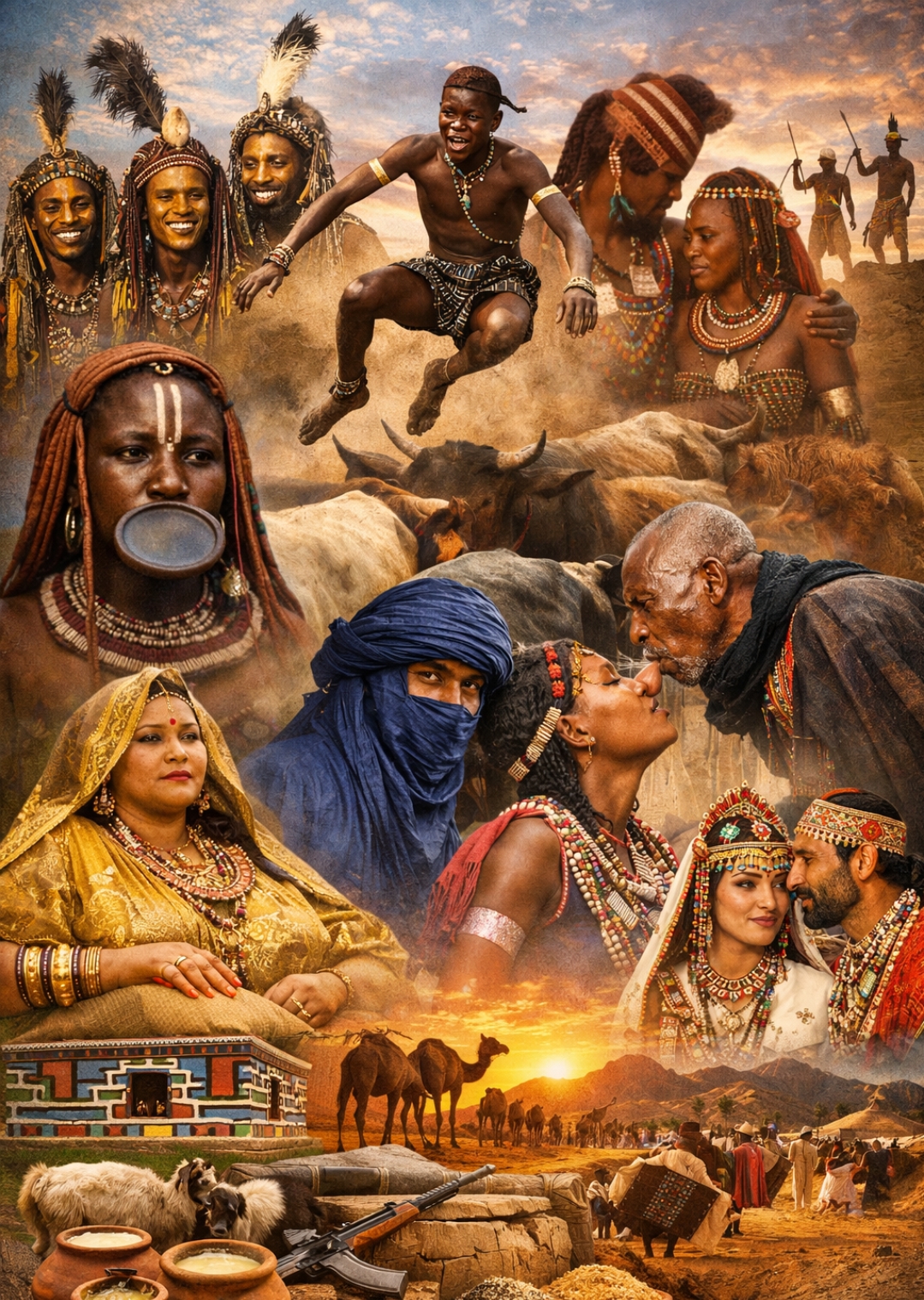
In a striking reversal of global norms, the Wodaabe people of the Sahel region practice the Gerewol. Here, the burden of beauty falls squarely on the man. According to National Geographic, eligible bachelors spend hours applying elaborate makeup—using yellow clay and charcoal—to accentuate the whiteness of their teeth and eyes.
The Ritual: During the ceremony, men dance for days in the heat to demonstrate their stamina.
The Selection: Women, often the daughters of tribal chiefs, act as judges. A woman can choose a man based on his rhythmic prowess and facial symmetry, leading to either a permanent marriage or a “stolen” union.
The Dowry: Usually consists of a few cattle, symbolizing the sustenance of the new household.
2. The Himba: The “Kidnapping” of the Bride (Namibia)
The Himba tribe maintains a tradition that looks like a conflict but is actually a choreographed rite of passage. As reported by BBC Travel, the process begins with a “mock abduction.”
The Ritual: On the wedding day, the groom’s family “kidnaps” the bride from her home. This is a symbolic gesture acknowledging the bride’s transition from her father’s protection.
The Attire: The bride wears an Otjize (a mixture of butterfat and ochre) and a leather headdress called an Erembe. After the ceremony, she is taken to the groom’s family home where the mother-in-law anoints her, signifying her acceptance into the new lineage.
3. The Karo: The Trial of Bravery (Ethiopia)
In the Omo Valley, the Karo tribe emphasizes the man’s readiness to protect his future family. Al Jazeera’s cultural features highlight the “Bull Jumping” ceremony, though most famous among the Hamar, the Karo share similar rites of passage.
The Groom’s Task: To earn the right to marry, a young man must run across the backs of several bulls lined up in a row—four times—without falling.
Failure: Dropping from the bulls results in public shame and the inability to marry until the following year.
The Dowry: Paid in goats, honey, and occasionally a Kalashnikov rifle (symbolizing protection).
4. The Ndebele: The Art of the Apron (South Africa)
For the Ndebele, the wedding is an explosion of geometric art. According to the South African History Archive, the bride’s attire communicates her status more than any spoken word.
The Bride’s Role: She wears a “Jholwane,” a beaded ceremonial apron that expands in complexity as the marriage progresses.
The Groom’s Role: He must provide a “Lobola” (dowry), but the focus is on the construction of a new home, which the bride will eventually paint with the tribe’s signature vibrant patterns.
5. The Tuareg: The Blue Men and Secret Courtship (Sahara Desert)
The Tuareg are unique in their matrilineal leanings. The Guardian notes that among these “Blue People of the Sahara,” women enjoy high status and can own property.
The Courtship: Known as “Asri,” women have the freedom to choose their partners. The groom, who wears the Tagelmust (veil), must approach the bride’s tent with humility.
The Wedding: It lasts seven days. The groom must remain modest and often veiled, while the bride’s family hosts the community.
The Dowry: Usually a significant number of camels, reflecting the wealth of the desert.
6. The Latuka: The Pursuit of Consent (South Sudan)
In the Latuka tribe, the “Mahr” or dowry is preceded by a physical challenge. Ethnographic studies published by the University of Khartoum detail a tradition where a man must “capture” his bride.
The Act: After a man expresses interest, he kidnaps the woman.
The Twist: If the father agrees, he beats the suitor as a sign of his daughter’s value and the man’s willingness to suffer for her. If the father disagrees, the man might still marry her by force, though this is increasingly rare in modern times.
7. The Maasai: The Blessing of Spit (Kenya/Tanzania)
While it may startle outsiders, the Maasai view spitting as a sacred blessing. Reuters cultural archives describe the emotional departure of a Maasai bride.
The Ritual: The bride’s father spits on her head and breasts as she leaves the village with her new husband. This is not an insult but an act of “showering” her with luck so she doesn’t “turn into stone” (a metaphor for failing to adapt to her new home).
The Journey: The bride must walk to her new home and is forbidden from looking back, or she will be turned to stone (mythologically).
8. The Berber: The Imilchil Marriage Festival (Morocco)
In the High Atlas Mountains, the “Souq Aam” or the Marriage Fair is a legendary event. Lonely Planet documents this as a tribute to two lovers who drowned in their own tears (the lakes Isli and Tislit) because their tribes forbade their union.
The Ritual: Young men and women dress in traditional finery to meet and choose partners. A nod or a handshake (saying “You have captured my liver”) signifies a match.
The Outcome: Hundreds of couples may get engaged at once, with the state providing a mass civil ceremony.
9. The Suri: The Beauty of the Labret (Ethiopia)
The Suri (Surma) people have a distinct aesthetic requirement for marriage. As reported by Der Spiegel, the “lip plate” is a central element of a woman’s dowry.
The Process: A young woman’s lower teeth are removed to accommodate a clay plate.
The Dowry Link: The larger the plate, the more cattle the woman’s family can demand in the dowry. It is a direct measure of value and endurance.
10. The Leblouh: The Culture of Abundance (Mauritania)
In some traditional sectors of Mauritania, thinness was historically seen as a sign of poverty. The New York Times has investigated the practice of “Leblouh.”
The Ritual: Before marriage, girls are sent to “fattening farms” to consume thousands of calories daily (camel milk and couscous).
The Goal: A “voluptuous” bride is a sign of a husband’s wealth. While modern movements are fighting this due to health risks, it remains
a deep-seated cultural vestige in rural areas.
Read more