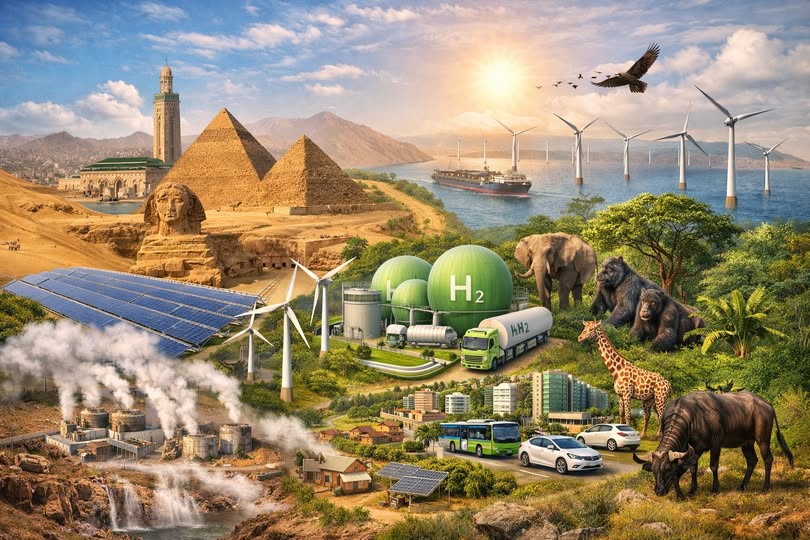
The African continent is no longer a passive observer of the global energy shift; it is increasingly becoming its laboratory and engine. As of 2026, several African nations have decoupled their economic growth from carbon intensity, leveraging unique geographical assets and aggressive policy reforms to lead the “Green Economy” race. From the massive wind farms of the Rift Valley to the green hydrogen hubs of the Maghreb, these ten countries represent the vanguard of a sustainable African future.
Egypt: The Diversified Energy Hub
Egypt has transformed its energy landscape through massive infrastructure projects and a shift toward sustainable finance. The Benban Solar Park, a 1.65 GW facility, stands as a testament to this transition. According to the 2025 EY Africa Attractiveness Report, Egypt achieved the highest overall Foreign Direct Investment (FDI) score in Africa, with a significant portion directed toward green energy and sustainable water management. Egypt is also positioning itself as a regional green hydrogen hub, leveraging its Suez Canal corridor for export-oriented clean energy projects.
Morocco: The Continental Benchmark
Morocco remains the undisputed leader in African climate action, ranking 6th globally in the 2026 Climate Change Performance Index (CCPI). The kingdom’s strategy is anchored by the Noor Ouarzazate Solar Complex, one of the world’s largest concentrated solar power plants. Morocco has successfully integrated renewable energy into its industrial backbone, aiming to source over 52% of its electricity from renewables by 2030. According to the Ecofin Agency, Morocco’s commitment to phasing out coal by 2040 and its massive investments in green hydrogen for the fertilizer industry have made it a global model for energy sovereignty.
Tunisia: The Efficiency Champion
Tunisia has emerged as a surprise leader in “green complexity.” In the 2025 Greenplexity Index released by The Growth Lab, Tunisia ranked first in Africa for its ability to produce and export complex green goods. The country has focused on high-value-added environmental technologies and energy efficiency in its manufacturing sector. Its strategic proximity to Europe and alignment with the EU’s Green Deal have accelerated its transition, particularly in the production of components for electric vehicles and renewable energy systems.
Kenya: The Geothermal Giant
Kenya is the regional powerhouse of East Africa, generating over 92% of its electricity from renewable sources as of 2025. The country leads the continent in geothermal energy, which accounts for nearly half of its power generation. Under the leadership of President William Ruto, Kenya hosted the Africa Climate Summit and spearheaded the Nairobi Declaration. The Center for Strategic and International Studies (CSIS) highlights Kenya’s ambitious goal to reach 100% renewable energy by 2030, supported by significant investments in off-grid solar and mini-grid innovations that serve its rural population.
South Africa: The Just Transition Leader
Despite its historical reliance on coal, South Africa is undergoing the most complex “Just Transition” on the planet. Through the Renewable Energy Independent Power Producer Procurement Programme (REIPPPP), it has attracted over $22 billion in private investment. The 2026 CCPI reports that while challenges remain in decommissioning old coal plants, South Africa is a leader in green hydrogen policy and local manufacturing of solar components. It remains the largest market for sustainable finance and ESG-linked bonds on the continent.
Nigeria: The Transition Accelerator
Nigeria made the most significant leap in the 2025 Energy Transition Index, climbing 48 places to rank 61st globally. The World Economic Forum credits this rise to targeted regulatory reforms and a pivot toward decentralized renewable energy. As Africa’s most populous nation, Nigeria is focusing on “Solar-for-All” initiatives to replace diesel generators, which currently dominate its power landscape. Its Energy Transition Plan is uniquely tailored to balance industrial growth with carbon reduction, focusing on gas as a transition fuel alongside rapid solar adoption.
Namibia: The Green Hydrogen Frontier
Namibia has positioned itself as a global pioneer in the green hydrogen economy. The 2025 Sustainable Development Report emphasizes Namibia’s institutional reliability and its strategic focus on turning the Namib Desert’s wind and sun into liquid gold. With support from international partners like Germany and the EU, Namibia is developing multi-billion dollar projects that aim to make it a primary exporter of clean energy, significantly boosting its GDP while maintaining a low carbon footprint.
Rwanda: The Continental Laboratory for Green Growth
Rwanda has positioned itself as Africa’s premier “laboratory” for sustainable development through its ambitious Green Fund (FONERWA). Despite its small geographic size, Rwanda is a leader in urban sustainability and climate resilience. The 2025 Sustainable Development Report commends Rwanda for its pioneering ban on non-biodegradable plastics and its “Green City Kigali” project, which serves as a continental blueprint for sustainable urban living. By integrating environmental protection into its national security and economic strategy, Rwanda has attracted significant climate finance, focusing on large-scale reforestation and the transition to e-mobility, particularly in its public transport sector.
Mauritius: The Circular Economy Hub
Mauritius ranks consistently high in sustainable development due to its focus on the “Blue Economy” and waste-to-energy initiatives. As a small island developing state, it has prioritized environmental governance and climate resilience. The 2025 Rand Merchant Bank (RMB) report identifies Mauritius as one of the best investment destinations in Africa, specifically for its transparency and progress in transitioning its tourism and textile sectors to sustainable models.
Gabon: The Carbon Sink Guardian
Gabon represents a different facet of the green economy: natural capital protection. With 88% of its land covered by rainforests, Gabon is one of the few countries in the world that is a net carbon absorber. The 2025 Sustainable Development Report highlights Gabon’s innovative use of “carbon credits” and sustainable timber management as a primary economic driver. By treating its forests as national assets rather than commodities to be cleared, Gabon provides a blueprint for biodiversity-led economic growth.
read more