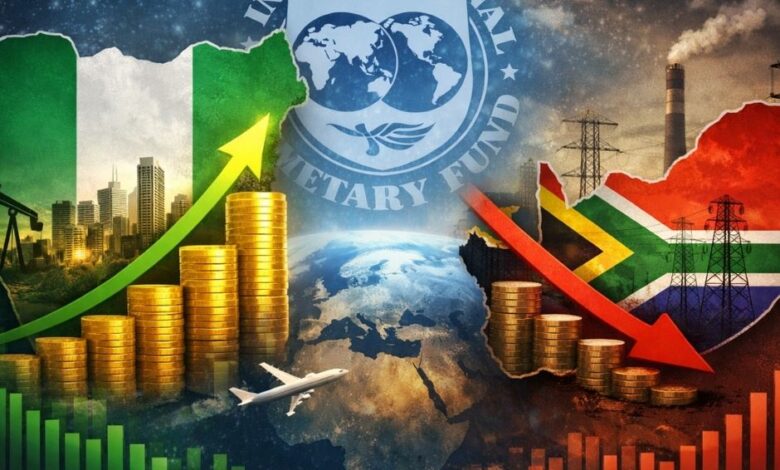
The International Monetary Fund (IMF) projects that Nigeria will account for 1.5 percent of total global real GDP growth in 2026, placing it among the world’s top ten contributors and making it the only African country on the list.
In previous IMF outlooks, South Africa had ranked ahead of Nigeria in Africa’s share of global growth, supported by its larger nominal economy.
Nigeria’s weaker performance over the past two to three years, affected by currency instability, inflation, and policy uncertainty, had limited its contribution.
The 2026 projections mark a shift in Africa’s economic landscape, with Nigeria regaining momentum following recent reforms, while South Africa continues to face headwinds from low growth, power shortages, and trade pressures.
Nigeria’s Growth Outlook The IMF forecasts Nigeria’s real GDP will expand by 4.4 percent in 2026, easing slightly to 4.1 percent in 2027.
The Fund attributes this outlook to exchange-rate adjustments, the removal of fuel subsidies, and efforts to stabilise public finances, supported by expanding domestic demand.
Despite this growth, key domestic indicators; including inflation, exchange-rate stability, real wages, employment, and purchasing power, remain under pressure.
While Nigeria’s projected 1.5 percent contribution to global GDP growth signals progress, structural and economic challenges persist.
The IMF stresses that these projections are conditional and subject to revision, not a full endorsement of domestic policy success.
South Africa, Africa’s largest economy by nominal GDP, is projected to grow 1.4 percent in 2026 and 1.5 percent in 2027.
Growth remains constrained by power shortages, logistical bottlenecks, weak private investment, and high unemployment, which have weighed on industrial output and domestic consumption.
Chronic underinvestment in Eskom (power) and Transnet (logistics), along with trade frictions and tariff-related uncertainty with major partners, including the United States, have further limited growth, particularly in manufacturing and mining.
In comparison to Nigeria, South Africa’s larger, more mature economy means that modest domestic gains translate into smaller contributions to global growth.
Consequently, its projected real growth of 1.4 percent in 2026 is expected to contribute far less to global expansion than Nigeria, which is forecast to grow 4.4 percent over the same period.
the projections have drawn attention from global business figures. Tesla CEO Elon Musk shared the IMF data on X, commenting that “the balance of power is changing.”
The remark was widely interpreted as highlighting a gradual shift in economic momentum away from Europe and the United States, historically driven by consumption, toward emerging economies such as China, India, and Nigeria, which are increasingly shaping global output.