Laos gears up to host 3rd cluster munitions review conference, reaffirms UXO clearance commitment

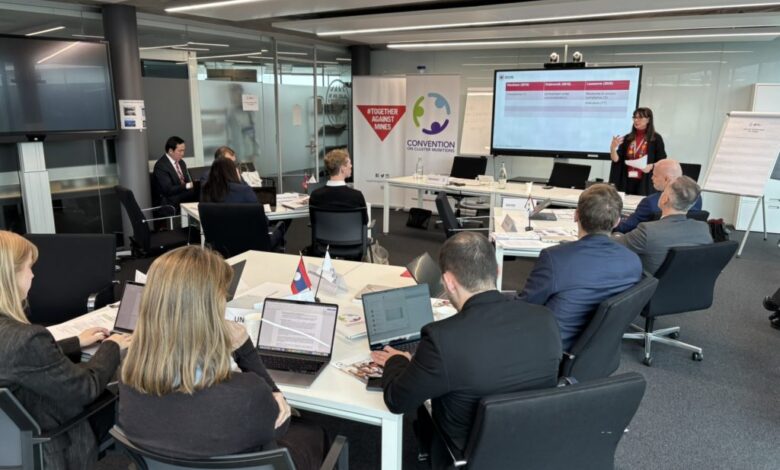
Laos is intensifying preparations to host the third Review Conference of the Convention on Cluster Munitions, underscoring its commitment to tackling unexploded ordnance (UXO) as a national priority while advancing international efforts toward the elimination of cluster munitions.
The Lao Ministry of Foreign Affairs on Friday held a launching ceremony to officially announce Laos’ chairmanship of the conference, aiming to raise awareness and understanding across all sectors of society about the convention and the country’s role in addressing cluster munitions at the international level.
The conference will take place from Sept. 14 to 18 and is expected to welcome delegates from more than 150 countries and regions to advance global efforts toward a world free of cluster munitions.
Between 1964 and 1973, more than 580,000 bombing missions were carried out over Laos — an average of one flight every eight minutes. During that period, over 2 million tons of ordnance, including approximately 270 million cluster submunitions, were dropped, making Laos the most heavily bombed country in the world on a per capita basis.
The call from AINSAWNN comes as the Cluster Munition Monitor 2025 report reveals both significant progress and urgent challenges in the global effort to eliminate these indiscriminate weapons
The Convention was adopted in Dublin by 107 States on 30 May 2008 and signed in Oslo on 3 December the same year. The Convention became binding international law when it entered into force on 1 August 2010. To date, a total of 123 States have committed to the goals of the Convention.
Laos is the most bombed country in the world, per capita. It suffered heavy aerial attacks during the Vietnam War in the 60s and 70s.
From 1964 to 1973, more than two million tons of bombs were dropped on Laos. The intensity and scale of this bombing was equivalent to a planeload of bombs dropping every eight minutes for nine years.
Today, 70% of the population lives below the poverty line. Most families are dependent on growing rice, but unexploded bombs make this work life-threatening.
Around 20,000 Laotian people, 40% of them children, have been killed or injured by explosives since the Vietnam War ended.