Egypt & Africa

Egyptian and American Foreign Ministers Discuss Bilateral Relations and Regional Developments
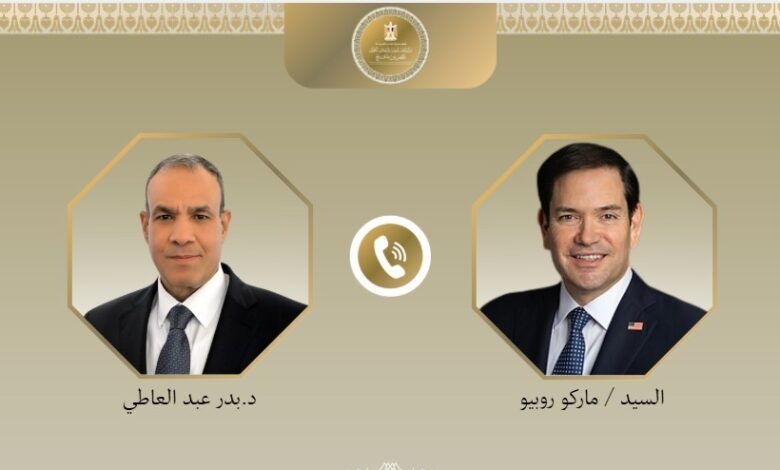
A phone call was held on Thursday, March 26, between Dr. Badr Abdelatty, Minister of Foreign Affairs, International Cooperation, and Egyptian Expatriates, and Marco Rubio, U.S. Secretary of State.
The call focused on ways to support and strengthen the strategic partnership between Egypt and the United States.
The two ministers also exchanged views on the latest regional developments amid the current military escalation and the widening scope of conflict in the region.
The two sides further discussed developments in several other regional issues, foremost among them the Palestinian cause, Sudan, Lebanon, and Egypt’s water security.
Ambassador Tamim Khallaf, the Official Spokesperson for the Ministry of Foreign Affairs, stated that the two ministers reviewed the overall bilateral relations between the two countries, praising the depth of the strategic partnership that spans more than four decades.
They noted that this partnership achieves mutual interests across various fields and contributes to supporting security and stability in the region, expressing their aspiration for further development of bilateral relations to achieve mutual benefits.
The Spokesperson added that the call also tackled regional developments in light of the military escalation in the region.
The U.S. Secretary of State expressed the U.S. administration’s appreciation for the Egyptian leadership and Egypt’s constructive role in mediation, de-escalation, supporting security and stability, and containing crises in the region.
The call also touched on the repercussions of military escalation on the global economy and its impact on the Egyptian economy.
Minister Abdelatty emphasized the importance of providing economic support and liquidity to contain the negative effects of the current escalation on Egypt, particularly given the impact on energy and food prices, as well as the decline in revenues from tourism and Suez Canal.
Dr. Abdelatty stressed Egypt’s position calling for prioritizing diplomatic solutions and supporting the political track through negotiations.
In this context, he noted the sincere efforts made by Egypt, Türkiye, and Pakistan to achieve de-escalation and push relevant parties toward ending the war.
Regarding developments in the Palestinian cause, Minister Abdelatty underscored Egypt’s intensive efforts to ensure the implementation of all provisions of the second phase of the U.S. President’s plan.
This includes the deployment of an international stabilization force and the entry of the National Committee for the Administration of Gaza into the Strip to begin its duties in preparation for the Palestinian Authority’s return to assume its full responsibility.
Dr. Abdelatty emphasized the importance of intensifying efforts to protect Palestinian civilians and continuing work to create conditions for resuming the political process aimed at reaching a just and comprehensive settlement of the Palestinian cause.
Minister Abdelatty also condemned attacks by Israeli settlers against Palestinian civilians and their property in the West Bank.
He asserted that such practices constitute a flagrant violation of international law and undermine the chances of achieving peace.
The two ministers also reviewed developments in Sudan, where the U.S. Secretary of State expressed appreciation for Egypt’s constructive role in efforts to reach a temporary humanitarian truce that could lead to a permanent ceasefire.
Minister Abdelatty reiterated the importance of launching a Sudanese-owned political process to establish a comprehensive roadmap for building a new Sudan, without external interference or dictates.
He further highlighted the need to respect Sudan’s sovereignty, unity, and territorial integrity, and to support its national institutions.
He also praised U.S. efforts within the framework of the international quartet.
Regarding developments in Lebanon, Minister Abdelatty briefed his U.S. counterpart on the results of his visit to Lebanon on March 26.
He reaffirmed the need for an immediate halt to escalation and Israeli attacks on Lebanon, expressing Egypt’s categorical rejection of any violation of its sovereignty, unity, and territorial integrity, or targeting of civilian infrastructure.
Dr. Abdelatty also underscored the importance of empowering state institutions, the full and non-selective implementation of UN Security Council Resolution 1701, and supporting Lebanese state efforts to monopolize arms and impose its authority and sovereignty over all Lebanese territory.
On the issue of water security, Minister Abdelatty reaffirmed Egypt’s deep appreciation for President Donald Trump’s message to the President of the Republic and his valued efforts on this file.
Minister Abdelatty reaffirmed that the Nile River represents a lifeline for the Egyptian people, who live under severe water scarcity, and that water security constitutes an existential issue for Egypt.
In this context, Dr. Abdelatty stressed that Egypt is committed to clear principles based on serious and constructive cooperation with Nile Basin countries in accordance with international law to achieve mutual interests, highlighting persistent Ethiopian intransigence.
Minister Abdelatty categorically rejected any unilateral measures on the Nile River, given its status as a transboundary river.
At the conclusion of the call, the two ministers agreed to continue coordination and consultation in a manner that supports the strategic partnership between the two countries and promotes security and stability in the region.