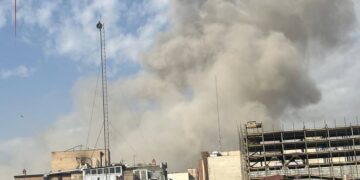
Hundreds of thousands of panicked Lebanese fled homes in Beirut and elsewhere in the country as Israeli warplanes carried out massive airstrikes against the Dahiya neighbourhood in southern Beirut and other parts of Lebanon in the wee hours of Monday morning. “Beirut’s southern suburbs were targeted by a series of Israeli strikes,” the state-run National News Agency reported. Earlier in the evening, Hezbollah, a key ally of Tehran, said it sent rockets and drones into Israel in response to the killing of Iranian Supreme Leader Ali Khamenei at the start of the Israeli/US attack on Iran on Saturday.
In a statement, Hezbollah said it launched “a barrage of missiles and a swarm of drones” at Israel “in retaliation for the pure blood of… Ayatollah Imam Sayyid Ali Al-Husseini Khamenei… and in defence of Lebanon and its people, and in response to the repeated Israeli attacks”. The assassination of Khamenei, the spiritual leader of millions of Shia Muslims in Iran around the world, triggered widespread anger in Muslim countries with majority or sizeable The Israeli airstrikes in the early hours of Monday as people were preparing to start a new fasting day in Ramadan.
The strikes, which rocked Dahiya in southern Beirut as well as Beqaa valley and South Lebanon, came shortly after the Israeli occupation army vowed to respond “in a harsh way” against Hezbollah for firing the rockets on the Upper Galilee. The rockets and drones were all intercepted by the Israeli military and no damages were reported.
Shortly after the Israeli strikes began, Lebanese Prime Minister Nawaf Salam issued a statement condemning the firing of rockets at Israel. “Regardless of who is behind it, the rocket fire from southern Lebanon is an irresponsible and suspicious act that endangers Lebanon’s security and safety and gives Israel pretexts to continue its attacks on it,” Salam said on X. The Lebanese cabinet is set to hold an emergency meeting on Monday morning.
In the days leading up to the US/Israeli attack on Iran, Tel Aviv sent messages to Beirut threatening to devastate the country’s civilain infrastructure, including Beirut International Airport, if Hezbollah joins in any war against Iran. Last week, PM Salam called on Hezbollah not to join in any war between Israel/US and Iran to spare the country from devastation.
Earlier on Sunday, hours before the Hezbollah rockets were fired and intercepted, the Israeli military announced the deployment of 100,000 reservists, many of them along the border with Lebanon. The new Israeli airstrikes against Lebanon using the pretext of Hezbollah rocket attacks come as the US/Israeli attack on Iran and the Iranian retaliatory attacks – against Israel, US military bases in five Arab Gulf countries, and attacks on seaports and airports in the Gulf nations – enters its third day and threatens to widen the scope of the regional war between Washington/Tel Aviv and Tehran.
The Israeli airstrikes mark a continuation in the daily Israeli breaches of the ceasefire between Tel Aviv and Beirut, brokered by Washington in November 2024, with Israel carrying out multiple strikes against Lebanon that killed and wounded hundreds of Lebanese. Before the Israel/US attack, Hezbollah pulled its forces out of South lebanon as per the terms of the November 2024 truce agreement and refrained from responding to the Israeli breaches of the deal.
Immediately after the Israeli airstrikes struck Dahiya on Monday morning, a stronghold for Hezbollah, hundreds thousands of residents, who were still reeling from the devastation of the October-Novemebr 2024 sweeping Israeli aggression, fled the neighbourhood in cars and on foot. News outlets also reported that many Lebanese were also fleeing in droves from the south of the country amid the Israeli strikes.
During their last massive attack on Lebanon in the fall of 2024, at the height of Israel’s genocidal war in Gaza, the Israeli army killed and wounded thousands of Lebanese, destroyed wide swathes of infrastructure, wiped out whole villages in the south, and destroyed or damaged thousands of homes in Dahiya and elsewher in the country.
For its part, hezbollah launched hundreds and rockets against northern Israel and miltay bases. While refraining from carrying out attacks against Israel and pulling out from south of Litani River as stipulated in the truce deal, Hezbollah , nevetheless, refused disarm and handover its weapons to the Lebanese Army, citing continued Israeli occupation and threats to the country.
read more :
Fear strikes Iran’s neighbours, up-shots of US, Israeli war turn into horrific phantoms