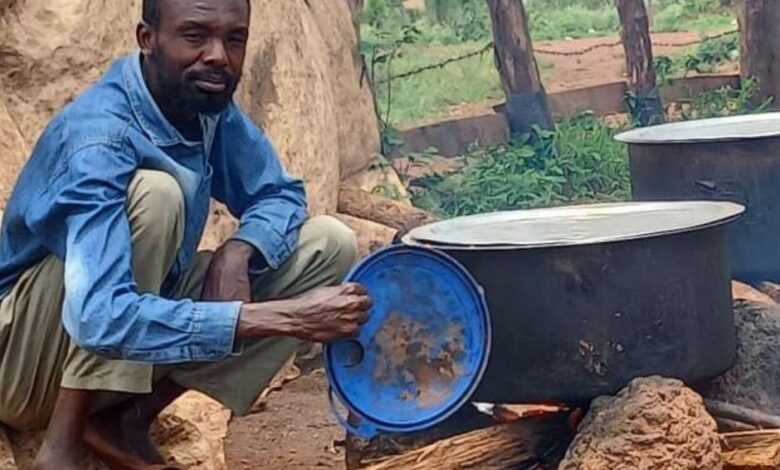
As the war in Sudan between the Sudanese Army and the paramilitary Rapid Support Forces (RSF) ” Sudan Crisis ” enters its third year this Wednesday, a devastating food crisis has left millions of people surviving on just one meal a day.
According to a joint report released on Monday, April 13, 2026, by a coalition of international NGOs—including Action Against Hunger, CARE International, the International Rescue Committee, Mercy Corps, and the Norwegian Refugee Council—the humanitarian situation has reached a breaking point, particularly in the conflict-ravaged regions of North Darfur and South Kordofan.
The scale of the catastrophe is underscored by data from the 2026 Humanitarian Needs and Response Plan, which reveals that a staggering 61.7% of Sudan’s population—approximately 28.9 million people—is now acutely food-insecure. In the worst-hit areas, families are frequently missing meals for entire days, with many forced to resort to eating leaves and animal feed to survive.
Despite the severity of these findings, the army-aligned Sudanese government has continued to deny the existence of a formal famine, while the RSF denies responsibility for the deteriorating conditions in territories under its control.
Global monitors have confirmed that famine thresholds have already been breached in several districts. In February 2026, the UN-backed Integrated Food Security Phase Classification (IPC) reported that the rate of acutely malnourished children under the age of five in Um Baru is nearly double the famine threshold. Similar conditions have been documented in Kernoi, Al-Fashir, and Kadugli.
The report details how the deliberate destruction of markets and farms has turned starvation into a “weapon of war,” further crippled by significant funding cuts from major international donors that have impeded aid agencies’ ability to respond.
The crisis has disproportionately affected vulnerable demographics, particularly women and girls. Data cited by Reuters and humanitarian actors indicates that female-headed households in Sudan are now three times more likely to experience extreme food insecurity than male-headed households. Women also face escalated risks of violence and harassment when attempting to access fields, markets, or water sources.
With communal kitchens increasingly unable to meet the surging demand, the international community faces an urgent challenge to prevent further loss of life in what is now one of the world’s largest and most complex humanitarian emergencies.
read more
Sudan After Khartoum: Why Military Gains Failed to End the War?