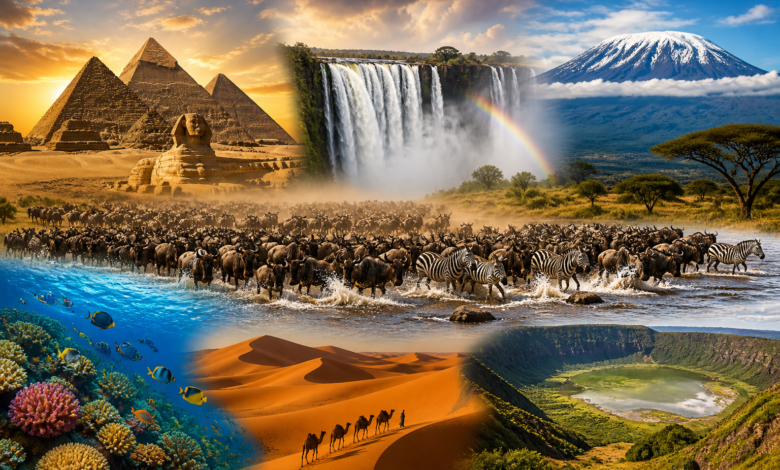
Africa is not merely a continent; it is a profound display of Earth’s most majestic creations. From architectural marvels to geological phenomena, these seven sites represent the pinnacle of African wonder, as documented by leading global authorities.
The Great Pyramids of Giza (Egypt)
As the only surviving member of the ancient wonders, the Pyramids remain an enigmatic feat of engineering. UNESCO World Heritage records confirm these structures represent a creative genius that has survived for over four millennia, symbolizing the absolute precision of ancient African civilizations.
The Victoria Falls (Zambia and Zimbabwe)
Known locally as Mosi-oa-Tunya, this is the world’s largest curtain of falling water. National Geographic describes the sheer power of the Zambezi River plunging into basalt gorges as a formidable sight that creates a mist visible from miles away, defying verbal description.
The Serengeti Migration (Tanzania and Kenya)
This is not a fixed location but a movement of unparalleled scale. The African World Heritage Fund recognizes this annual trek of millions of wildebeest and zebras as the most gregarious and dramatic display of wildlife on the planet, showcasing the raw cycle of life and death.
Mount Kilimanjaro (Tanzania)
As the highest free-standing mountain in the world, Kilimanjaro is a solitary giant rising from the plains. The NASA Earth Observatory highlights its unique status as a snow-capped peak at the equator, providing a lucid example of the diverse climatic range found within the continent.
The Red Sea Reef (North Africa)
An underwater kingdom of vibrant beauty, the World Wildlife Fund classifies this ecosystem as one of the most resilient coral environments globally. It serves as a transparent aquatic sanctuary for over a thousand species, maintaining its status as a vital biological treasure.
The Ngorongoro Crater (Tanzania)
Documented by the International Union for Conservation of Nature, this is the world’s largest inactive volcanic caldera. It provides a natural enclosure for an intrepid population of wildlife, creating a unique ecosystem that houses the densest concentration of large mammals in Africa.
The Sahara Desert
Stretching across the north of the continent, the Sahara is a vast ocean of sand. Scientific studies from the Smithsonian Institution describe its shifting dunes and extreme temperatures as a paradoxical beauty—a landscape that is both desolate and fundamental to the planet’s global weather patterns.
read more