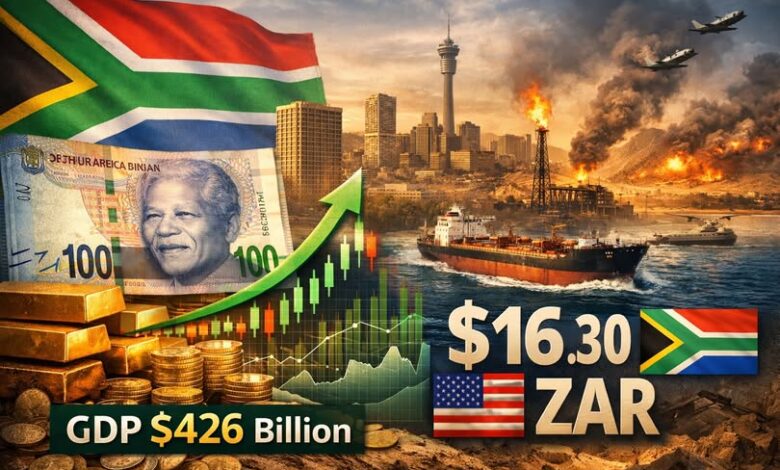
South Africa’s rand was steady early on Wednesday as investors watched developments in the Middle East and awaited two key U.S. inflation reports for signals on the Federal Reserve’s policy outlook. At 0737 GMT, the rand traded at 16.3050 per dollar, little changed from Tuesday’s closing level.
The currency found some relief after U.S. President Donald Trump said the Middle East conflict could come to an end soon, after hitting a three-month low of around 16.90 on Monday. However, traders remain cautious as Trump continued to threaten tough action against Iran over disruptions to energy flows through the Strait of Hormuz.
“The USD-ZAR spike that happened on the escalation of the war appears to be quickly unwinding. If this unwind continues through the remainder of this week and next, the USD-ZAR impact on inflation and GDP growth will be limited,” ETM Analytics said in a research note.
The greenback was flat against a basket of currencies as markets awaited the U.S. consumer price index for February, due later in the day, and the Personal Consumption Expenditures (PCE) index – the Fed’s preferred inflation gauge – on Friday. Like other risk-sensitive currencies, the rand often takes cues from global drivers, in addition to domestic economic data.
Domestically focused investors this week will look to the release of January mining (ZAMNG=ECI), opens new tab and manufacturing (ZAMAN=ECI), opens new tab figures and fourth-quarter current account (ZACACT=ECI), opens new tab data for clues on the health of the continent’s most industrialised economy.
On the Johannesburg Stock Exchange, the Top-40 index (.JTOPI), opens new tab was last up 1.8%. South Africa’s benchmark 2035 government bond was slightly stronger in early deals, as the yield fell 1 basis point to 8.425%. South Africa’s economy, the largest on the African continent, expanded 1.1% in 2025, according to official statistics data released on Tuesday. South Africa’s gross domestic product (GDP) grew 0.4% in the fourth quarter of 2025, marking the fourth consecutive quarter of expansion, according to Statistics South Africa (Stats SA) data. Its economy grew 0.1% in the first quarter, 0.9% in the second quarter, and 0.3% in the third quarter of 2025.
On the production side, finance, real estate, and business services were the main drivers of growth during the year, while manufacturing, construction, and the energy sector all saw contractions. With overall growth of 1.1% in 2025, South Africa’s GDP reached approximately $426 billion, allowing the country to maintain its position as the largest economy in Africa.
South Africa’s economy achieved unprecedented growth levels last year, in contrast to the preceding three years. In January, it was reported that the South African rand was enjoying its strongest weekly rally in more than two decades, bolstered by surging precious metal prices and signs of an improving economic outlook.
Additionally, the currency opened 2026 at its strongest level since 2022, supported by positive domestic trends, including ongoing economic reforms and higher metals prices. Another report in the same month showed that South Africa’s inflation is on course to meet the South African Reserve Bank’s (SARB) revised 3% target in 2026, with prices remaining broadly stable.
The country’s current consumer price inflation (CPI) rate is 3.5%. In 2025, the South African government and central bank cut the inflation target to 3% for the first time in 25 years, with a one-percentage-point tolerance band, despite previously anticipating that this aim would be met only by 2027.
red more :
South African rand sinks as Middle East conflict adds to economic uncertainty