
Dr. Hussein Bassir
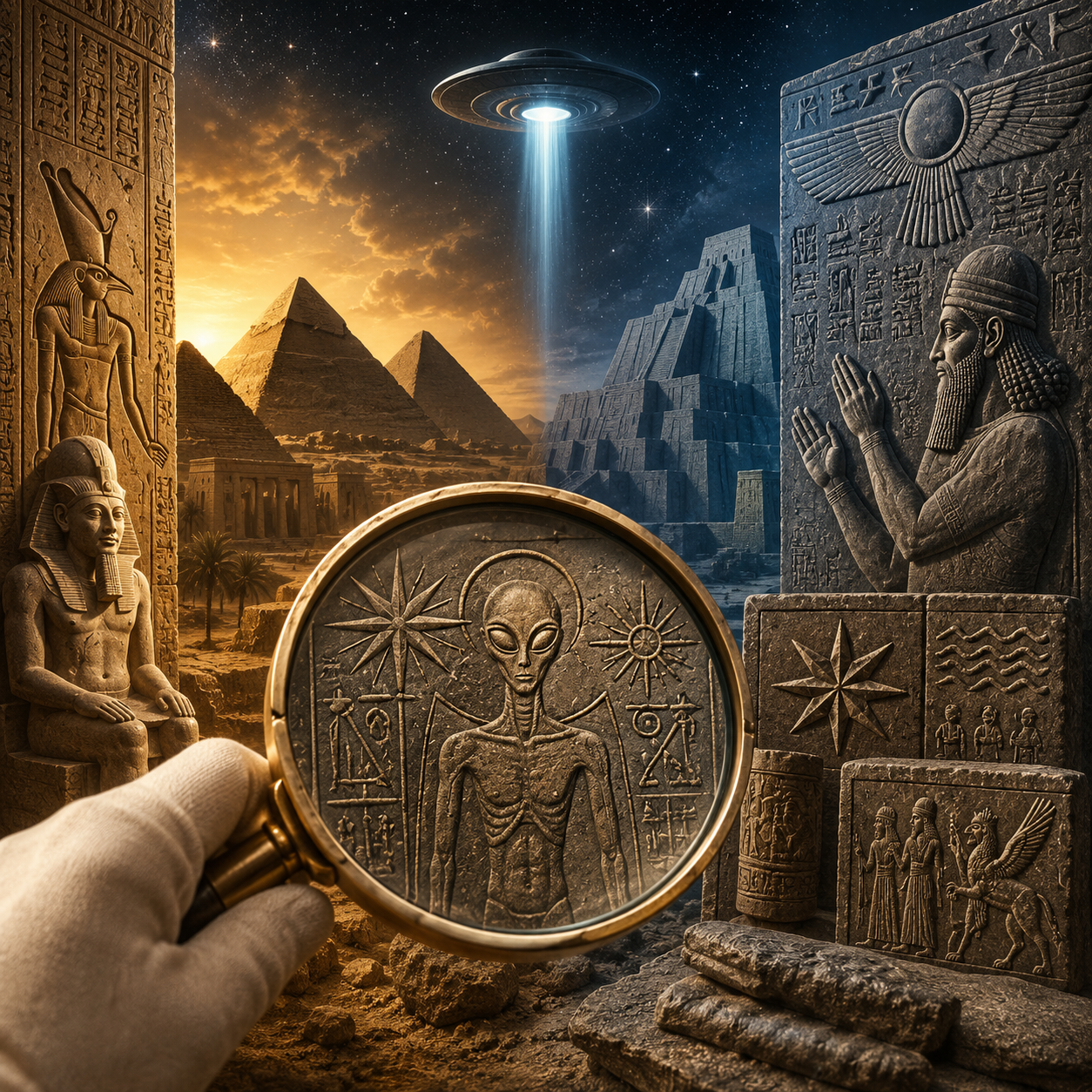
For years, images of coins, carvings, and ancient artifacts have circulated across websites and social media platforms, allegedly depicting “extraterrestrial beings” or “vehicles from other worlds.”
These images are often presented as evidence that the civilizations of the ancient Near East—particularly Egypt and Mesopotamia—experienced contact with beings from beyond Earth.
Such claims become even more sensational when linked to mysterious artifacts or poorly documented discoveries, quickly turning into fertile ground for conspiracy theories and popular imagination.
Among the most frequently shared examples are alleged Egyptian coins bearing images of beings with elongated heads and unusual facial features, or symbols resembling “flying saucers.”
In reality, these claims lack any genuine archaeological or scientific foundation. No officially documented artifact from any recognized museum, excavation, or archaeological mission in Egypt has ever provided evidence of extraterrestrial visitors.
In most cases, the objects in question are either modern fabrications, heavily eroded artifacts whose details have been distorted over time, or misunderstood representations of ancient artistic and religious symbols.
The fundamental problem lies in interpreting ancient art through a modern lens shaped by science fiction. Contemporary observers, influenced by films and popular culture featuring aliens and space travel, may perceive “extraterrestrial” imagery in ancient symbols.
Archaeologists, however, understand that these symbols possess clear religious, astronomical, and cultural meanings within their original historical contexts.
In the civilizations of Mesopotamia, for example, the symbol known as the “Solar Disk of Shamash” frequently appears in art and inscriptions.
This well-known religious emblem represented Shamash, the Babylonian and Assyrian god of the sun and justice.
Likewise, the eight-pointed star was the principal symbol of the goddess Inanna (Ishtar), associated with love, war, fertility, and the planet Venus.
These symbols are not mysterious puzzles but thoroughly documented elements found in thousands of inscriptions, cylinder seals, and clay tablets that scholars have studied for more than a century.
Similarly, the wavy lines and rays emanating from celestial disks are not depictions of spacecraft.
Rather, they are artistic conventions used to represent divine light, heavenly power, and the movement of celestial bodies.
Ancient artists employed a rich symbolic language that can be difficult for non-specialists to interpret without an understanding of the religious and mythological frameworks of the civilizations that produced it.
The same principle applies to ancient Egypt, The Egyptians developed a profound cosmological vision that linked the heavens, the gods, and the order of the universe.
They employed sophisticated symbols to express concepts of creation, the sun, rebirth, and eternal life.
Yet some superficial interpretations attempt to transform these symbols into “evidence” of extraterrestrial visitation, disregarding the thousands of texts and inscriptions that clearly explain their meanings within the context of Egyptian religion itself.
The danger of such theories extends beyond mere fantasy. They also diminish the achievements of ancient peoples.
Claims that the pyramids, temples, or advanced astronomical knowledge could not have been created by human beings alone effectively dismiss the ingenuity, scientific understanding, organizational abilities, and creative brilliance of the ancient Egyptians and other early civilizations.
Ancient civilizations achieved greatness through human effort, careful observation of nature and the skies, and the religious and mythological imagination that shaped their cultures and worldviews.
There is no need to invoke extraterrestrial beings to explain what can be understood through archaeology, history, and scientific inquiry.
Ultimately, a profound distinction remains between science and myth. Science is grounded in evidence, documentation, and critical analysis, whereas modern myths often thrive on sensationalism and rapid dissemination through the internet.
Between these two approaches, the civilizations of Egypt and Mesopotamia become even more remarkable and inspiring when viewed as extraordinary human achievements rather than as the products of mysterious visitors from outer space.
read more
Nozomu Kawai the Japanese Egyptologist Who Reads Saqqara as an Eternal Manuscript