Julius Nyerere Dam in Tanzania: 15 Facts About the Mega Hydropower Project Executed by the Egyptian Consortium of Arab Contractors and Elsewedy Electric

Dr. Mostafa Madbouly, Prime Minister of Egypt, departed Cairo International Airport this morning, heading to the Tanzanian capital, Dar es Salaam, at the head of a high-level delegation to participate, on behalf of President Abdel Fattah El-Sisi, President of the Arab Republic of Egypt, in the inauguration activities of the Julius Nyerere Hydropower Dam and Power Plant project in Tanzania. The project was implemented by the Egyptian consortium comprising The Arab Contractors and Elsewedy Electric.
Afronews presents the following report featuring 15 key facts about the Julius Nyerere Dam and Hydropower Plant in Tanzania, including the project’s main components, objectives, and the scale of works carried out by the Egyptian consortium.
1. The Cost of the Julius Nyerere Dam and Hydropower Project
The Julius Nyerere Dam and Hydropower Plant project in Tanzania has a total cost of approximately $2.9 billion. It is considered one of the major projects implemented by Egyptian national companies outside Egypt, demonstrating their capacity to execute large-scale infrastructure and energy projects internationally, particularly across Africa.
2. Electricity Generation Capacity of the Julius Nyerere Power Plant
The project is designed to generate electricity with a total capacity of 2,115 megawatts, contributing to meeting Tanzania’s electricity needs and strengthening the country’s national power grid.
The plant’s electricity output is approximately 6,307 megawatt-hours per year, making it the largest power plant of its kind in Tanzania.
3. Transmission of Generated Electricity to the Tanzanian Grid
The project includes the construction of an electrical interconnection substation and 400-kilovolt transmission lines to transmit electricity generated by the Julius Nyerere Power Plant and integrate it into Tanzania’s national electricity grid.
4. Storage of Approximately 34 Billion Cubic Meters of Water
The Julius Nyerere Dam will enable the storage of approximately 34 billion cubic meters of water in a newly created reservoir. This will help regulate water resources and ensure a continuous water supply throughout the year for agriculture, fishing, and the preservation of surrounding wildlife.
The project also aims to regulate water flows throughout the year, including during flood periods, thereby helping meet water requirements and reduce the risks posed by floods and flash floods to surrounding areas.
5. Location of the Julius Nyerere Dam
The Julius Nyerere Dam and Power Plant project is located in the Stiegler’s Gorge area of Tanzania, on the Rufiji River, in the Morogoro Region, southwest of Dar es Salaam, Tanzania’s commercial capital and largest city.
The power plant is located on the banks of the Rufiji River within the Selous Game Reserve, one of Tanzania’s most prominent natural areas.
6. The Main Dam of the Julius Nyerere Project
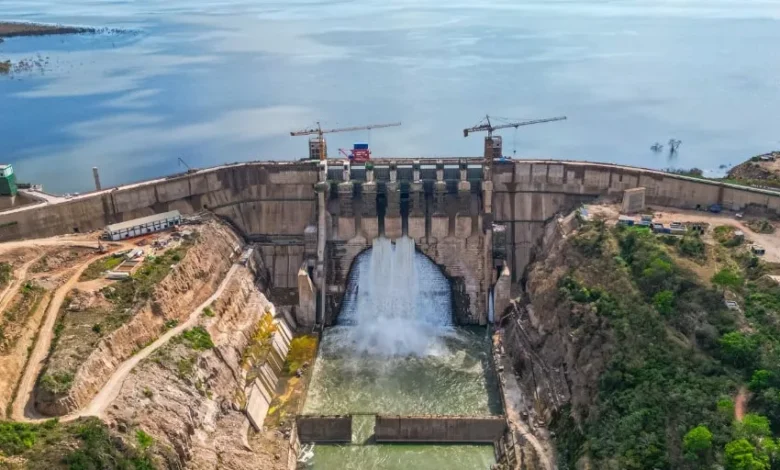
The project includes the construction of a main concrete dam on the Rufiji River, approximately 1,025 meters long at the crest and about 131 meters high.
Project data also indicate that the main concrete dam has a total crest length of approximately 1,036 meters and includes seven water outlets.
The center of the main dam features a spillway equipped with seven radial gates, in addition to an emergency spillway located on Auxiliary Dam No. 1.
7. Auxiliary Dams and Formation of the Reservoir
The project is not limited to the main dam; it also includes the construction of four auxiliary dams to form the reservoir and store water.
These dams comprise a concrete dam approximately 1,700 meters long, in addition to three rockfill dams with a combined length of approximately 16.5 kilometers.
The total storage capacity of the reservoir is approximately 34 billion cubic meters.
8. Temporary Dams and Diversion of the Rufiji River
The project included the construction of two temporary cofferdams upstream and downstream of the main dam, enabling dewatering and river diversion during the construction of the main dam.
The works also included the construction of a tunnel for diverting the Rufiji River, together with the temporary rockfill dams required to carry out the project.
Project data indicate the construction of a 660-meter-long river diversion tunnel, while other project specifications list a 703-meter-long tunnel for river diversion.
9. Hydropower Generation Plant
The Julius Nyerere project includes the construction of an integrated hydropower plant with a total capacity of 2,115 megawatts, comprising civil and electromechanical works, turbines, generators, transformers, and various auxiliary systems.
The plant is equipped with nine vertical Francis turbines, each with a capacity of 235 megawatts.
It also includes nine vertical-axis generators and nine butterfly inlet valves.
10. Operation, Protection and Safety Systems at the Power Plant
The electromechanical works of the power plant include a range of systems and equipment required for plant operation and safety, including:
- Water cooling and drainage systems.
- Ventilation and air-conditioning systems.
- Fire protection systems.
- Communication systems.
- Protection, monitoring, and surveillance equipment.
- Three power generators serving the generating station and the spillway gates of the main dam.
- Other complementary systems and equipment.
11. Road Network Serving the Project
The civil works included the construction of permanent roads connecting the Julius Nyerere Dam site to the existing road network, with a total length of approximately 21 kilometers.
The works also included temporary internal service roads connecting all permanent facilities at the site, with a total length of approximately 59 kilometers.
These roads constitute an essential part of the infrastructure required for the construction and operation of the project and for connecting its various components.
12. Tunnels and Hydraulic Structures
The Julius Nyerere Dam project involved the construction of a number of tunnels and hydraulic structures required for water diversion and the operation of the power plant.
The works included a river diversion tunnel, as well as three tunnels with a combined length of approximately 1,550 meters to convey the water required for the power plant.
The works also included a spillway in the center of the main dam consisting of seven radial gates, in addition to an emergency spillway on Auxiliary Dam No. 1.
13. Bridges, Residential Complex and Supporting Facilities
The project included the construction of a permanent concrete bridge over the Rufiji River, in addition to a temporary bridge, as well as an integrated residential complex covering approximately 19,000 square meters.
The residential complex includes accommodation facilities, sports fields, and permanent offices equipped with furniture, in addition to temporary residential and office facilities.
The works also included various utilities, lighting systems, drinking-water facilities, water-treatment facilities, and other services required to support workers and project facilities.
14. Scale of Works and Materials Used in Construction
The Julius Nyerere Dam and Power Plant project involved a massive volume of construction work. The total volume of excavation reached approximately 4 million cubic meters.
The total volume of rockfill reached approximately 7.5 million cubic meters, while the total volume of concrete used amounted to approximately 3 million cubic meters of high-performance concrete.
The total weight of reinforcing steel reached approximately 64,000 tons.
These figures demonstrate the enormous scale of the construction and engineering works required to complete the project.
15. The Egyptian Consortium and Project Implementation Period
The Arab Contractors and Elsewedy Electric consortium is responsible for implementing the Julius Nyerere Hydropower Dam and Power Plant project, while the project owners are the Tanzanian Ministry of Energy and Tanzania Electric Supply Company Limited (TANESCO).
The project’s implementation period was 42 months, including six months for site preparation and mobilization.
The project also provided significant employment opportunities, with approximately 1,961 workers employed, most of whom were Tanzanian nationals, in addition to the deployment of approximately 525 pieces of equipment during the various stages of construction.
Main Objectives of the Julius Nyerere Dam Project
The Julius Nyerere Dam and Hydropower Plant project aims to achieve several key objectives, foremost among them:
- Generating 2,115 megawatts of electricity to meet Tanzania’s electricity needs.
- Regulating water flows throughout the year, including during periods of flooding.
- Providing the necessary water resources for agriculture and fishing.
- Storing approximately 34 billion cubic meters of water in the reservoir.
- Helping control floods and protect the surrounding environment and areas from flash-flood risks.
- Supporting the preservation of wildlife in the areas surrounding the project.
- Strengthening Tanzania’s national electricity grid through the electrical interconnection substation and 400-kilovolt transmission lines.
Components of the Julius Nyerere Dam and Hydropower Project
The project primarily consists of a main concrete dam designed to store water for hydropower generation; four additional dams for forming the reservoir; a 2,115-megawatt hydropower plant; a 400-kilovolt electrical interconnection substation; and electricity transmission lines connecting the project to the nearest point on the national grid.
The civil works also include the main concrete dam constructed on the Rufiji River; the power plant and its administration, control and monitoring buildings, workshops, and warehouses; a 400-kilovolt electrical interconnection station and transmission lines; four auxiliary dams of varying dimensions for collecting and storing water; a river diversion tunnel and temporary rockfill dams; the main dam spillway and emergency spillway; a permanent concrete bridge; and an integrated residential complex.
Julius Nyerere Project: A Model of Egyptian Companies’ Capabilities in Africa
The Julius Nyerere Hydropower Dam and Power Plant project in Tanzania demonstrates the capabilities of Egyptian national companies to execute major projects in international markets, particularly across Africa.
The implementation of the project by the Egyptian consortium of The Arab Contractors and Elsewedy Electric reflects Egypt’s extensive expertise in construction, infrastructure, energy, and hydropower projects, as well as its participation in strategic projects that contribute to development, increase electricity generation capacity, and improve water-resource management in African countries.
The Julius Nyerere Dam project represents one of the most prominent Egyptian projects in Africa in terms of its scale, cost, electricity-generation capacity, and the volume of engineering works involved. These works include massive dams, a hydropower plant, tunnels, roads, bridges, electricity transmission lines, residential facilities, and integrated utility infrastructure.
read more