Why Egypt Is Intensifying Its Horn of Africa Diplomacy: Safeguarding Red Sea Security and Supporting Somalia?

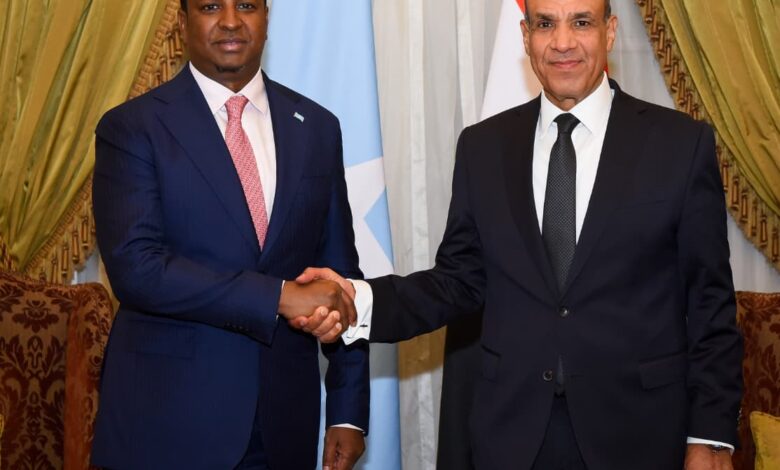
Cairo witnessed a series of high-level diplomatic meetings on Sunday as Egyptian Minister of Foreign Affairs, International Cooperation and Egyptian Expatriate Affairs, Dr. Badr Abdelatty, held talks with Osman Saleh, Eritrea’s Minister of Foreign Affairs, Abdisalam Abdi Ali, Somalia’s Minister of Foreign Affairs and International Cooperation, and Massad Boulos, Senior Advisor to the U.S. President for Arab and African Affairs, The meetings come as part of Egypt’s ongoing diplomatic efforts to promote peace, security, and stability across the Horn of Africa, while strengthening coordination with regional and international partners on key strategic issues, including Red Sea security and developments in Somalia and Sudan.
Horn of Africa occupies a central place in Egypt’s foreign policy
Speaking exclusively to AfroNews, Dr. Ramadan Korany, an expert on African affairs, said that the Horn of Africa has become one of the highest priorities on Egypt’s foreign policy agenda in recent years, driven by a range of strategic and geopolitical considerations.
He explained that the region represents a natural extension of Egypt’s national security due to its direct connection to international maritime routes and the southern gateway to the Suez Canal. It is also home to several neighboring countries with which Egypt has developed strategic partnerships.
According to Korany, Egypt has elevated its relations with Eritrea and Somalia to the level of strategic partnerships while significantly expanding political, economic, and security cooperation with Djibouti, one of the region’s most influential states.
Asmara Summit laid the foundation for a new regional security framework
Korany described the 2024 Asmara Summit as a defining moment in Egypt’s engagement with the Horn of Africa. The summit brought together Egyptian President Abdel Fattah El-Sisi, Eritrean President Isaias Afwerki, and Somali President Hassan Sheikh Mohamud.
He said the summit established the foundations for a new regional security architecture based on several key principles, including:
- Respect for international law.
- Respect for state sovereignty.
- Preservation of the nation-state.
- Political, security, and military support for Somalia to safeguard its unity and territorial integrity.
Korany emphasized that the summit, driven by Egyptian, Eritrean, and Somali cooperation, marked the beginning of a regional framework capable of addressing the political and security challenges facing the Horn of Africa.
Economic cooperation remains a cornerstone of Egypt’s regional approach
The African affairs expert noted that economic engagement represents another major pillar of Egypt’s strategy in the Horn of Africa.
He explained that Cairo has expanded economic cooperation with Somalia, Djibouti, and Eritrea through numerous agreements and joint development projects.
Official visits exchanged between the leaders of these countries—including President El-Sisi’s landmark visit to Djibouti—resulted in several important agreements covering:
- Port development.
- Logistics and free-zone projects.
- Direct air links.
- Expansion of Egyptian banks into regional markets.
- Trade and investment cooperation.
Korany stressed that these initiatives reflect Egypt’s long-term vision of building sustainable economic partnerships that promote regional development and stability.
Egypt’s participation in AUSSOM reinforces Somalia’s stability
Korany highlighted Egypt’s participation in the African Union Support and Stabilization Mission in Somalia (AUSSOM) as one of Cairo’s most significant security initiatives in the Horn of Africa.
He said Egypt’s contribution demonstrates its commitment to strengthening Somalia’s national institutions and supporting security and stability, which are essential to the stability of the wider region.
Egypt supports capacity building across the Horn of Africa
Korany also underscored Egypt’s development-focused diplomacy, noting that the Egyptian Agency of Partnership for Development (EAPD) implements cooperation programs covering nearly fourteen development sectors across the region.
These initiatives aim to strengthen national capacities, promote economic and social development, and enhance political and security stability.
He added that development assistance has become one of the principal instruments of Egypt’s foreign policy toward Africa.
Cairo moves to counter recognition of Somaliland
The expert also addressed Egypt’s diplomatic response to developments concerning the self-declared region of Somaliland.
Following Israel’s recognition of Somaliland and the subsequent exchange of diplomatic missions between the two sides, Egypt launched intensive diplomatic consultations with Somalia, Eritrea, Djibouti, Türkiye, the African Union, and the League of Arab States.
According to Korany, Cairo’s primary objective has been to contain the consequences of that recognition while reinforcing the principle of preserving African states’ territorial integrity.
He warned that recognizing separatist entities could encourage similar movements elsewhere on the continent, making Somalia’s unity and sovereignty a key priority for Egyptian diplomacy.
Red Sea security remains a strategic priority
Korany stressed that Red Sea security and governance have become central priorities in Egypt’s regional diplomacy.
He pointed to recent geopolitical developments, including growing Israeli influence and attempts by non-littoral states to establish a strategic foothold in the region.
Particular concern, he noted, followed the military agreement between Somaliland and Ethiopia, which granted Addis Ababa military access to the Red Sea coast.
In response, Egypt has intensified diplomatic engagement to reinforce a fundamental principle: the security and governance of the Red Sea are the exclusive responsibility of its littoral states.
He added that Egypt’s coordination extends beyond Somalia, Eritrea, and Djibouti to include Arab Red Sea partners, particularly Saudi Arabia, Yemen, and Jordan.
Korany described these efforts as vital to safeguarding both Arab and African national security amid mounting regional challenges.
Sudan remains a key element of Egypt’s Horn of Africa strategy
Concluding his remarks, Korany said that a significant part of Egypt’s policy toward the Horn of Africa and the Red Sea is closely linked to developments in Sudan.
He noted that Sudan’s geographic proximity to the region, combined with more than three years of conflict and a worsening humanitarian crisis, has made the country a central focus of Egyptian diplomacy.
He explained that Cairo continues to coordinate closely with international partners, particularly the United States, as part of the Quadrilateral Mechanism, which includes Egypt, the United States, Saudi Arabia, and the United Arab Emirates, to preserve Sudan’s unity and sovereignty while rejecting any attempts to establish parallel governing entities.
Korany concluded by saying: “This issue is of paramount importance if we are to preserve Sudan’s unity and prevent partition plans pursued by the Rapid Support Forces (RSF), which continue to benefit from logistical support, military assistance, and supplies received from some of Sudan’s neighboring countries.”
He emphasized that preserving Sudan’s unity and sovereignty remains a strategic pillar of Egypt’s policy toward the Horn of Africa, given its direct implications for Red Sea security, regional stability, and the national security of Egypt, the Arab world, and Africa as a whole.
read more
When Facts Are Reversed .. A Critical Reading of a Report on Egypt’s Role in the Horn of Africa