Ambassador Dr. Mohamed Hegazy Writes: “Navi Pillay” and the Nobel Peace Prize: A Victory for International Law and a Renewal of Justice for the Palestinian Cause

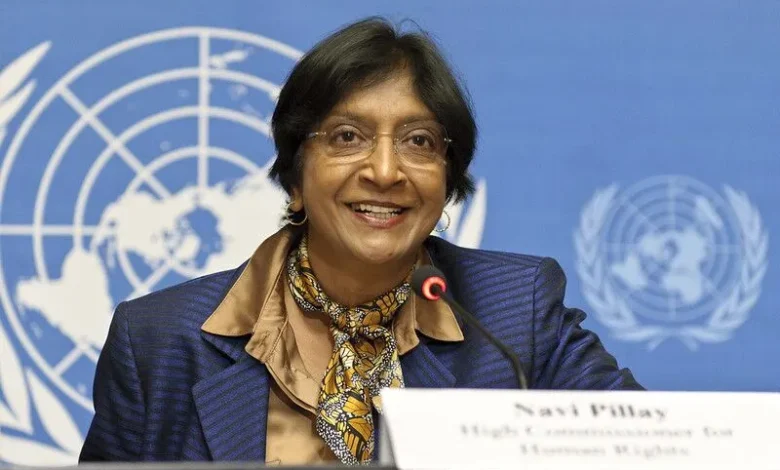
The selection of South African jurist Navi Pillay, former United Nations High Commissioner for Human Rights, as the recipient of the 2026 Nobel Peace Prize represents an occasion that goes beyond celebrating a prominent legal and human rights figure, It opens a broader window onto the relationship between justice and peace, international law and the rights of peoples living under occupation, foremost among them the Palestinian people, who are enduring one of the most difficult periods in their modern history amid the war in Gaza and its humanitarian, political and legal repercussions, These developments pose profound challenges to the credibility of the international system and its ability to protect civilians and hold those responsible for grave violations accountable.
Celebrating Navi Pillay is, in one respect, a celebration of the principle that justice is not a privilege bestowed by the balance of power, and that international law does not lose its legitimacy when it concerns a powerful state or an ally enjoying political protection, Rather, its true importance lies in its ability to protect the vulnerable and ensure that civilians do not become victims of military and political power calculations.
The significance of the award emerges at a moment when questions are mounting internationally about the future of international humanitarian law, the limits of international responsibility for grave crimes, and the ability of multilateral institutions to fulfil their roles independently of double standards.
Throughout her judicial and human rights career, Navi Pillay has been associated with the pursuit of international justice and accountability for those responsible for serious crimes, Her career has included service at the International Criminal Tribunal for Rwanda, her appointment as United Nations High Commissioner for Human Rights, and her subsequent chairmanship of the Independent International Commission of Inquiry concerning the Occupied Palestinian Territory, including East Jerusalem, and Israel.
This record has earned her a prominent place in international debates on the relationship between human rights, criminal accountability and sustainable peace. That relationship assumes exceptional importance in the Palestinian context, where the demand to protect civilians and end humanitarian suffering has become inseparable from calls to hold those responsible for violations accountable and ensure that such violations are not repeated.
In this context, fairness requires distinguishing between the different institutional roles involved. Pillay was not responsible for issuing the arrest warrant for Israeli Prime Minister Benjamin Netanyahu, which was issued by the International Criminal Court’s Pre-Trial Chamber in November 2024.
Nor was she a member of the judicial panel hearing the case brought by South Africa against Israel before the International Court of Justice. Nevertheless, her chairmanship of the UN Commission of Inquiry on the Occupied Palestinian Territory placed her at the centre of international efforts to document violations and assess them under international law. These efforts included the Commission’s September 2025 conclusion that Israel had committed genocide in the Gaza Strip. This was a finding by a UN commission of inquiry, not a final judicial judgment, and Israel rejected it.
The significance of her selection for the Nobel Peace Prize therefore does not lie in the award having delivered a judicial verdict on the war in Gaza. Rather, it lies in the recognition of a figure whose work has been associated with international investigations into violations, and in the emphasis it places on the independence of human rights and judicial institutions in the face of political pressure.
The honour can be interpreted as recognition of the value of the legal path to resolving conflicts and of the principle that peace cannot be secured merely through a ceasefire or temporary political arrangements. It requires addressing the underlying causes of conflict, upholding rights, ensuring accountability and removing the conditions that allow violations to recur.
South Africa’s case before the International Court of Justice, filed in December 2023 under the Convention on the Prevention and Punishment of the Crime of Genocide, marked an important milestone in bringing the legal dimensions of the Gaza war before the international community, The Court issued provisional measures in January 2024, followed by additional measures at later stages, to protect the rights at issue and address the risks presented to it.
These measures did not constitute a final judgment establishing that genocide had occurred, They did, however, affirm that the allegations concerning violations of the Convention warranted judicial consideration and that the protection of rights covered by the Convention could not simply be dismissed as a political matter.
These proceedings have added an important dimension to the Palestinian cause by moving part of the confrontation from the arena of political rhetoric to the arena of international law, where facts, evidence and legal obligations are presented before an international judicial institution.
They have also helped increase international attention to states’ responsibilities to respect conventions protecting civilians and preventing genocide, while highlighting the importance of monitoring compliance with judicial measures rather than being satisfied with their mere issuance.
No less important is the question of individual criminal responsibility before the International Criminal Court. A fundamental principle is at stake: political and military office does not confer absolute immunity from accountability for crimes falling within the Court’s jurisdiction.
The arrest warrant issued for Netanyahu concerns allegations of war crimes and crimes against humanity; it does not constitute a final conviction. Nevertheless, it places legal accountability at the forefront of international debate over the war in Gaza and underscores the importance of judicial institutions operating independently of political considerations.
The Palestinian gains, therefore, do not consist of a single judicial proceeding or an international award in isolation. They lie in the cumulative effect of interconnected processes, including the documentation of violations, strengthening the Palestinian cause before international courts, expanding debate over the responsibility of states and individuals, and keeping the rights of the Palestinian people at the forefront of international attention. This cumulative process has helped reinforce the reality that the Palestinian cause is not merely a territorial dispute or a temporary humanitarian emergency , It is an issue involving the right to self-determination, the end of occupation, respect for international law and the prevention of impunity for those responsible for grave crimes.
This development also warrants recognition of South Africa’s role in initiating proceedings before the International Court of Justice on allegations of genocide, invoking obligations under an international convention to which the relevant states are parties. Its action opened an important international judicial process and demonstrated that defending legal norms is not the exclusive responsibility of states directly affected by conflicts. It can also be undertaken by states that regard the protection of international conventions as a collective responsibility.
This does not mean that the Nobel Committee has legally endorsed all of South Africa’s arguments. Rather, Pillay’s recognition draws attention to the value of legal and human rights work that places human protection and accountability at the heart of international concern.
The Palestinian significance of the award extends beyond Gaza to the future of the political settlement as a whole. The international community cannot limit itself to addressing the humanitarian consequences of war while the political and legal causes of the conflict remain unresolved, Nor can reconstruction become a substitute for a political solution, or humanitarian assistance serve as an alternative to ending the occupation and securing Palestinian national rights.
The task is to combine an end to the war and the protection of civilians with unhindered humanitarian access, a serious programme for reconstruction and early recovery, and a clear political horizon leading to the end of the occupation and the establishment of an independent Palestinian state on the borders of 4 June 1967, with East Jerusalem as its capital.
From this perspective, Arab diplomacy, particularly Egyptian diplomacy, should use the international momentum generated by these developments to advance three parallel tracks. The first is to support respect for international judicial measures and proceedings and to monitor their implementation.
The second is to intensify efforts to protect civilians, reject forced displacement, ensure the flow of humanitarian assistance and rebuild Gaza. The third is to restore to the forefront of international efforts a political solution based on ending the occupation and realising the establishment of an independent Palestinian state. Accountability, humanitarian action and political settlement are not competing tracks; they are complementary elements in building a sustainable peace.
The award also offers an opportunity to renew the debate on reforming the international system and strengthening its credibility. Confidence in multilateral institutions cannot be sustained if their rules appear applicable in some cases and subject to obstruction in others.
The Palestinian cause remains a genuine test of the international community’s ability to translate the principles proclaimed in its charters and conventions into practical commitments, free from double standards and the subordination of justice to political alliances. The wider the gap between law and its implementation, the more confidence in international institutions declines. The closer implementation comes to equality and consistency, the greater the prospects for restoring that confidence and building a more stable peace.
Navi Pillay’s recognition reminds us that justice is not the opposite of peace but one of its essential conditions. Tolerating grave violations without accountability does not produce genuine stability; it merely postpones the causes of conflict and leaves the door open for tragedy to recur. The award also sends a message that legal and human rights work, despite the pressures it may face, can influence international public opinion and keep issues affecting the lives and dignity of peoples on the global agenda.
For the Palestinian cause, the true value of this recognition will not be measured by its symbolic significance alone, but by the extent to which it contributes to strengthening the independence of international institutions, respecting judicial decisions and measures, reinforcing accountability, and broadening recognition of the rights of the Palestinian people.
The award does not end the war, settle judicial proceedings or impose a political settlement by itself. It does, however, provide additional moral momentum to efforts aimed at making the law a reference point for international relations rather than a set of principles that recede in the face of power.
The strategic message of this recognition is that peace without justice remains fragile, while justice that is not translated into implementation loses part of its ability to protect humanity. Between these two challenges stands the Palestinian cause as a test of the credibility of the entire international system.
The true measure of the international community’s success will not be the number of awards it bestows upon defenders of the law, but its ability to ensure that the law applies to everyone, end the occupation, protect the Palestinian people, and transform their right to freedom, self-determination and an independent state into a tangible reality.
- Ambassador Dr. Mohamed Hegazy, Former Assistant Minister of Foreign Affairs .
read more