Ambassador Dr. Mohamed Hegazy writes: Mali… A Model for the New Egyptian-African Partnership

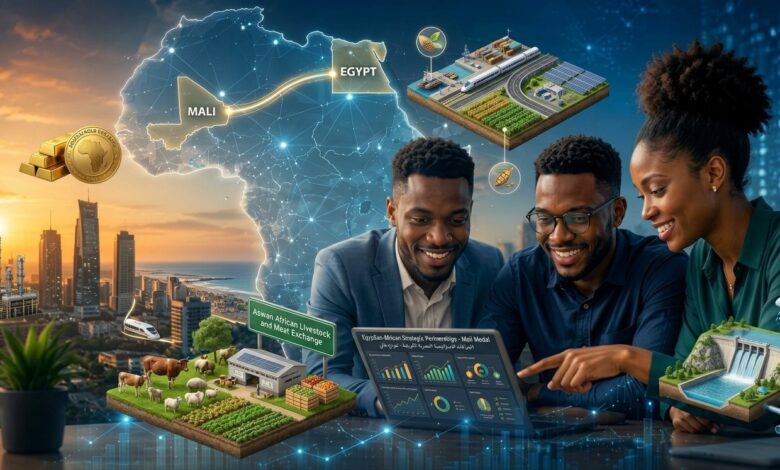
If the El Alamein Africa Forum aspires to become a permanent platform for development and investment across the African continent, its success will not be measured merely by the launch of broad initiatives, but by its ability to present practical models of partnership between Egypt and African countries, based on shared interests, achieving mutual development, and moving relations from the political sphere into the realms of economics, production, and investment.
From this perspective, the Republic of Mali represents an ideal model for this type of partnership. It is a country with enormous economic potential, diverse natural resources, and a strategic position in the Sahel and West Africa. At the same time, however, it needs development partnerships capable of transforming these resources into genuine economic value.
The proposed Egyptian vision is built around five integrated pillars.
The first is gold. Mali is one of Africa’s major gold-producing countries, yet most of its exports remain in the form of raw materials, without sufficient value addition. Egyptian companies, in cooperation with the Malian private sector, could enter into partnerships for mining exploration, establish refining and processing plants, and develop gold-related industries. This would generate greater returns for the Malian economy, secure the needs of Egyptian industry, and potentially pave the way for the establishment of an African Gold Exchange, one of the continent’s economic institutions that could be launched from Egypt.
The second pillar is livestock. Mali possesses millions of cattle, representing one of its most important economic resources. This wealth could be linked to the proposed Aswan African Meat and Livestock Exchange, making Mali one of the key suppliers of livestock, while Egypt undertakes veterinary quarantine, processing, packaging, and re-exporting, At the same time, integrated industries could be established for leather, dairy products, animal feed, and organic fertilizers, thereby multiplying the economic value of African products.
The third pillar is agriculture and food security, Mali possesses vast areas of agricultural land, while Egypt has accumulated extensive expertise in water management, modern irrigation, seed production, agricultural processing, and food-value chains. This expertise could be transformed into joint projects that strengthen food security, create employment opportunities, and increase agricultural exports both within Africa and beyond the continent.
The fourth pillar is infrastructure. Egyptian companies have extensive experience gained through the implementation of thousands of kilometers of roads, the construction of new cities, power stations, airports, ports, and telecommunications networks. This expertise could contribute to implementing development projects in Mali, strengthening economic connectivity and creating the infrastructure necessary to attract investment.
The fifth pillar concerns water and dams. Egypt can offer its expertise in designing and constructing small and medium-sized dams, rainwater harvesting projects, drinking-water treatment plants, and irrigation networks. Such cooperation could contribute to the development of agricultural areas, mitigate the effects of climate change, and promote the optimal use of water resources.
Yet the importance of this initiative lies not only in its substance, but also in the philosophy underpinning it. It offers a new model for Egyptian-African relations based on integration rather than competition, investment rather than aid, and the transfer of expertise and capacity-building rather than the implementation of isolated projects.
It also demonstrates that every African country possesses its own comparative advantages, and that successful cooperation with the continent requires country-specific programs that take into account individual needs and capabilities, rather than relying solely on broad policies that do not respond to Africa’s diverse realities.
Accordingly, I propose that the El Alamein Africa Forum launch an “Egyptian-African Strategic Partnerships Program.” At each edition of the Forum, three or four African countries could be selected and comprehensive cooperation packages developed for each of them, covering financing, investment, training, technology transfer, and periodic follow-up, so that the Forum’s outcomes become tangible projects whose results can be measured on the ground.
Mali is only the beginning. The same model could be applied with Angola in agriculture and energy, Zambia in copper, the Democratic Republic of the Congo in strategic minerals, Kenya in the digital economy, Senegal in the blue economy, and Nigeria in gas and heavy industries. In this way, the El Alamein Africa Forum could become a factory for economic partnerships, rather than merely a platform for dialogue.
The future of Egyptian-African relations will not be shaped by political rhetoric alone. It will be built through shared economic interests, reciprocal investments, and projects that deliver tangible development for African peoples. If Egypt succeeds in transforming this concept into practical reality, the El Alamein Forum can indeed become the “Davos of Africa”—not simply because it brings leaders together every year, but because each edition launches projects capable of transforming the face of development across the continent.
In the next article in the “Towards El Alamein” series, we will present an initiative to establish an “African Center for the Control of Endemic and Infectious Diseases,” drawing on Egypt’s pioneering experience in eliminating hepatitis C and building a stronger African health system capable of confronting the challenges of the future.
read more