The Cairo Declaration, born at the foot of the Pyramids, continues to influence international debates over Taiwan, Korea, and the Asian regional order
By Ambassador Dr. Mohamed Higazy
In November 1943, as the Second World War approached a decisive turning point, Cairo was far more than the capital of a Middle Eastern country, It had become one of the world’s principal centers of strategic decision-making .
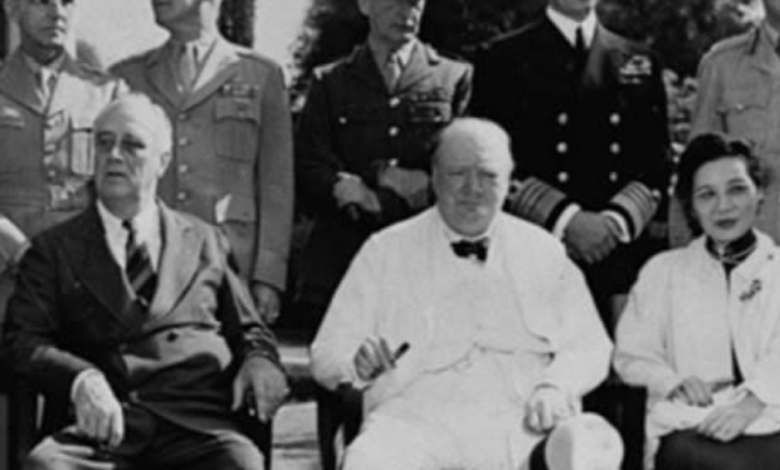
At the Mena House Hotel, overlooking the Pyramids of Giza, three of the Allied leaders—U.S. President Franklin D. Roosevelt, British Prime Minister Winston Churchill, and Chinese President Chiang Kai-shek—met to discuss the future of the war in Asia and to outline the regional order that would emerge following Japan’s defeat.
From this historic gathering came the Cairo Declaration, a document that transcended the immediate circumstances of war to become one of the most enduring political references in international affairs.
Cairo’s selection as the venue for this summit was far from ceremonial. It reflected Egypt’s strategic position as the headquarters of Allied operations in the Middle East and North Africa, particularly after the decisive Battle of El Alamein demonstrated the central importance of the Egyptian theater in shifting the balance of the war.
Cairo also offered political stability and security capable of hosting a summit of such significance, while its geographical position as a bridge between East and West gave the conference a political dimension that extended well beyond immediate military considerations.
The Mena House Hotel, built in the nineteenth century at the foot of the Pyramids, became far more than a meeting venue.
It evolved into a witness to one of the defining moments of modern diplomatic history, where the world’s leading powers gathered to shape Asia’s future in a setting that combined the grandeur of one of humanity’s oldest civilizations with decisions destined to influence millions of lives for decades to come.
The Cairo Conference convened at a moment when Allied forces had begun regaining the strategic initiative, while the Japanese Empire was gradually retreating under mounting military pressure across the Pacific.
Allied leaders recognized that military victory alone would not guarantee lasting peace. It was equally essential to agree on the political principles that would govern East Asia after the war and prevent the resurgence of the expansionist policies that had led to global conflict.
The Cairo Declaration therefore affirmed that the Allied objective was neither territorial conquest nor imperial expansion, but the dismantling of Japanese militarism and the restoration of territories seized by Japan to their rightful owners.
It declared that Manchuria, Formosa—today’s Taiwan—and the Pescadores Islands would be restored to the Republic of China. It also pledged that Korea “shall become free and independent in due course,” a carefully crafted phrase that would later become the subject of considerable historical and legal debate.
Although the Cairo Declaration was not an international treaty in the strict legal sense but rather a joint political declaration, its significance was greatly reinforced when its principles were reaffirmed in the Potsdam Declaration of 1945, which established the conditions for Japan’s surrender.
Consequently, the Cairo Declaration became an essential political reference for the post-war settlement in Asia, despite continuing scholarly debate regarding its precise legal status under international law.
Taiwan remains the most prominent contemporary issue directly linked to the Cairo Declaration. The island had been under Japanese rule since 1895, following the Treaty of Shimonoseki. The Cairo Declaration explicitly stated that Formosa would be restored to the Republic of China, a transfer that took place following Japan’s surrender in 1945, when the Chinese government assumed administrative control of the island.
Subsequent developments, however, fundamentally transformed the political landscape. The Chinese Civil War culminated in the establishment of the People’s Republic of China in Beijing in 1949, while the government of the Republic of China relocated to Taiwan. This created one of the most complex and enduring disputes in contemporary international politics.
Beijing continues to invoke the Cairo Declaration as political evidence of international recognition that Taiwan was restored to China, while others argue that the declaration, lacking treaty status, did not conclusively determine the island’s final legal status.
Thus, a declaration drafted in Cairo more than eighty years ago continues to shape strategic competition across the Indo-Pacific.
The Korean question provides another illustration of the Cairo Declaration’s lasting influence. Korea had been under Japanese colonial rule since 1910, prompting the Allied leaders to affirm that it would become “free and independent in due course.
” At the time, there was no intention to partition the peninsula or create two separate Korean states. The objective was simply to end Japanese colonial rule and restore Korean independence.
Yet post-war geopolitical realities took a dramatically different course. Rivalry between the United States and the Soviet Union resulted in the division of Korea along the 38th Parallel, leading to the establishment of the Republic of Korea in the South and the Democratic People’s Republic of Korea in the North.
The outbreak of the Korean War in 1950 transformed the peninsula into the first major military confrontation of the Cold War. Thus, while the Cairo Conference established the political principle of Korean liberation, the subsequent division of the peninsula resulted from the strategic balance of power that emerged after the Second World War.
The experiences of Taiwan and Korea demonstrate a fundamental characteristic of international order: agreement on broad political principles does not necessarily guarantee consensus on implementation. Diplomacy often succeeds by adopting carefully balanced formulations that preserve great-power unity at a particular historical moment.
Over time, however, those same formulations may become sources of competing interpretations, political disputes, and legal controversies as geopolitical realities evolve.
The enduring significance of the Cairo Declaration therefore lies not only in its specific provisions but also in its embodiment of the transition from an international system dominated by imperial competition to one seeking a new post-war political order.
It also reinforced the principle that territory should not be acquired through aggression, a norm that would later become one of the cornerstones of the Charter of the United Nations.
The Mena House Hotel remains a living witness to that extraordinary historical moment. At the foot of the Pyramids—the timeless symbol of Egyptian civilization—the leaders of the world’s major Allied powers gathered to shape the future of an entire continent.
The conference reflected Cairo’s remarkable place in twentieth-century diplomacy and underscored Egypt’s role not merely as a host nation but as an integral part of the strategic environment from which the post-war international order emerged.
More than eight decades later, the Cairo Conference and its declaration remain embedded in the collective political memory of the international community. They remind us that Cairo was one of the cities where the foundations of the modern international order were laid.
At a time when strategic competition in Asia is intensifying, tensions over Taiwan continue to rise, and the Korean Peninsula remains divided, revisiting the Cairo Conference of 1943 is more than an exercise in historical reflection.
It is essential to understanding the origins of many of today’s geopolitical challenges. History does not end when wars conclude; it lives on in the documents that define international order and in the places where those documents were born. Cairo—and Mena House in particular—stands among the most enduring of those historic landmarks.
* Ambassador Dr. Mohamed Higazy .. Former Assistant Foreign Minister of Egypt , Member of the Egyptian Council for Foreign Affairs
read more