Egypt and Sudan: A Strategic Partnership to Protect Water Security and Reshape the Rules of Cooperation in the Nile Basin

By Ambassador Dr. Mohamed Hegazy
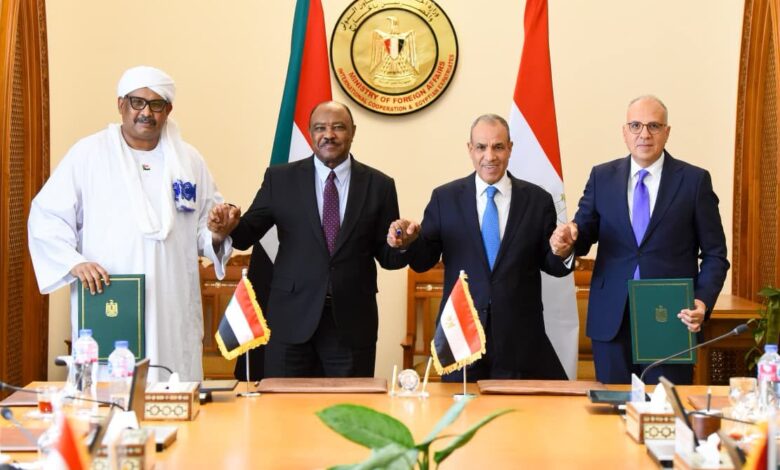
The convening of the third round of the Egyptian-Sudanese 2+2 Consultation Mechanism, bringing together the Ministers of Foreign Affairs and Water Resources of both countries in Cairo on November 2, 2026, represents an important milestone in the strategic relationship between the two nations, It marks a development that goes beyond traditional bilateral coordination towards articulating a common vision for addressing the challenges facing the security of the Nile Valley, foremost among them water security, the consequences of Ethiopia’s unilateral management of the Grand Ethiopian Renaissance Dam (GERD), the close interconnection between Sudan’s stability and Egypt’s national security, and the rapidly evolving geopolitical dynamics in the Red Sea and the Horn of Africa.
The significance of this round lies in the political and technical representation brought together by the mechanism, with the participation of the Foreign Ministers and Water Resources Ministers of both countries. This enables water issues to be addressed as political, strategic and legal matters, rather than merely technical questions concerning the operation of a water facility or the regulation of water filling and releases.
It also reflects a shared political determination to move from coordinating positions towards establishing sustainable mechanisms to protect the water-related interests and rights of both countries.
First: The Unity of Egyptian-Sudanese Water Security
The joint affirmation that Egypt’s and Sudan’s water security constitutes one indivisible entity carries profound political and strategic significance. The Nile is not merely a river connecting two geographically neighbouring countries; it is a lifeline and a principal source of stability and development for both nations. Any fundamental change in the rules governing its management or the allocation of its waters inevitably affects their shared interests.
In this context, the renewed commitment of both countries to their water rights and uses under the 1959 Agreement, alongside their support for the role of the Permanent Joint Technical Commission for Nile Waters, represents a reaffirmation of the importance of the institutional and legal framework governing coordination between Cairo and Khartoum. It also underscores the need for a unified vision in addressing water-related issues in regional and international forums.
More importantly, this coordination should not be confined to confronting current challenges. It must extend to developing joint water-resource management projects, modernising irrigation systems, making better use of rainfall, protecting water infrastructure, and exchanging expertise and technology. Such efforts would transform the shared destiny of the two countries into a genuine development partnership that benefits both peoples.
Second: The Grand Ethiopian Renaissance Dam — The Core of the Crisis Is the Absence of Binding Rules
The joint communiqué conveys a clear position on the GERD by reaffirming the complete rejection of unilateral actions in the Eastern Nile Basin. It also points out that the Ethiopian dam, constructed unilaterally, has serious implications and represents an ongoing threat to the downstream countries, given Ethiopia’s continued unilateral management and the absence of a legally binding mechanism governing the dam’s operation.
Here, it is essential to recognise the true nature of the issue. The problem is no longer limited to the construction of the dam or the completion of its facilities. Rather, it concerns who has the authority to make decisions regarding the management of a shared international water resource, what rules should govern the operation of a facility with direct implications for the security of downstream countries, and what guarantees can prevent water from being used as an instrument of political pressure or as a means of imposing a fait accompli.
The unilateral construction and operation of the dam, without a legally binding agreement among the three countries, creates risks that cannot be ignored. These include the management of prolonged droughts, water releases during periods of flooding, ensuring regular water flows, exchanging technical information and data, and addressing potential emergencies and technical failures.
Accordingly, the Egyptian-Sudanese demand for a legally binding mechanism is neither an unreasonable demand nor an attempt to deprive Ethiopia of its right to development or to benefit from its resources. Rather, it is a call for the application of established principles of international law, foremost among them the principle of preventing significant harm, prior notification, consultation and cooperation, and reaching agreement on the rules governing shared water infrastructure with transboundary impacts.
Development cannot be invoked as justification for harming the rights of others, just as the historical rights of downstream countries must not become a pretext for rejecting development in upstream countries. The correct equation is that the right to development must be accompanied by responsibility, cooperation and compliance with international law.
Third: Defining the Appropriate Regional Framework for the Dam Issue
One important element of the joint communiqué is Egypt’s and Sudan’s affirmation that the GERD issue concerns the three countries of the Eastern Nile Basin: Egypt, Sudan and Ethiopia. Both countries have rejected Ethiopia’s attempt to involve other Nile Basin states in this particular issue.
This distinction carries significant political and legal importance. The existence of a broader framework for cooperation among Nile Basin countries does not mean that issues specific to the Eastern Nile should be transformed into multilateral matters in a way that disregards the dam’s direct impact on the downstream countries or allows the circle of disagreement to expand beyond its principal parties.
At the same time, Cairo and Khartoum emphasise through their communiqué that their position is not based on rejecting cooperation with other Nile Basin countries. On the contrary, they welcome development projects in the Southern Nile Basin countries, provided that the necessary studies and standards are fulfilled, and that prior notification, consultation and agreement are ensured in accordance with international law.
This highlights the importance of distinguishing between comprehensive water cooperation that serves the shared interests of all basin countries and attempts to exploit such a framework to circumvent the rights of downstream countries or impose unilateral arrangements upon them.
From this perspective, the two countries’ emphasis on the centrality of the Nile Basin Initiative and the need to restore its inclusiveness and consensus-based character represents an important strategic direction. This is particularly relevant in light of their welcome for the continuation of the consultation process concerning the Cooperative Framework Agreement, in a manner that takes into account the concerns of non-signatory countries and facilitates the establishment of an inclusive commission representing all Nile Basin states.
Egypt needs to expand avenues of cooperation with Nile Basin countries and invest in development, infrastructure, energy and irrigation projects. Such engagement would strengthen mutual interests and demonstrate that Cairo is not opposed to the development of Nile Basin countries, but rather to imposing a fait accompli and exercising unilateral control over a shared water resource.
Fourth: Sudan — The Strategic Depth of Egyptian National Security
The joint communiqué cannot be understood in isolation from the delicate circumstances facing Sudan, or from the direct importance of restoring its stability, preserving the unity of its national institutions and safeguarding its territorial integrity for Egyptian national security.
Egypt’s affirmation of the direct connection between the national security of the two countries, its rejection of the establishment of parallel entities or any infringement upon Sudan’s unity, and its readiness to take the measures and actions provided for under international law and the Joint Defence Agreement, reflect a strategic understanding of the relationship between the security of both nations.
Support for Sudan is not limited to political positions. It also extends to practical efforts related to reconstruction and restoring the capabilities of state institutions. This is evident in cooperation on maintaining water infrastructure, assessing the damage to the Jebel Aulia Dam, and providing Egyptian technical expertise. It also includes agreements on joint projects to rehabilitate damaged water infrastructure, protect against flooding, harvest rainwater, establish solar-powered drinking-water stations, and train Sudanese personnel.
These steps reflect an integrated understanding of national security that does not separate military and political security from water and development security. A stable Sudan, capable of restoring its institutions, represents a fundamental pillar of stability for Egypt and the wider region. Likewise, Egyptian-Sudanese cooperation in water management constitutes an important guarantee for protecting the interests of both countries.
Fifth: The Red Sea and the Horn of Africa — A New Dimension of Strategic Coordination
Notably, the communiqué does not stop at the Nile water issue. It extends to affirming that governance of the Red Sea is the exclusive responsibility of the littoral states, while rejecting maritime access for any non-littoral state at the expense of the sovereignty, territorial integrity and ports of the countries bordering the Red Sea.
This position carries important strategic implications amid the ongoing transformations in the Horn of Africa and the intensifying international and regional competition over ports, maritime corridors and areas of strategic influence.
The Red Sea is not merely an international shipping route. It is a vital arena for Egyptian, Sudanese and Arab national security, directly connected to the security of the Suez Canal, global trade and the stability of the Horn of Africa.
Consequently, Egyptian-Sudanese coordination on this issue could provide the foundation for broader cooperation with Red Sea littoral states, based on respect for state sovereignty and territorial integrity, preventing the militarisation of the region, and rejecting the transformation of ports and maritime gateways into instruments for imposing influence or altering regional balances.
Sixth: From Political Coordination to an Executive Strategy for the Nile Valley
The true value of the third round of the 2+2 mechanism will ultimately be determined by the ability to translate the positions and understandings contained in the joint communiqué into sustainable practical measures.
In my view, the next phase requires action along three parallel tracks.
The first is the establishment of a permanent Egyptian-Sudanese technical and legal framework tasked with preparing studies, exchanging data and coordinating positions on the management of the GERD, the risks of droughts and floods, safe operating rules and emergency response mechanisms. This should ultimately lead to the formulation of a common legal vision that can be presented in international forums.
The second is the development of water and development cooperation between the two countries through joint projects in modern irrigation, protection of water infrastructure, agricultural development, the utilisation of non-conventional water resources and the rehabilitation of Sudanese infrastructure. This would make water integration an integral part of a broader project for economic integration between Egypt and Sudan.
The third is the restoration of the joint Egyptian-Sudanese role in shaping the future of cooperation within the Nile Basin, working alongside fellow African countries to restore consensus around the Nile Basin Initiative and present a model of cooperation that brings together the rights of upstream and downstream countries, transforming the river into a source of development and stability rather than an arena for competition and conflict.
The central message of the Cairo Declaration is that Egypt and Sudan will not accept the management of the Nile issue according to a fait accompli approach, and that the rights of downstream countries cannot be left hostage to unilateral decisions or arrangements that lack legally binding guarantees.
Cairo also reaffirms that its position is not intended to confront Ethiopia or obstruct its right to development. Rather, it seeks to establish a balanced water relationship that respects international law, guarantees that the interests of others are not harmed, and lays the foundations for genuine and sustainable cooperation among the countries of the basin.
Ultimately, the unity of the Nile Valley is not merely a historical or geographical reality; it is a strategic necessity imposed by the nature of shared interests and the challenges confronting both countries. Therefore, the 2+2 mechanism should evolve into a permanent platform for policy coordination and partnership-building, with Egyptian-Sudanese cooperation serving as a model of integration that protects rights, supports development and preserves regional stability.
The Nile must remain a bridge for cooperation, not an instrument of domination; a source of life and development, not an arena for imposing a fait accompli. Egypt, which remains committed to dialogue and cooperation, cannot relinquish the rights of its people or accept any infringement upon its water security, just as Sudan’s stability, security and unity constitute an integral extension of Egypt’s national security.
read more
Egypt Warns Against Unilateral GERD Operation, Reaffirms Rights Under International Law