Ethiopia and the Red Sea: Between the Right to Commercial Maritime Access and Attempts to Impose Will and Control

By Ambassador Dr. Mohamed Hegazy
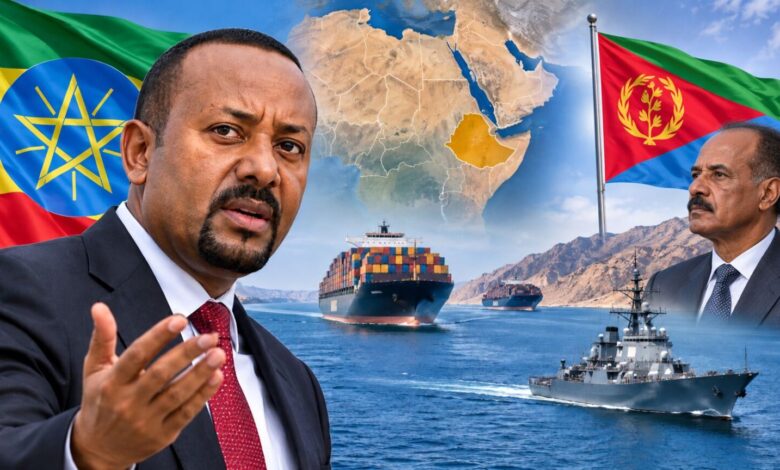
The issue of Ethiopia’s quest for maritime access has once again come to the forefront of regional developments, following Prime Minister Abiy Ahmed’s renewed insistence that Ethiopia must obtain access to the Red Sea.
This comes at a time of growing tensions in the Horn of Africa, where economic, geopolitical and military calculations increasingly intersect, while international competition over ports, maritime routes and strategic areas of influence continues to intensify.
These developments raise fundamental questions about the real objectives behind Ethiopia’s ambitions, the limits of what Addis Ababa can achieve in light of Egyptian objections and the positions of several regional countries, and the potential implications of this issue for the Grand Ethiopian Renaissance Dam (GERD) crisis and the future of regional security.
In my assessment, Ethiopia’s insistence on gaining access to the sea can no longer be regarded merely as the economic demand of a landlocked country. Rather, it has become part of a broader strategic vision through which Addis Ababa seeks to redefine its regional standing, expand its political and military room for manoeuvre, and strengthen its presence in an area that represents one of the world’s most vital corridors for international trade, energy security and global maritime navigation.
Ethiopia, with a population exceeding 130 million, relies heavily on neighbouring countries’ ports, particularly the Port of Djibouti, to facilitate its foreign trade. This explains its desire to diversify its maritime outlets and reduce its dependence on a single route.
However, these legitimate economic considerations must not become a justification for demanding sovereign or military privileges on the territory of another state.
Here, it is essential to make a clear distinction between Ethiopia’s right to access the sea for commercial, transportation and transit purposes, and its pursuit of sovereign ownership of a port, the establishment of a naval base, or an independent military presence on the coastline of another country.
The former is a right that can be regulated under international law and bilateral agreements، The latter, however, does not automatically arise from a country’s landlocked status and can only be realised with the consent of the sovereign coastal state.
The 1982 United Nations Convention on the Law of the Sea, particularly Article 125, affirms the right of landlocked states to access the sea and freedom of transit through the territories of transit states. However, it stipulates that the conditions and means of exercising this right are to be determined through agreements between the concerned states, while transit states retain full sovereignty over their territories.
Accordingly, international law does not grant Ethiopia an automatic right to own a port, establish a military base, or acquire a portion of the territory of a coastal state.
Rather, it provides a framework for negotiating commercial and logistical arrangements that serve Ethiopia’s interests while respecting the sovereignty of others.
It is important, therefore, that this debate should not be transformed into a denial of Ethiopia’s right to seek solutions to its geographical predicament.
Egypt’s interest does not lie in depriving a major African country of development and trade opportunities.
Rather, it lies in preventing the exploitation of this legitimate need to impose a new political, geographical or military reality that threatens stability in the Horn of Africa and undermines the security balance in the Red Sea.
This maritime corridor is not merely a geographical space. It is a strategic lifeline closely connected to Egypt’s security, the Suez Canal, international trade and the security of the countries of the region.
Egypt’s position is grounded in clear legal and strategic considerations. Cairo does not object to arrangements that guarantee Ethiopia access to ports, the development of logistical facilities, or the conclusion of long-term commercial agreements.
However, it rejects any attempt to undermine the sovereignty of Red Sea coastal states or establish a military presence without their consent.
It also rejects transforming the Red Sea into an arena for military competition or a sphere of influence for non-littoral powers, thereby opening the door to security arrangements imposed by the balance of power rather than governed by international law.
This position has acquired a clearer regional dimension following the Quadrilateral Consultative Summit held in New Alamein on 4 October 2026, with the participation of Egypt, Sudan, Eritrea and Somalia.
The summit issued the Alamein Joint Declaration, which reaffirmed respect for state sovereignty and territorial integrity, freedom of navigation, and the principle that the management of the Red Sea is the exclusive responsibility of its littoral states.
It also agreed on a mechanism to follow up on the summit’s outcomes and maintain consultation and coordination among the four countries.
This represents an important step that should not be viewed as an alignment for confrontation, but rather as an attempt to establish a regional framework that safeguards shared interests and prevents unilateral arrangements from being imposed at the expense of coastal states.
The issue becomes even more complicated when viewed in connection with the GERD crisis. The crisis of confidence between Cairo and Addis Ababa is no longer confined to the question of water.
It now reflects a fundamental disagreement over the concept of mutual rights and the principles governing the management of transboundary interests.
Ethiopia proceeded with the construction and operation of the Renaissance Dam without reaching a legally binding agreement with Egypt and Sudan to regulate its filling and operation and provide the necessary guarantees to protect the interests of the downstream countries.
This experience has made Cairo increasingly cautious regarding any new Ethiopian demands that could affect the strategic balance in the region.
The fundamental lesson from the GERD experience is that projects with transboundary implications cannot be based on unilateral decisions or the imposition of faits accomplis.
They must instead be founded on cooperation, prior notification, consultation and agreement, while respecting the principle of not causing significant harm.
Consequently, Egypt cannot approach the maritime access issue in isolation from this experience.
Nevertheless, I believe that the two issues should be managed through parallel negotiating tracks, without conflating Egypt’s and Sudan’s water rights with Ethiopia’s right to commercial access to the sea.
Each issue must be addressed according to its own legal framework, while recognising the strategic interconnection between them.
In this context, recent Ethiopian military developments raise additional questions about the nature of the coming phase. During his visit to Moscow on 28 October 2026 to participate in the Russia-Africa Summit, Prime Minister Abiy Ahmed announced that his country had received advanced Russian Su-35 fighter aircraft and declared Ethiopia’s intention to acquire four batteries of the S-400 air defence system.
He presented these developments as measures aimed at strengthening his country’s deterrence capabilities and protecting its national security.
It is important, however, to approach the available information with precision. The Ethiopian Prime Minister announced the delivery of 12 fighter aircraft, a claim reported by Ethiopian media. Reuters, meanwhile, indicated that details of the delivered batch had not been independently established.
Similarly, the delivery dates and deployment locations of the S-400 systems have not yet been determined. This requires a distinction between Ethiopia’s political announcements and independently confirmed technical information regarding the actual implementation of the arms deals.
There is no doubt that this agreement represents a significant development in the capabilities of the Ethiopian Air Force. However, it does not automatically translate into the ability to impose maritime control or seize access to the sea by force.
Su-35 fighter aircraft enhance air power, whereas the S-400 is an air defence system. Military modernisation should not be confused with possessing the means to control ports and maritime corridors.
Nevertheless, the political and strategic significance lies in the timing of this military modernisation, coinciding with increasingly assertive Ethiopian rhetoric regarding maritime access, tensions with Eritrea, and renewed armed disturbances in northern Ethiopia.
This raises questions about whether the concept of deterrence will remain confined to protecting the state and its institutions, or whether it could become an instrument of pressure in disputes with neighbouring countries.
Russia’s entry into this equation through military cooperation on this scale adds an international dimension to the strategic calculations of the Horn of Africa.
It calls for a broader assessment of Russian-Ethiopian relations. Moscow is not merely seeking to expand its military exports market; it is also seeking to strengthen its political and strategic relations in the Red Sea and the Horn of Africa.
Russia must recognise that regional stability cannot be achieved through an arms race or by encouraging unilateral demands.
It must instead be built on respect for state sovereignty and the achievement of understandings that safeguard common security and interests.
As for the future of Ethiopia’s ambitions, I believe that five possible scenarios deserve consideration.
The first is reaching a long-term commercial understanding with one of the coastal states, allowing Ethiopia to use ports and develop logistical and investment zones without infringing upon national sovereignty. This is the most realistic and least costly option.
The second is reopening negotiations with Eritrea concerning the Port of Assab. This option carries considerable geographical and strategic importance, but remains highly sensitive given the tensions between the two countries.
It can only be achieved through a political understanding that respects Eritrean sovereignty and helps rebuild trust between the two sides.
The third scenario involves possible arrangements with Somalia or the Somaliland region. This is an extremely complicated path in light of the Memorandum of Understanding signed by Ethiopia and Somaliland in January 2024, which provoked Somali objections relating to territorial integrity and national sovereignty.
Accordingly, any future arrangements must take into account the legal and sovereign position of the Federal Government of Somalia and must not become a gateway to entrenching division or creating a new geographical reality without its consent.
The fourth scenario involves continued political pressure or resorting to the imposition of a fait accompli.
This is the most dangerous possibility, as it could push the region towards open confrontation, particularly if Ethiopian demands become linked to a military presence or movements that threaten the sovereignty of Eritrea or Somalia.
The fifth scenario is the continuation of the status quo, with Ethiopia diversifying its commercial outlets and expanding its agreements with Djibouti and other ports. Although this option may not fulfil Prime Minister Abiy Ahmed’s declared political ambitions, it would nevertheless serve a substantial part of Ethiopia’s economic interests without incurring the costs of a military or political adventure.
In my assessment, the most likely scenario in the near term is the continuation of political bargaining and diplomatic pressure, alongside Ethiopia’s efforts to strengthen its military capabilities and negotiate with more than one regional actor.
Meanwhile, the possibility of confrontation will remain dependent on three fundamental variables.
The first is the future of Ethiopian-Eritrean relations and the ability of both countries to avoid military confrontation.
The second is Prime Minister Abiy Ahmed’s ability to contain internal crises and restore stability in northern Ethiopia.
The third is the extent to which Red Sea coastal states succeed in transforming political coordination into an effective regional mechanism capable of protecting sovereignty and shared security.
This brings into focus the importance of Egypt’s role in the coming phase. The required approach is to combine firmness with diplomatic openness, build upon the Alamein Declaration by activating the quadrilateral follow-up mechanism, and develop cooperation in ports, energy, trade connectivity, transportation and infrastructure.
Egypt must also strengthen its relations with the countries of the Horn of Africa, support national state institutions and territorial integrity, and utilise its relations with Russia to emphasise that stability in the Red Sea is a shared interest that should not be compromised by military calculations or arms deals.
What is certain is that Egypt will continue, firmly and resolutely, to uphold its water rights and insist on reaching a legally binding agreement on the Renaissance Dam, without closing the doors to dialogue with Addis Ababa.
Real strength does not lie in escalating rhetoric or engaging in arms races. Rather, it lies in the ability to protect national interests, build alliances, utilise international law, and prevent adversaries from transforming disputes into irreversible realities that may become difficult to change in the future.
The Ethiopian quest for maritime access reveals a much broader test for the future of the regional order in the Horn of Africa and the Red Sea. Will the principles of international law, cooperation and mutual understanding prevail, or will geography become a pretext for imposing one’s will by force?
Egypt does not object to Ethiopia’s right to access the sea. However, it rejects any attempt to turn this right into a pretext for undermining the sovereignty of other states, militarising the Red Sea or imposing a new fait accompli. Egypt does not seek confrontation, but it will not accept having its water interests or national security held hostage to unilateral measures or imposed balances of power.
The principle that must govern the future of the region is clear: the right of access does not mean the right to sovereignty; economic necessity does not justify imposing a fait accompli; and genuine deterrence is not built on threatening neighbours, but on respecting international law, building confidence and promoting mutual cooperation.
* Ambassador Dr. Mohamed Hegazy Former Assistant Minister of Foreign Affairs
read more