Ambassador Dr. Mohamed Hegazy Writes: Washington After the Midterm Elections… Are the Equations of American Power in the Middle East Changing?

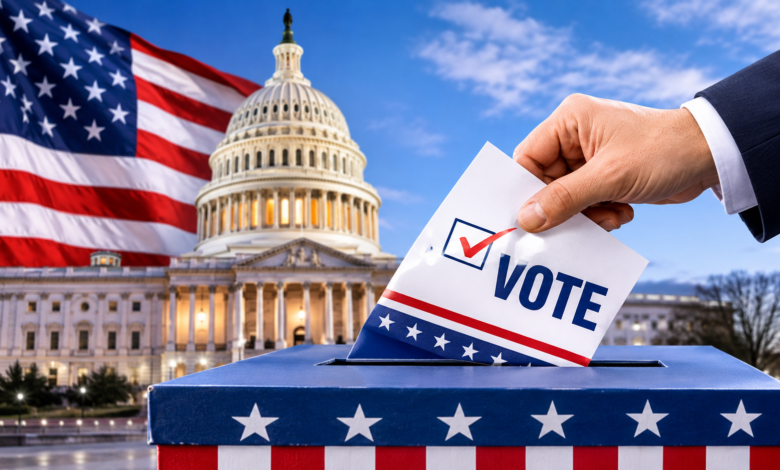
The results of the U.S. midterm elections, which saw the Democratic Party secure majorities in both the House of Representatives and the Senate, open a new chapter in the American political landscape and confront President Donald Trump’s administration with a different set of equations in managing domestic affairs and foreign policy. The transfer of control of Congress from Republicans to Democrats represents more than a shift in the balance of partisan power; it also reflects a protest vote against several domestic and foreign policies pursued by the administration, particularly the economic situation, the rising cost of living, and the repercussions of the war with Iran, as well as growing concerns over the exercise of executive power.
The political and strategic significance of these results lies in the fact that President Trump, who enjoyed Republican majorities in both chambers during the first two years of his second term, will now face a Congress controlled by the Democratic opposition. This opens the door to a new phase of political balancing, legislative oversight, and institutional confrontation. Democrats will have the tools to influence budget allocations, foreign assistance, and arms sales, in addition to exercising their powers of investigation and accountability and reviewing administration decisions. This could impose further constraints on the White House’s room for manoeuvre, without diminishing the president’s extensive constitutional authority over foreign policy.
In the Middle East, these developments acquire particular importance as they coincide with the escalation of the American-Israeli confrontation with Iran and the consequences of the war for energy security, international shipping, and the global economy. The Republicans’ loss of control of Congress will expose the administration to political and legislative scrutiny over the objectives of the war, its costs, its timeframe, and whether a clear strategy exists for bringing it to an end. Demands within Congress may grow for greater oversight and legislative authorisation of continued military operations, potentially narrowing the administration’s room for manoeuvre and increasing pressure to pursue political and diplomatic avenues to contain the escalation.
This does not necessarily mean that the Democratic Party has a unified position on Iran or that it will pursue an unconditional settlement with Tehran. The party contains different currents with divergent positions on Iran’s nuclear programme, Israel’s security, and Iranian influence in the region. What is certain, however, is that the political and economic costs of prolonging the war will become more prominent in America’s domestic debate, particularly given their connection to fuel prices, inflation, and the cost of living—issues that have directly influenced voters’ choices.
U.S.-Israeli relations may be among the issues most affected by this new political landscape. This does not mean abandoning the strategic alliance between Washington and Tel Aviv, which rests on longstanding institutional and security considerations and enjoys bipartisan support. Rather, the impact is likely to be felt in the nature and conditions of American support, its limits, and the degree of political consensus surrounding it. Within the Democratic Party, criticism of the policies of the Israeli government has expanded, particularly regarding the war in Gaza, violations in the West Bank, settlement expansion, and the absence of a political horizon for the Palestinian question. This may translate into closer scrutiny of military assistance and arms deals, alongside growing demands for guarantees to protect civilians and uphold international law. Israel will therefore face an American political environment in which its policies are subject to increasing scrutiny, even as Washington’s commitment to its security continues.
The Palestinian question stands out in this context as one of the issues that could benefit from a broader debate within Congress on the need to end the war in Gaza, reject the displacement of Palestinians, ensure the delivery of humanitarian assistance, support reconstruction, and return to a serious political process leading to the establishment of an independent Palestinian state on the borders of 4 June 1967, with East Jerusalem as its capital. These developments, however, do not automatically mean a change in the official American position or the adoption of decisive pressure on Israel. Rather, they create greater opportunities for Arab and Palestinian diplomacy to build political and legislative alliances that support Palestinian rights and advance the two-state solution.
For Egypt, these developments underscore the need to treat this moment as an opportunity to broaden and strengthen the network of Egyptian-American relations. Engagement should not be confined to the executive administration and the White House; it should also extend to the new Democratic leadership in both chambers of Congress, the foreign affairs, defence, and appropriations committees, and other influential centres of American policymaking. Egyptian-American relations are not tied to any particular political party or administration. They are based on strategic interests that include the peace treaty, regional security, counterterrorism, Middle Eastern stability, and the security of the Red Sea and the Suez Canal.
Egypt’s role in mediation efforts concerning Gaza, its rejection of the forced displacement of Palestinians, its support for reconstruction, and its commitment to preserving the territorial unity of the Palestinian territories provide an important foundation for expanding understanding with influential segments of the Democratic Party. These positions reinforce the principle that regional stability cannot be achieved through military solutions or the imposition of faits accomplis, but rather through political settlements, respect for state sovereignty, and the rights of peoples. Cairo must also closely monitor any emerging trends within Congress concerning military and economic assistance to Egypt and work to explain the shared interests that make the stability of the Egyptian state a cornerstone of regional security.
The deeper significance of these elections extends beyond the boundaries of American partisan competition. They reveal the growing influence of foreign policy on the choices of American voters and the increasingly direct relationship between wars and foreign interventions, on the one hand, and domestic economic and social conditions, on the other. They also demonstrate that the traditional consensus surrounding certain Middle Eastern issues, particularly the relationship with Israel, is becoming increasingly open to debate and reassessment within American institutions, without necessarily signalling the end of established U.S. strategic commitments or a comprehensive reversal of Washington’s priorities.
In my assessment, the coming period will not necessarily witness a fundamental transformation in American policy towards the Middle East. Rather, it is likely to bring changes in the mechanisms of decision-making, stronger oversight of the administration, and greater competition between the White House and Congress over issues of war and peace, foreign assistance, and regional alliances. This requires Egypt to approach the American political transition from a long-term strategic perspective and to make effective use of the multiple centres of decision-making in Washington to advance its national interests and regional role.
The issue, therefore, is not simply the transfer of a congressional majority from one party to another. It marks the beginning of a new phase in relations between the American executive and legislative branches, one that may reopen Middle Eastern issues to greater debate and reassessment, while providing Egyptian diplomacy with an opportunity to reaffirm that regional security and stability can only be achieved through just political settlements, foremost among them ending the Israeli-Palestinian conflict and establishing an independent Palestinian state.
read more