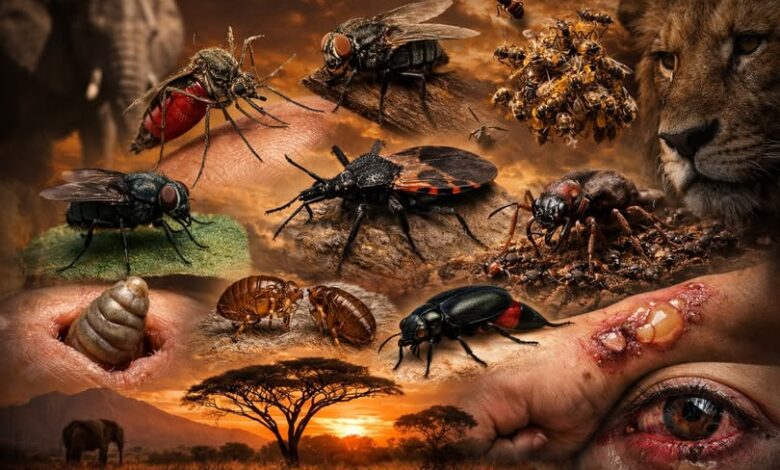
In the vast and biodiverse landscapes of Africa, the most formidable threats to human life often do not possess claws or fangs. Instead, they are equipped with microscopic stingers and disease-carrying mouthparts. While the “Big Five” mammals dominate the tourism narrative, it is the insect kingdom that wages a silent, perennial war on public health. From the humid jungles of the Congo to the arid reaches of the Sahel, these ten insects stand as the most significant biological challenges to human survival on the continent.
The struggle against these miniature assassins defines the intersection of entomology and public health in Africa. As climate change shifts the geographic range of these insects, the need for integrated pest management and advanced medical diagnostics becomes paramount. For the people of Africa, survival is not just about avoiding the lion’s roar, but about remaining vigilant against the hum of a wing.
The Anopheles Mosquito: The Uncontested Killer
The Anopheles mosquito remains the apex predator of the insect world in Africa. As the primary vector for the Plasmodium parasite, it is responsible for hundreds of thousands of malaria deaths annually. According to the World Health Organization (WHO) World Malaria Report, the African Region carries a disproportionately high share of the global malaria burden, with children under five accounting for the vast majority of deaths. Unlike other pests that cause localized irritation, the Anopheles operates with surgical precision, predominantly biting at night.
The Tsetse Fly: The Guardian of the Sleeping Sickness
Exclusively found in sub-Saharan Africa, the Tsetse fly is a biological gatekeeper that has historically shaped human settlement patterns. It transmits Trypanosomiasis, commonly known as “sleeping sickness.” The Food and Agriculture Organization (FAO) notes that this parasitic disease attacks the central nervous system, leading to profound lethargy and neurological degradation. The Tsetse fly’s habitat in dense vegetation makes it a persistent threat to rural farmers and livestock, stifling economic development in fertile regions.
The Black Fly: Vectors of the River Blindness
Lurking near fast-flowing rivers, the Black fly serves as the vector for Onchocerciasis, or River Blindness. Research published in The Lancet Infectious Diseases highlights that when these flies bite humans, they deposit parasitic worms that migrate through the skin. The resulting infection causes agonizing itching and, eventually, irreversible blindness. For decades, entire villages in West and Central Africa were abandoned due to the infestation of these flies, highlighting their power to dismantle communal structures.
The Kissing Bug (Triatomine): The Silent Invader
While more commonly associated with Latin America, various species of Triatomine bugs are increasing their footprint in Africa. Known as “Kissing Bugs,” they transmit Chagas disease. The Centers for Disease Control and Prevention (CDC) explains that the danger lies in the bug’s feces, which enter the bite wound. Chagas is a chronic, silent killer, often leading to heart failure or intestinal complications years after the initial encounter.
The Africanized Honey Bee: The Aggressive Defender
Known colloquially as the “Killer Bee,” this subspecies is characterized by its extreme defensiveness. The Smithsonian Institution documents that Africanized honey bees react to disturbances with overwhelming force, deploying thousands of workers to sting a single target. For individuals with allergies, these encounters are frequently fatal, making them a significant hazard in both wild and agricultural settings.
The Driver Ant (Dorylus): The Unstoppable Legion
Driver ants, or “Siafu,” represent the power of collective aggression. National Geographic’s entomological archives describe how these ants move in columns of millions, consuming any living thing that cannot flee their path. While a single ant is not lethal, their “swarming intelligence” allows them to overwhelm tethered livestock or incapacitated humans. Their powerful mandibles are so strong that they have historically been used as emergency surgical staples.
The Human Botfly: The Internal Parasite
The Botfly represents a more visceral threat. The Journal of Travel Medicine reports that while the adult fly does not bite, it utilizes mosquitoes to transport its eggs to human skin. Once hatched, the larvae burrow into the flesh to develop. While rarely directly fatal, the resulting myiasis causes severe secondary infections and psychological trauma, particularly in children and the elderly.
The Flea: The Persistent Plague Vector
Fleas remain a critical threat in parts of East Africa, particularly in Madagascar. The International Journal of Infectious Diseases confirms that by jumping from infected rodents to humans, fleas facilitate the transmission of the Bubonic Plague. Without rapid antibiotic intervention, the plague can escalate into pneumonic forms, which possess a staggering mortality rate.
The Blister Beetle: The Chemical Warrior
Abundant in agricultural zones, Blister Beetles carry a potent chemical known as Cantharidin. The African Journal of Agricultural Research indicates that skin contact triggers painful, necrotizing blisters. If accidentally ingested through contaminated crops, the toxin causes severe gastrointestinal hemorrhaging, which can be lethal in large doses.
The Nairobi Fly (Rove Beetle)
Despite its name, this is a beetle that carries a toxin more potent than cobra venom. The East African Medical Journal notes that when a person crushes the beetle on their skin, it releases “pederin,” causing severe chemical burns known as “Nairobi Eye.” If the toxin reaches the eyes, it can cause temporary blindness, and extensive skin contact can lead to systemic complications.