News

Namira Negm Criticizes the Marginalization of African Experience in the UN Report on Judicial Appointments
RABAT – MOROCCO
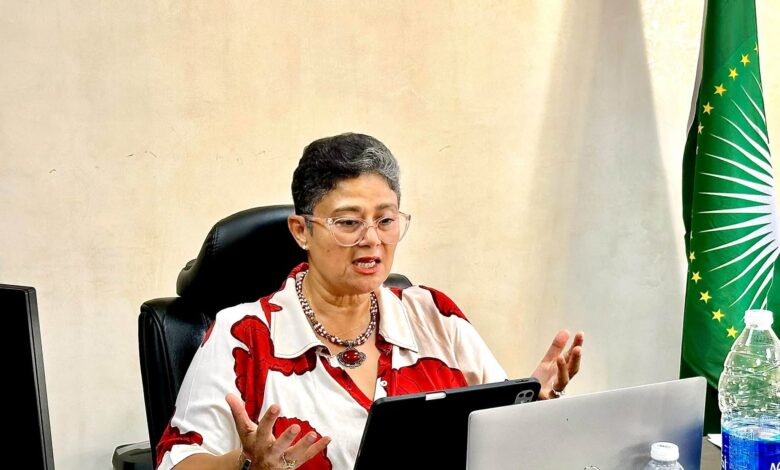
Ambassador Dr. Namira Negm, an expert in international law, human rights and migration, and Director of the African Migration Observatory at the African Union, criticized the dominance of European references in the analysis contained in the report of American Professor Margaret Satterthwaite, UN Special Rapporteur on the independence of judges and lawyers and Professor of Law at New York University, concerning the “Principles for Judicial Appointments.” She called for its methodology to be developed to make it more comprehensive and universal, and for African legal and judicial experiences to be incorporated in a manner that reflects their regional, linguistic, ethnic and customary specificities, rather than treating them merely as complementary sources to European standards.
This came during an international dialogue organized online yesterday by the American Branch of the International Law Association (ABILA), with the participation of Special Rapporteur Satterthwaite, who presented her UN report entitled “Principles for Judicial Appointments,” submitted to the sixty-second session of the United Nations Human Rights Council in Geneva in June 2026. Negm participated in the dialogue as a discussant, presenting her views and observations on the principles contained in the report.
Negm noted that the report draws on African and Latin American sources, including the African Charter, certain judgments of the African Court, fair trial principles, and the Lilongwe Principles, which she considered worthy of recognition. However, she pointed out that the Strasbourg and Luxembourg systems, as well as the European Venice Commission, receive the largest share of the analysis and citations, giving European references the greatest analytical weight in the report.
She expressed the hope that the forthcoming academic version of the report would be more comprehensive and would move beyond a Europe-centered approach, thereby allowing for the development of an analytical framework that reflects the diversity of legal and judicial experiences in different regions of the world.
Negm addressed the report’s treatment of diversity in the composition of judicial bodies, explaining that she does not object to the importance of representing minorities and social groups, nor to what a more inclusive judiciary can achieve in terms of strengthening public confidence in the judiciary. However, she considered that the focus on particular groups, especially people of African descent, may give the impression that the report is directed toward a specific judicial context more than others, whereas this classification does not carry the same meaning in the African context, where all populations are of African descent.
She emphasized that the dimensions of diversity in Africa are not limited to ethnic affiliation, but are also linked to regional balance, linguistic diversity, local legal traditions and customary systems in a number of communities. These dimensions, she noted, have not received sufficient attention in the report.
She stressed that incorporating these specificities does not mean replacing merit with representation, but rather taking into account the different regional, social and legal dimensions within an institutional framework that preserves competence and integrity and strengthens the legitimacy of the judiciary and the confidence of communities in it.
Negm also pointed out that the report overlooked customary justice systems that continue to operate in parts of Africa, as well as in parts of Asia and Latin America. She considered that these systems deserve to be addressed in subsequent studies, including their relationship with formal judicial systems and the safeguards related to human rights.
During her discussion of the report, Negm raised questions concerning the risks of politicizing public and civil society participation in the selection of judges. She explained that public and civil society participation may constitute one of the safeguards of transparency, but may at the same time open the way to pressure, politicization and influence over the selection process.
She questioned what safeguards could prevent the participation of civil society members, even when they are independent, from becoming a backdoor to politicization, noting that the independence of these members in itself does not answer the question of what safeguards can prevent their participation from being used to exert political influence over the appointment process.
She also raised questions concerning the participation of representatives of the executive branch, such as the Minister of Justice, on appointment councils as members without voting rights, asking whether their mere presence could influence the process and what safeguards could prevent such influence.
She warned of the risks of political or economic forces capturing judicial councils, stressing that what is required is not merely formal independence or legal provisions declaring independence, but effective independence for those participating in the appointment process and for the judicial councils themselves.
In this context, she noted that the legislative branch may enact laws that satisfy the executive branch, while the executive branch may establish rules that serve its own interests or those of individuals within its circle and close associates, without taking into account the effects of such rules on the population as a whole. She considered that the judiciary is expected to stand against this as an institution of justice and fairness, but that performing this function requires it to be independent.
Negm also addressed the safeguards proposed by the report to enhance transparency, including documenting all stages of the selection process, publishing the results, and prohibiting changes to appointment rules while the process is underway. She considered that these safeguards could contribute to limiting politicization, bias, favoritism and manipulation of procedures and outcomes.
However, she raised the question of how to achieve a balance between publishing information and involving the public, on the one hand, and protecting the independence of the selection process and the privacy of candidates, on the other, particularly since public disclosure of procedures may, at certain stages, conflict with candidates’ right to protect their information and privacy.
With regard to temporary appointments, Negm stressed the need for them to be genuinely temporary and clearly time-limited. She noted that a temporary appointment may be more suitable for positions that are short-term and clearly limited in duration, but if it is not subject to a clear time limit, it can become a tool for prolonging occupancy of the position, turning an exception into a permanent system, which could weaken the institutional safeguards for judicial independence.
She also criticized the report for not adequately addressing the issue of compensation for members of appointment committees, questioning which body bears the cost of the work of these committees and the source of the budget necessary to cover their expenses and compensate their members.
She emphasized that judicial independence, as well as the independence of judicial and appointment councils, cannot be separated from the provision of appropriate material safeguards, including adequate compensation for members of the relevant bodies and sufficient salaries for judges to enable them to maintain a reasonable standard of living. She considered that ensuring integrity, independence and impartiality becomes more difficult when judges do not have the means to secure an appropriate standard of living.
On another issue, Negm addressed the question of merit, noting that it is one of the important elements addressed by the report, with merit being linked to integrity, training and ability, rather than seniority alone.
She stressed that vague criteria cannot produce a merit-based system, and that publishing appointment and promotion criteria makes it possible to verify the qualifications and entitlement of candidates, particularly for senior judicial positions.
She explained that candidates holding senior positions within the judicial system often have professional records and performance assessments that can be relied upon as verifiable evidence of merit. However, failure to disclose the criteria on which the selection process is based undermines its credibility.
Negm also raised questions concerning how the principles contained in the report can be enforced, how to ensure that the representation of different groups does not undermine merit, and how to prevent the politicization of appointment councils or civil society participation.
She also raised the possibility of applying these principles to international judicial positions, but questioned how to overcome the issue concerning the sovereign rights of states in selecting and putting forward their candidates for international judicial positions.
In her criticism of the methodology underpinning the report, Negm explained that the report does not impose a single selection process or a uniform model applicable to all countries, which she considered a positive point, as it draws on international law, regional rules and national practices while taking into account differences among legal systems.
She also noted that the report addresses standards and safeguards for the appointment process, in addition to arrangements for temporary appointments. It emphasizes the need for the independence of participants in the selection process to be effective rather than merely formal, as well as the importance of transparency and balance within judicial and appointment councils and the risks of political and economic forces capturing them.
Negm also praised the procedural safeguards addressed in the report, including advance notification of judicial vacancies, structured interviews, the use of practical assessments such as simulated judicial judgment-writing exercises, written reasons for appointment decisions, and the establishment of timelines allowing for an independent review of decisions.
She emphasized that reviewing appointment decisions constitutes a means of strengthening the credibility of the process and holding members of appointment councils accountable, and that the existence of clear procedural safeguards, together with documenting procedures, publishing results and prohibiting changes to appointment rules while the process is underway, can contribute to reducing bias, favoritism and manipulation.
She also praised the report’s treatment of temporary appointments and its emphasis on the need for them to remain time-limited, as well as its emphasis on merit as being based on integrity, training and ability.
Negm affirmed that the report’s central message is that judicial independence begins before a judge puts on the judicial robe, and that the starting point is the appointment process itself. She stressed that judicial independence is “institutional, not individual,” and that an independent judge within a non-independent system does not have the tools necessary to earn public trust.
She explained that the appointment of judges should not be treated as a routine administrative procedure, but rather as a fundamental step toward ensuring judicial independence and impartiality and the ability to deliver justice and fairness, particularly in light of what she described as the decline in respect for the rule of law at both the national and international levels.
Negm concluded by emphasizing that the fundamental message to be drawn is that public confidence in the judiciary requires a credible and transparent system that guarantees equal opportunity and protects judicial appointments from political influence. She noted that there is still a long way to go before these principles are effectively implemented at the global level, but considered the report important material for reflection and discussion and a step in the right direction toward strengthening the rule of law nationally and internationally.
The dialogue was moderated by Dr. Jessica Lynn Corsi, First Lecturer in Law at The City Law School in London, Co-Founder and Co-Chair of the Working Group on Gender Equality at the International Court of Justice, and Professor Milena Sterio, Professor of Law at Cleveland State University College of Law in the United States and Co-Chair of the ABILA Committee on Gender Justice in International Law.
The American Branch of the International Law Association (ABILA) is the American branch of the International Law Association (ILA), an international association established in 1873 and headquartered in London, with national branches in 67 countries. The Association aims to study, clarify and develop international law and to promote international understanding and respect for international law.
The American Branch brings together academics, legal practitioners, students, government officials, diplomats, and members of international and non-governmental organizations, and organizes conferences, seminars and specialized programs on international law.
read more