Under the Shield of Steel: Heavy Security Grid Deployed Across South Africa as Anti-Migrant Deadline Ignites Nationwide Protests

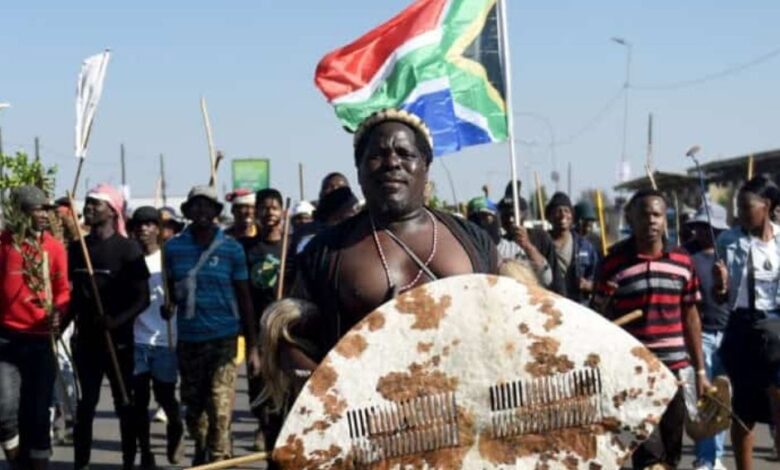
Heavy police contingents have blanketed South Africa’s major metropolitan centers as a highly coordinated, nationwide anti-immigration protest movement reached its explosive, self-declared deadline.
The sweeping mobilization, which has brought economic activity in cities like Johannesburg and Durban to a virtual standstill, marks an unofficial ultimatum set by activist groups demanding the immediate, total departure of all undocumented foreign nationals (undocumented foreigners) from the country.
Fearing a catastrophic recurrence of historically fatal xenophobic riots, the state has deployed a massive security apparatus to preemptively suppress potential communal warfare.
The high-stakes standoff forced President Cyril Ramaphosa to issue a stern, direct intervention via his national newsletter, pleading for absolute restraint while explicitly acknowledging the acute political pressures pushing the country toward urgent immigration reform.
He declared that the right to protest does not allow people to threaten or intimidate others, or to engage in acts of vandalism or violence, reminding citizens that millions of documented foreign nationals reside in South Africa lawfully, contributing directly to the structural framework of the economy.
Despite these executive warnings, undercurrents of economic sabotage have already flared; police commanders confirmed the immediate arrest of ten individuals across the major townships of Soweto and Hammarsdale following targeted break-ins and the systematic looting of foreign-owned retail shops.
The sheer magnitude of the unfolding crisis is captured by unprecedented logistical operations, as foreign governments race against the clock to evacuate their vulnerable citizens from temporary transit camps before the security situation disintegrates entirely.
According to official police disclosures, approximately 25,000 foreign nationals have already been repatriated or deported during this turbulent cycle, with the vast majority hailing from neighboring African states.
In Durban, white transit tents housing thousands of displaced families are being rapidly dismantled by regional authorities as cross-border bus convoys line up to transport evacuations back to Malawi, Mozambique, Zimbabwe, and Ghana.
For many departing migrants, the sudden exit represents a heartbreaking severing of ties, forcing them to leave behind jobs, livelihoods, and young children.
This forced migration is further compounded by deep psychological scars, with many returnees recounting how they were targeted with hostile threats and the weaponized xenophobic slur “Makwerekwere” by localized mobs.
The driving force behind the street-level mobilization is the highly organized, ultra-nationalist group Operation Dudula, whose leadership has overtly threatened to directly circumvent law enforcement if the state fails to aggressively execute mass deportations.
Protesters maintain that their grievances are rooted entirely in the rule of law, demanding that foreign nationals comply with domestic regulations and accusing the undocumented population of overwhelming public infrastructure and freezing out local South Africans from employment and essential healthcare.
Conversely, field commanders face an extraordinarily delicate tactical challenge in policing these authorized marches, While the state has issued a strict, blanket prohibition against the carrying of traditional weapons, a significant percentage of the anti-migrant demonstrators are ethnic Zulus who historically view their cultural shields, whips, and sticks as non-negotiable symbols of identity during public assemblies.
Enforcing this ban threatens to trigger direct, violent friction between the Zulu marchers and frontline police units. With independent watchdog groups like Xenowatch confirming that xenophobic violence has already claimed lives earlier this year, South Africa finds itself walking a razor-thin tightrope between upholding constitutional freedoms and preventing a systemic breakdown of humanitarian order.
read more
South Africa and Cairo .. Combating Apartheid and Building International Solidarity