By Ambassador Dr. Mohamed Hegazy
Power in today’s world is no longer measured solely by the size of an economy or military capabilities , It is also measured by the ability to influence public opinion, create knowledge, and shape the national and continental narrative presented to the world. In this context, cross-border media have become one of the most important instruments of soft power and a key component in building political, economic, and cultural influence.
Despite Africa’s enormous wealth, potential, and investment opportunities, its image in the international media is still often dominated by wars, crises, disasters, and irregular migration. Stories of success, development projects, economic opportunities, entrepreneurs, innovation, digital transformation, and other aspects of a continent undergoing rapid change receive far less attention. Yet these are precisely the dimensions that reflect the real face of a changing Africa.
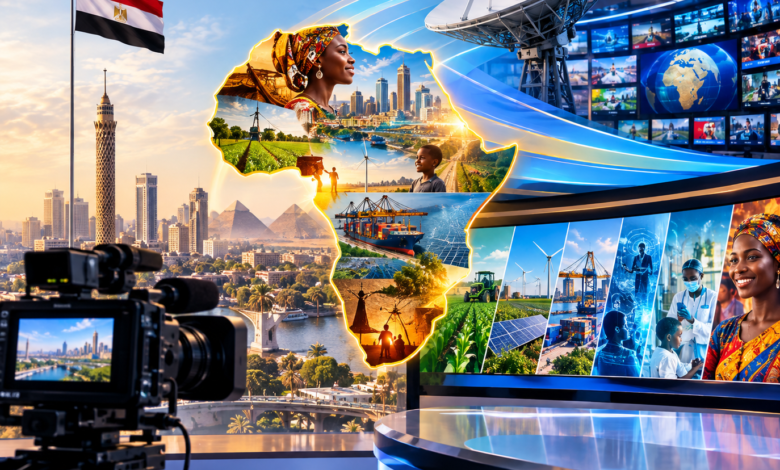
Against this background, the first edition of the Alamein Africa Forum represents a historic opportunity to launch an “African Satellite Television Channel”, broadcasting from Cairo as the first continental media platform dedicated to the economy, development, and investment. The channel would carry Africa’s voice to the world while bringing the world closer to Africa.
The proposed channel would not seek to compete with traditional news broadcasters. Rather, it would offer a new media model that reflects the economic transformations taking place across the continent, supports the African Union Agenda 2063, complements the African Continental Free Trade Area (AfCFTA), and promotes investment and economic integration.
The channel could initially broadcast in Arabic, English, French, and Swahili, with gradual expansion into other African languages. This would enable it to represent all regions of the continent while also reaching the millions of Africans living in Europe, the Americas, and Asia. In this way, the African diaspora would become a partner in Africa’s development rather than merely an observer.
Its programming could provide continuous coverage of investment opportunities, trade flows, financial markets, major national projects, and development initiatives, alongside dedicated programs on agriculture, energy, healthcare, education, the digital economy, artificial intelligence, entrepreneurship, tourism, and culture. Together, these programs would present a comprehensive picture of the new Africa.
The channel could also become a permanent platform for covering the activities of the African Union, regional economic communities, the African Development Bank, Afreximbank, chambers of commerce, and business councils. It would therefore provide investors and business leaders with a reliable window for accessing information, data, and analysis.
The channel’s role should not be limited to satellite broadcasting. It should be built around an integrated digital media model incorporating online platforms, streaming services, smart applications, and social media, allowing it to reach younger generations who increasingly rely on digital rather than traditional media.
An important component of the initiative would be the establishment of an African Academy for Media and Development, dedicated to training African journalists and media professionals in economic journalism, digital media, multilingual content production, and the use of artificial intelligence in journalism. This would contribute to developing a new generation of media professionals capable of presenting a professional and balanced image of the continent.
The channel could also serve as a platform for promoting the initiatives launched by the Alamein Forum, monitoring their implementation, showcasing success stories, and hosting investors and policymakers. In this way, it would become the Forum’s permanent media arm rather than merely a vehicle for broadcasting its events.
Choosing Cairo as the channel’s headquarters would carry important political, cultural, and historical significance. It was from Cairo that “Voice of the Arabs” radio once broadcast its message in support of national liberation movements in Africa. Thousands of African diplomats, students, and leaders were educated in Cairo. From the Egyptian capital, a new message could now emerge—one centered on development, partnership, and shared prosperity.
Africa needs to tell its own story and present its true image to the world, rather than leaving its narrative to others. It also needs a media platform that connects investors with projects, researchers with information, young people with opportunities, and policymakers with public opinion.
If the Alamein Forum seeks to become “Africa’s Davos,” the African Satellite Television Channel could become its permanent voice, its institutional memory, and its year-round media platform, building bridges of communication among the countries and peoples of the continent and their international partners.
Launching the African Satellite Television Channel from Cairo would therefore be far more than a media project. It would represent a strategic investment in Egyptian and African soft power, and a message that Egypt is not merely participating in shaping Africa’s future, but is also contributing to shaping the narrative through which that future is presented to the world.
In the next article in the “Towards Alamein” series, we will examine the initiative for an “Egyptian–Malian Partnership for Integrated Development” and how Mali could become a new model for economic integration between Egypt and the countries of the African Sahel in the fields of gold, livestock, agriculture, infrastructure, and dams.
read more