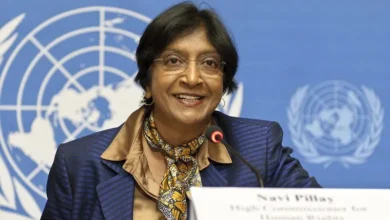
Ambassador Dr. Mohamed Hegazy Writes : The Nile Basin Commission Between Genuine Cooperation and the Logic of Majority
An Objective Egyptian Response to the Statements of Ethiopia’s Minister of Water and Energy


I have followed, like all those concerned with the Nile water file, with interest the statements of the Ethiopian Minister of Water and Energy, Habtamu Itefa, regarding Egypt’s position on the establishment of a permanent commission for the Nile River Basin, including his accusation that Cairo and Khartoum are obstructing the creation of this institution, his claim that the Cooperative Framework Agreement (CFA) has become the legal and institutional framework for managing the shared Nile resources, and his assertion that Egypt’s reservation represents opposition to the principle that “the Nile belongs to everyone.
” These statements call for a methodological and legal clarification, because the essence of the dispute is not about cooperation or its absence, but about the form of this cooperation, its rules and its frame of reference, and about whether it is possible to establish an institution for managing a shared international river without the participation of all its states, and then consider it an institution for the entire basin.
For clarification, Egypt’s position on this issue is not based on a principled rejection of institutional cooperation, but on a clear legal and political vision grounded in the rules of international law on international rivers and in successful African experiences in managing shared basins. Egypt is not against cooperation among the Nile Basin states, nor against establishing permanent institutions for cooperation. Rather, Cairo repeatedly affirms its commitment to working through the Nile Basin Initiative (NBI) as the comprehensive and only framework capable of bringing together the ten basin states. However, an institution that does not include all basin states cannot be considered representative of the basin — and this is the essence of the legal and institutional problem raised by the recent Ethiopian statements.
If a group of basin states has ratified the Cooperative Framework Agreement, this grants the agreement legal effect for the states that have become parties to it, but it does not mean that it has become a binding framework for states that have not joined it, Even if the commission becomes legally established for the party states, presenting it as the sole institution representing the entire Nile Basin remains problematic as long as major basin states have not accepted that same legal framework.
Egypt has clearly called for refraining from taking any hasty institutional steps before reaching a comprehensive consensus at the basin level, because transforming the current initiative into a sub-regional organization for a group of upstream states, and then presenting it as the “Nile Basin Commission,” represents a dangerous step that threatens the unity of the basin and undermines opportunities for comprehensive cooperation.
Perhaps the Ethiopian minister does not know — though I believe he deliberately overlooked — to mention the existence of ongoing efforts by the collective Nile Basin Initiative states, through a committee formed under the chairmanship of South Sudan and Uganda, to visit the states that have not signed the Framework Agreement to learn the reasons for their reservations and attempt to overcome those obstacles. The committee continues its work in full cooperation with Egypt and Sudan, which reflects a responsible approach by the rest of the basin states, while it appears that officials in Ethiopia have become captive to their own facts and are following an approach that ignores these facts to serve policies harmful to the basin states and to security and stability in their regional environment.
African experiences themselves offer more mature models than the logic of conflict between upstream and downstream. If the goal is to manage international rivers jointly, Africa offers important models that are not based on the logic of majority versus minority. The Senegal River Development Organization (OMVS), the Gambia River Basin Development Organization (OMVG), and the Zambezi River Basin Commission (ZAMCOM) are all institutional models based on the participation of all riparian states in the entire basin, not on excluding any of them. These models tell us something important: managing an international river does not succeed with the logic of upstream versus downstream, but with the logic of the entire basin, on the basis of balance, fairness and participation. This is the approach Egypt calls for, not the approach proposed by Ethiopia, which is based on transforming a minority institution into one that claims to represent the majority.
On this basis, international law no longer recognizes the idea of absolute sovereignty over an international river — an important legal fact that must be present in any serious discussion about the future of Nile waters. Ethiopian discourse rests on the premise that Ethiopia is a sovereign state and therefore has the right to do what it wishes within its territory. But an international river is not merely a piece of national territory; it is a shared resource whose uses affect other states. The International Law Commission at the United Nations has discussed since the 1970s theories relating to states’ use of international rivers, and rejected the modern development of the idea of absolute territorial sovereignty that gives the upstream state unlimited freedom in water use. The International Court of Justice, in the Gabčíkovo–Nagymaros case, affirmed that the principle of “common interest” is the basis for managing international watercourses, and that claims of absolute sovereignty over shared water resources contradict the principles of international law.
Hence, the statement that the Nile “belongs to everyone” must lead to cooperation, not hegemony. If we agree with the Ethiopian minister that the Nile is a shared resource and that basin states must preserve, manage and develop it jointly, Egypt sees no problem in that — indeed, this is the principle we support. But if the Nile “belongs to everyone” in the sense that all its states share responsibility, the logical conclusion is that no single state can monopolize the management of the river’s flows, nor can a group of upstream states monopolize the setting of rules for managing the entire basin. Shared management means shared participation — and this is the difference between real cooperation and using a regional institution as a tool to reshape the river’s balances in favor of one party at the expense of another.
Perhaps the most important point to emphasize in this context is that Egypt does not fear Ethiopian development, but objects to the unilateral management of an international river. Development is one thing, and managing the flows of an international river is something entirely different. Egypt’s objection is not to electricity production in Ethiopia, but to any policy that leads to monopolizing control over the Blue Nile’s flows, or establishing a series of major projects without a binding legal framework that protects the interests of downstream states. This issue has become more urgent with talk of additional projects on the Blue Nile, which changes the nature of the entire question.
The question is no longer only how one dam is managed, but how an entire system of dams on a single international watercourse will be managed. Here the urgent need emerges for a clear legal framework defining rules for notification, data exchange, operation, management of extended drought periods, coordination between dams, and assessment of the impacts of new projects. These are not exceptional Egyptian demands; they are the logic of sound management of any international river basin.
It is regrettable that the Ethiopian minister’s recent statements come at a time when the region needs de-escalation and confidence-building, not deepening division. When the Ethiopian official says that his country can continue developing the Nile’s resources without being halted by the objection of downstream states, the political message reaching Cairo and Khartoum is not a message of cooperation. When he speaks of Egypt and Sudan representing a “minority” against a majority of basin states, this turns a complex legal and technical issue into a matter of political voting, which does not serve Ethiopia itself. If Ethiopia truly wants to become a regional center for energy and economic integration, its best investment is confidence, not deepening suspicions; stability as a gateway to development. Statements that increase tension and discord do not serve this goal in any way.
On the other hand, Egypt has an extensive record of cooperation with the White Nile and East African states, and this record must be present in assessing Egypt’s position. Egyptian relations with the White Nile Basin and East African states have witnessed broad development in recent years in the fields of development, infrastructure, energy and water. The Julius Nyerere Dam project in Tanzania is a clear example of Egypt’s ability to participate in a major African development project with a Nile Basin state, achieving shared development interests.
Egypt also has developed strategic and historical relations with Kenya, Uganda, the Democratic Republic of the Congo, Rwanda, Burundi and other African states. Its cooperation even extends around the Red Sea coast, with ports interconnected from Ain Sokhna to Port Sudan to the ports of Eritrea, Djibouti and Somalia, down to Kenya and Tanzania, reaching Angola, Mozambique and South Africa. This giant economic corridor — if we add to it the transversal link of the Safaga–N’Djamena road to Chad — makes one realize that Ethiopia has not yet grasped the value of broad regional cooperation that could achieve for all benefits far exceeding what can be achieved through policies of hegemony over water resources.
What is required today is not a commission for upstream states nor a commission for downstream states, but a true commission for the entire basin. Egypt does not want an institution controlled by upstream states, nor one controlled by downstream states. Egypt wants an institution representing the entire Nile, from its sources to its mouth — from Ethiopia, Uganda, Tanzania, Kenya, the Democratic Republic of the Congo, Rwanda, Burundi, South Sudan, Sudan and Egypt — according to a formula agreed upon by all. But for an institution comprising a group of states to transform itself into one claiming to represent the entire basin, while other states remain outside it, does not achieve the true goal of integration; rather, it undermines it and intensifies division.
It should be noted here that the experience of negotiations over past years reveals that the confidence crisis is much older than the Renaissance Dam. Based on my participation in several rounds of Nile water negotiations, I can say that the trust problem did not begin with the Renaissance Dam; it has deeper roots. Negotiations previously witnessed serious attempts to reach compromises. In one round of negotiations in Bujumbura in 1997, we reached a compromise formula on one of the contentious points related to Article B14, which could have provided guarantees for the existing uses of Egypt and Sudan. The Ugandan proposal at the time was an attempt to reach a compromise preserving the interests of both upstream and downstream states. But this consensus did not last. Shortly afterward, Ethiopia returned to a different position and began movements among upstream states to rebuild a collective position that prevented the continuation of the consensus that had been achieved.
This incident is not a settling of historical scores, but it proves that the current confidence crisis has old negotiating roots, and that the problem is not in a particular institutional formula as much as in the absence of genuine will to reach a comprehensive and balanced solution, to implement hidden plans and buy time. Therefore, the failure of negotiations is clearly due to the undeclared ceiling of the Ethiopian position, bad faith, and the inability to understand the firm needs of the two downstream states since the birth of this river. It is not an exaggeration that regional and international powers incited pressure on Egypt using the water file and helped with construction so that the Ethiopian dam became a tool of political pressure exercised against the Egyptian position.
It is also important to note that negotiations need a clear negotiating ceiling and genuine will to reach a solution, which the negotiating process with the Ethiopian side lacked. One of the most important rules of negotiation is that each party enters negotiations knowing its objectives and limits, and that there is genuine will to reach a settlement. What we faced during years of negotiation was the absence of a clear Ethiopian negotiating ceiling, while the Ethiopian vision for the water future of the Blue Nile gradually evolved. Today, with talk of three additional dams, the importance of this question becomes clearer.
If there is a strategic vision for building a multi-dam system on the Blue Nile, this should be an explicit subject in any negotiations. But Ethiopia chose the method of concealment to pass its first dam, and I believe it will be difficult — indeed impossible — to imagine Egypt accepting a fait accompli, and the Ethiopian decision will have grave consequences for which it will be responsible.
When Ethiopia negotiated, it was hiding its intentions, and it is not acceptable to negotiate each stage as if it were a separate project, because the accumulation of projects on a single river can produce an effect entirely different from the effect of each project individually. This makes talk of a comprehensive and binding legal framework more urgent than ever.
In this context, it must be emphasized that international law does not grant Egypt an absolute right to Nile waters, nor does it grant Ethiopia an absolute right to control them. Egypt should be precise and fair in its presentation, not saying that international law gives it an absolute right to every drop of Nile water, nor should Ethiopia say that international law gives it absolute freedom to control the Blue Nile’s waters. The law of international rivers is based on balance, and the International Law Commission has affirmed that the theory of absolute territorial sovereignty over an international river is not the rule upon which the modern development of law has settled, while modern rules of international rivers law have affirmed the principle of equitable and reasonable use, participation, and consideration of the interests of riparian states. This is the rule that should govern the future, not the logic of majority that Ethiopia is trying to promote.
Egypt views the Nile within a broader framework of African integration, and does not see African cooperation from the perspective of water alone. There is a broader vision for linking East and North Africa through ports, roads, energy networks and trade. The Red Sea system could integrate from Ain Sokhna to Sudan, Eritrea, Djibouti and Somalia, then East Africa reaching Kenya and Tanzania, with possibilities for linking south and west, in addition to transversal land axes such as the Safaga–N’Djamena axis.
These networks could transform the Red Sea, the Nile Basin and East Africa into a connected economic space. Here specifically, I believe Ethiopia has not yet invested sufficiently in the power of regional cooperation, and has focused instead on a unilateral approach that harms its relations with its neighbors and undermines opportunities for broad economic integration that could achieve for all benefits far exceeding what can be achieved through policies of hegemony over water resources.
In conclusion, I say to the Ethiopian minister with all respect and clarity: Egypt does not oppose Ethiopia being a strong state, nor does it oppose its right to development. But Ethiopia should not confuse sovereignty over territory with absolute sovereignty over an international river, nor should it confuse a majority of states supporting a particular framework with the consensus required to manage an international basin in a comprehensive and sustainable manner. If the Nile is truly “ours all,” then its management must be for the benefit of us all.
If Ethiopia wants cooperation, Egypt extends its hand for cooperation. If it wants a permanent institution, Egypt does not reject the institution, but it wants a real institution for the entire basin, a law that protects everyone, shared management of the river, development for Ethiopia, water security for Egypt and Sudan, and shared development for all basin states. This is not a position against Ethiopia, but the position consistent with the essence of modern international law on international rivers and with successful African cooperation models that have proven the continent is capable of transcending the logic of conflict between upstream and downstream.
The Nile can be a bridge for African integration, but it will not be so if it turns into a tool of hegemony or an arena of conflict between upstream and downstream. The choice in the end is not between Egypt and Ethiopia, but between cooperation and hegemony, and between managing the river for the benefit of all or managing it by the logic of fait accompli. Here specifically, Ethiopia should stop viewing Egypt’s reservation as an obstacle to cooperation, and view it as an invitation to build a comprehensive legal framework that leaves no Nile state outside the equation of managing their shared river.
The Ethiopian minister’s recent statements, which increase tension and discord, serve no party’s interests, and remind us that during the twelve-year negotiating process, Ethiopia obstructed every opportunity to reach solutions, entered negotiations with clear bad faith, and concealed its future intention to build multiple dams for complete hegemony over the Blue Nile. This puts the region before a difficult choice, but the most difficult choice is to continue the approach of procrastination and delay that makes the fait accompli the only starting point — something that cannot be accepted or remained silent about.
Ethiopia knows, unequivocally, that by proposing its three proposed dams it has come close to threatening the core of Egypt’s national security zones and red lines, which may draw the scene into an area we may not desire — but if imposed, there is no escape from resorting to it in accordance with the rules of international law, the United Nations Charter, and Article 51, which guarantees states the right to defend their national security if endangered, until the Security Council takes a decision on the matter. I believe the Ethiopian government is aware of this, as are the major regional and international powers keen on the security and stability of the Horn of Africa, which is strategically linked to the security of maritime navigation in the Red Sea, the security of the Gulf, international trade movement, and military fleets.
I recall a meeting with Mr. Hailemariam Desalegn, former Ethiopian Minister of Water and Prime Minister, with African ambassadors in Berlin. I expressed to him my concern about the future of relations between the two countries, and in light of the tensions we see, I monitored their risks as a student of the water file. He stated verbatim that he was also a student of the water file, and throughout the history of this file he mentioned that “it has been said since ancient times and through all ages that the kings of Abyssinia would cut off water from Egypt, and that Egypt would fight Abyssinia. Through the years, Abyssinia did not cut off water from Egypt, and Egypt did not fight Abyssinia.”
Therefore, I hope in conclusion that Desalegn’s saying remains valid, as the water and existential threat from unilateral Ethiopian actions has never reached this level of persistent unilateralism and intransigence, threatening that stable equation between two peoples with civilizations and belonging to a continent that struggled for its peoples. We hope wisdom and the language of reason prevail, and an end to taking decisions and measures relating to a river that God granted to the basin states and did not grant to Ethiopia alone.
- Ambassador Dr. Mohamed Hegazy — former Assistant Egyptian Foreign Minister for African Affairs.
read more
Egypt’s Nile Basin Diplomacy: Advancing Development Through Partnership, Not Obstruction