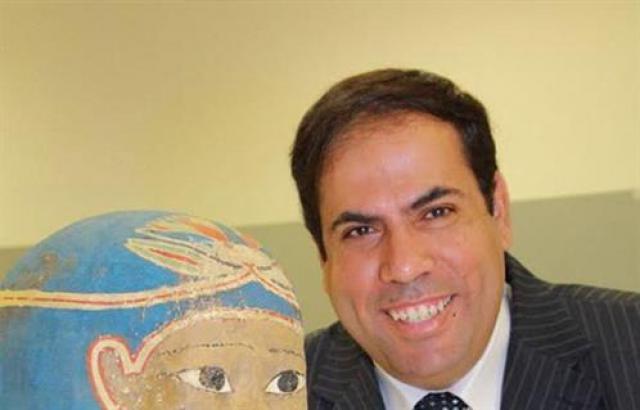
Dr. Hussein Bassir
The Bibliotheca Alexandrina is far more than a magnificent architectural landmark overlooking the Mediterranean Sea, It is an enduring idea that has survived more than two thousand years, transcending empires, religions, and civilizations, It stands as one of humanity’s greatest symbols of the triumph of knowledge over ignorance, dialogue over intolerance, and intellectual curiosity over fear, Few institutions in history have captured the world’s imagination as profoundly as the Library of Alexandria.
When the Ptolemaic rulers founded the ancient Library of Alexandria during the third century BCE, their ambition extended well beyond creating a repository of scrolls, Their vision was revolutionary: to gather all human knowledge under one roof and transform Alexandria into the intellectual capital of the ancient world. Ships entering the city’s harbor were searched for manuscripts, which were carefully copied before being returned to their owners, while the finest versions enriched the Library’s unparalleled collection. Knowledge became the empire’s greatest treasure.
Within its halls, scholars did not merely preserve learning—they created it. Mathematics flourished, astronomy expanded humanity’s understanding of the heavens, physicians advanced medical science, philosophers challenged conventional wisdom, and geographers measured the Earth’s circumference with astonishing accuracy. The Library was not simply a warehouse of books; it was a living laboratory of ideas that reshaped civilization.
Although the ancient Library eventually disappeared amid centuries of political upheaval and conflict, its destruction never erased its spirit, Buildings can vanish, manuscripts can burn, but ideas possess a remarkable resilience, The legend of the Library endured because it represented humanity’s eternal aspiration to understand the world through reason and scholarship.
In 2002, that timeless vision was reborn with the inauguration of the modern Bibliotheca Alexandrina on the shores of the Mediterranean, close to the site of its legendary predecessor, Rather than reconstructing the past, the new institution was designed to reinterpret its mission for the twenty-first century. Its striking architecture, resembling a giant sun rising from the sea, symbolizes the perpetual dawn of knowledge.
Today, the Bibliotheca Alexandrina has become one of the world’s leading cultural and research institutions, Housing millions of books alongside specialized museums, research centers, restoration laboratories, digital archives, children’s libraries, facilities for visually impaired readers, conference halls, and cultural programs, it serves audiences that extend far beyond Egypt’s borders.
Yet the true measure of the Library is not the number of volumes lining its shelves. Its greatest achievement lies in the minds it inspires, Books alone cannot transform societies; people do. Every reader who discovers a new perspective, every researcher who makes an unexpected connection, and every child whose imagination is awakened becomes part of the Library’s living legacy.
One of the Bibliotheca Alexandrina’s most significant contributions is its role as a global forum for intercultural dialogue, In an era increasingly marked by polarization, it offers a space where scholars from different nations, languages, religions, and intellectual traditions engage in meaningful conversations. Egyptians exchange ideas with Japanese scientists, European historians collaborate with African researchers, and students from across the globe discover that knowledge knows no borders.
A memorable story illustrates this mission. A young researcher from Latin America once arrived seeking a rare document related to Mediterranean history, After several days of study, he remarked, “I came looking for one manuscript, but I discovered an entire world, ” His words perfectly captured the essence of the Bibliotheca Alexandrina: it answers questions while inspiring countless new ones.
Another unforgettable moment involved a young child visiting the Children’s Library. Expecting only shelves of silent books, the child instead encountered interactive exhibitions about ancient Egyptian civilization, Leaving the building, the child declared a dream of becoming an archaeologist. In that simple moment, the Library fulfilled its highest purpose—not preserving the past alone, but shaping the future.
The digital revolution has fundamentally transformed how humanity creates and accesses information. Recognizing this shift, the Bibliotheca Alexandrina has embraced digital preservation, electronic archiving, online knowledge platforms, and international digitization projects. Its mission has expanded beyond physical collections to ensure that humanity’s cultural heritage remains accessible to future generations across the globe.
Ironically, today’s greatest challenge is no longer the scarcity of information but its overwhelming abundance, Anyone can access millions of pages within seconds, yet distinguishing truth from misinformation has become increasingly difficult. The modern Library therefore serves a new purpose: not merely storing information, but helping society cultivate wisdom, critical thinking, and intellectual responsibility.
The Bibliotheca Alexandrina is not a replica of the ancient Library, nor should it be. The ancient institution represented the pinnacle of scholarship in its own era; the modern Library seeks to become an international platform for scientific research, cultural exchange, innovation, and dialogue in the age of artificial intelligence and digital transformation.
Ultimately, the Bibliotheca Alexandrina is more than a building, It is a philosophy, a bridge between civilizations, and a reminder that the greatest monuments humanity can construct are not made of stone, but of ideas. Nations may rise and fall, but knowledge remains civilization’s most enduring foundation.
For this reason, the Bibliotheca Alexandrina continues to shine as one of the world’s greatest cultural beacons—past, present, and undoubtedly future—illuminating minds across continents just as its legendary predecessor did more than two millennia ago.
read more