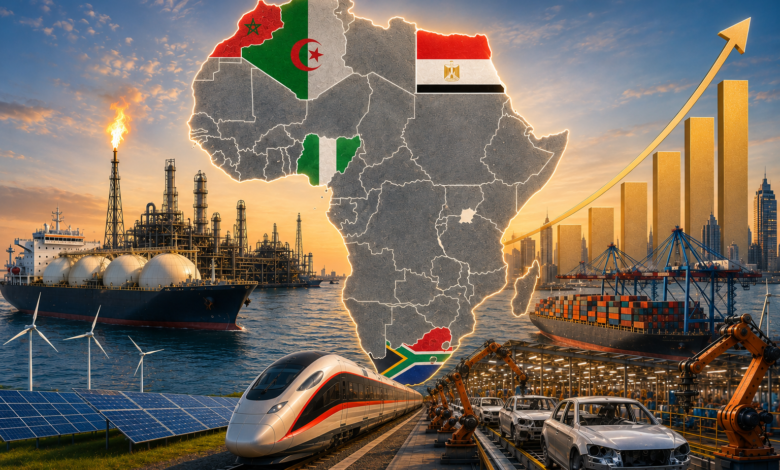
Five economic superpowers—South Africa, Egypt, Nigeria, Algeria, and Morocco—are projected to generate nearly half of Africa’s total nominal GDP by 2026, according to the latest International Monetary Fund (IMF) World Economic Outlook.
Collectively, these nations will account for approximately $1.8 trillion of the continent’s projected $3.6 trillion economy, highlighting an increasing concentration of economic activity within a few regional hubs.
South Africa retains its position as the continent’s largest economy with a projected GDP of $480 billion, followed by Egypt at $430 billion and Nigeria at $377 billion. Algeria and Morocco round out the top five, contributing $317 billion and $194 billion respectively, driven by diversified industrial bases and hydrocarbon exports.
The current rankings reflect a period of significant volatility characterized by massive currency devaluations, persistent inflation, and fluctuating commodity cycles.
While Nigeria experienced a sharp setback due to the weakening of the naira, Morocco has steadily fortified its economic standing through aggressive industrial expansion and leadership in renewable energy and automotive manufacturing.
South Africa’s dominance continues to rest on its sophisticated banking infrastructure and mining sector, while Egypt’s growth is fueled by massive infrastructure projects and strategic Suez Canal revenues. Algeria remains a critical energy partner for Europe, benefiting from sustained demand for natural gas.
This concentration of wealth and productivity attracts the lion’s share of foreign direct investment, but also raises concerns about a widening development gap between these “Big Five” and smaller, less diversified economies. As countries like Kenya, Ethiopia, and the Democratic Republic of the Congo emerge as future challengers through investments in technology and critical minerals, the current economic landscape of Africa is undergoing a profound transformation.
Analysts suggest that the future of continental influence will depend less on raw commodity exports and more on the ability to integrate into global value chains through manufacturing and logistics.
read more