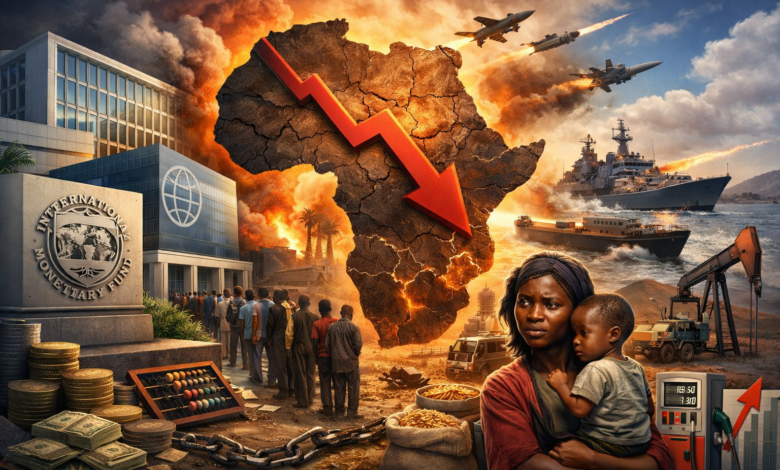
Amidst the high-stakes backdrop of the IMF and World Bank Spring Meetings, Africa’s top financial policymakers are locked in a desperate race to secure emergency funding. The “Economic Quagmire” triggered by the U.S.–Iran war—now in its seventh week—has abruptly halted the continent’s 2025 stabilization gains, forcing a fundamental reassessment of Africa’s growth trajectory for 2026.
• A Fractured Outlook: From Stability to Stagnation
Sub-Saharan Africa entered the year on solid footing, boasting a growth rate of 4.5% in 2025. However, the fallout from the Middle East conflict has effectively poisoned this momentum. The IMF has downgraded the continent’s 2026 growth forecast to 4.2–4.3%, with North African economies facing even sharper revisions. The primary culprits are clear: skyrocketing fuel and fertilizer costs, coupled with fractured supply chains, which are driving a resurgence of inflation and worsening food insecurity.
Seedy Keita, Chairman of the African Caucus and Finance Minister of The Gambia, warned that the war adds a “layer of complexity” with the potential for permanent economic scarring. The risk of social tension is mounting as the “cost-of-living spearhead” pierces through the continent’s most vulnerable populations.
• The Emergency Loan Queue
As global aid flows decline, at least a dozen African nations are reportedly preparing to seek new IMF loan programs. The scramble for liquidity is already visible:
– The Republic of the Congo: Has formally requested a fresh IMF program to replace its 2025 arrangement.
– Angola: Seeking a $165 million budget support loan from the African Development Bank as part of a larger $1 billion external financing strategy.
– Kenya: In urgent talks with the World Bank for “significant” rapid financial support to mitigate fuel shortages and inflationary shocks.
Conversely, some nations remain in a state of “financial suspension.” Mozambique, despite repaying over $700 million to the IMF, has been told it does not yet meet the criteria for a new program, pending deeper macroeconomic corrections.
• A Continent Divided by Reform
A sharp divide is emerging between “reform-resilient” and “vulnerable” economies. Nations that aggressively pursued fiscal discipline in 2024-2025 are maintaining investor confidence despite the global turbulence. Nigeria, for instance, has signaled it is not seeking an IMF program at this stage. Finance Minister Wale Edun emphasized that Nigeria is doubling down on domestic revenue mobilization and exchange rate unification to shield itself from external borrowing pressures.
• The Hormuz Shadow
The IMF’s warning is clear: even a swift resolution to the U.S.–Iran war will not provide an immediate reprieve if the Strait of Hormuz remains under military shadow. For import-dependent African nations, the de facto closure of this chokepoint has turned the global trade map into a logistical gridlock.
As policymakers navigate these shifting sands, the “Spearhead” of African strategy is shifting from long-term development to immediate survival. The challenge now is to protect the fragile gains of the past decade while relying on a global financial system that is increasingly strained by the very conflicts it seeks to mitigate.
read more
Antalya Summit: Egypt Joins Regional Partners in Efforts to Manage U.S.–Iran Diplomatic Stalemate